
Readiness audits
Runs a structural AI Search Readiness audit that scores whether answer engines can crawl, parse, extract, and trust public pages.

AIO.GEO is an AI Search Readiness tool that audits whether answer engines can read and trust a site, then helps teams prepare dry-run fixes and verify results with receipts. It is aimed at developers, agencies, and marketing operators who need a structured workflow rather than AI ranking claims.
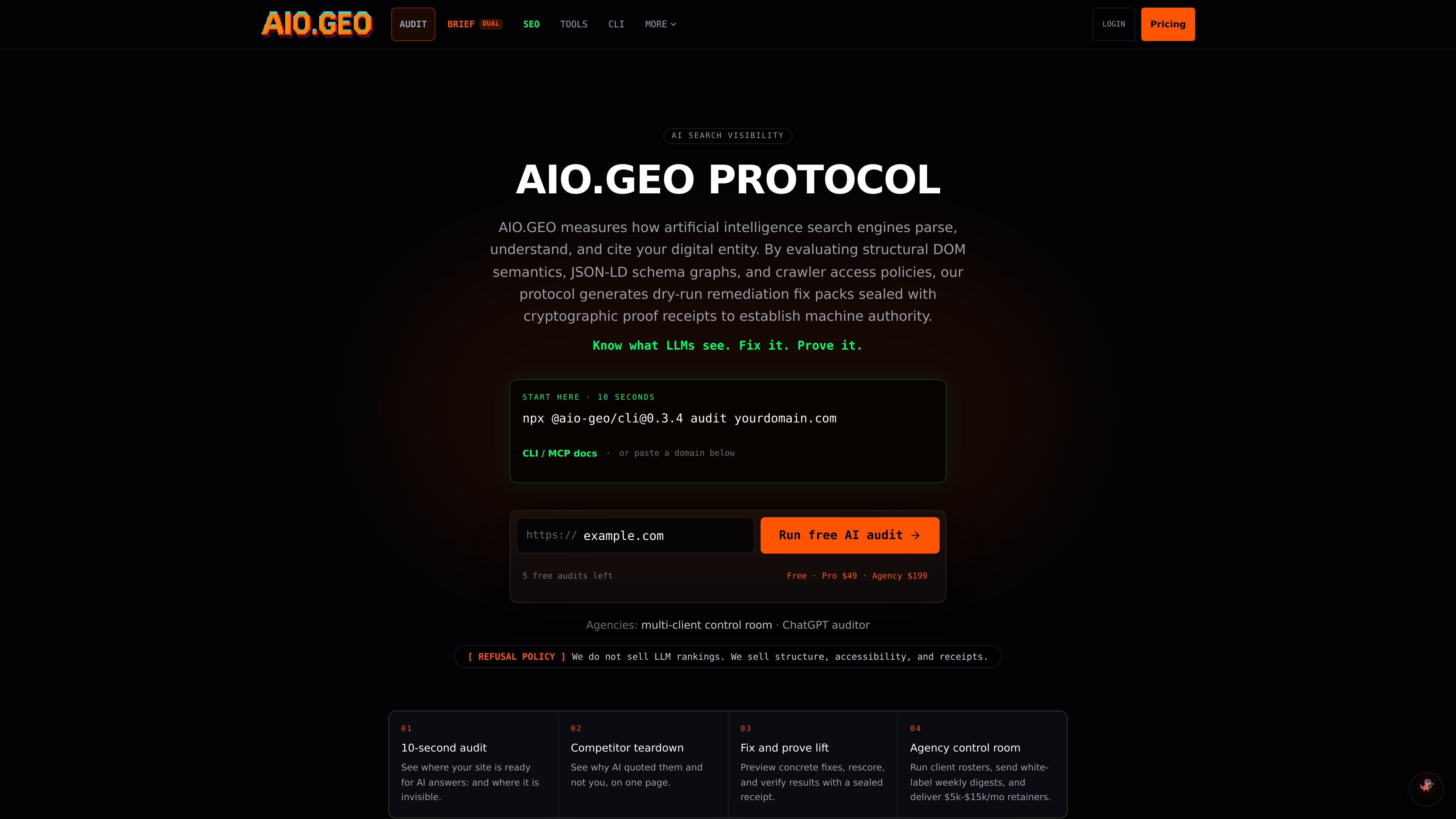
AIO.GEO is a closed-loop AI Search Readiness product for sites that want to know whether generative answer engines can actually read, parse, and cite their public pages. The site describes it as a way to measure structure, accessibility, and proof rather than claim LLM rankings.
The workflow centers on a deterministic audit, a dry-run remediation pack, and a rescore after changes are applied. Source pages show three main operating paths: a developer lane for CLI and MCP use, an agency lane for multi-client reporting, and a governance lane for policy and disclosure work.
Runs a structural AI Search Readiness audit that scores whether answer engines can crawl, parse, extract, and trust public pages.
Generates dry-run remediation packs for items like robots.txt, JSON-LD graphs, answer-first headers, and structural anchors before anything is applied.
Supports direct operator workflows in the terminal with commands for doctor, audit, apply, rescore, loop, seal, and verify-proof.
Provides an MCP path for Cursor and Claude Code, with a server configuration shown for the AIO.GEO MCP server.
Offers a multi-client agency mode with client roster management, white-label HTML/PDF exports, and priority handling on the pricing page.
Includes proof-oriented output, such as HMAC receipts and before-and-after rescore verification, so changes can be documented instead of just reported.
A developer can run the CLI doctor and audit commands against a domain, inspect structural issues, and use apply in dry-run mode before sending changes to a repository or production system.
An agency can assess multiple client domains, generate white-label reports, and use the control room workflow to support retainers built around AI visibility and site fixes.
A content or SEO team can compare a site with competitors, identify answer-first structure gaps, and prioritize fixes such as schema, headings, or bot access policy changes.
A legal or governance team can use the policy-oriented tools and disclosures to document AI opt-out and copyright settings for public pages.
AIO.GEO positions itself as a closed-loop AI Search Readiness tool. It measures whether generative answer engines can find, read, and trust a site, then produces dry-run fix packs and a rescore with a sealed receipt.
The CLI is designed for direct terminal use. The docs show commands such as doctor, audit, apply, rescore, loop, seal, verify-proof, and inject, with dry-run as the default for apply and loop.
The pricing page shows a free tier, a Pro plan, and an Agency plan. The free tier covers light scans, Pro adds deeper scans and fix packs, and Agency adds multi-client workflow features.
AIO.GEO says it does not sell LLM rankings. It focuses on structure, accessibility, bot access, schema, and receipts, so the product is aimed at readiness and remediation rather than ranking guarantees.

ByteAsk is a terminal-first AI coding agent for C and C++ that edits repositories and verifies changes with the real compiler, debugger, sanitizers, and tests before showing a diff. It offers a free tier plus paid plans, with editor connectors and zero-retention handling described in the source.

Manta AI is an autonomous web app testing tool for teams that want to map application behavior, catch regressions, and generate tests without writing scripts or maintaining selectors. It works from a URL and supports plain-English test flows, run results with screenshots, and scheduled or deployment-triggered checks.

PromptScout tracks how ChatGPT, Gemini, Google AI Overviews, and Perplexity mention your brand or competitors, then pairs those results with source analysis and website audits. It helps teams decide what to fix in content, positioning, or site readiness next.

CreateOS Sandbox is an isolated compute environment for running code and agent workloads inside Firecracker micro-VMs. It is designed for workflows that need machine-level isolation, private networking between sandboxes, and programmatic control through SDK, CLI, or MCP.

hob is an independent workspace for coding agents that keeps agent sessions, terminals, history, and follow-up work organized around the tools and providers you already use. It is aimed at developers who want local control over routing, history, and workspace structure rather than a bundled model stack.

Ably Chat is a chat API platform for building custom realtime chat applications. It supports room-based messaging, typing indicators, presence, reactions, and message updates, with usage-based pricing options for different deployment stages.