
Predictive dependency scoring
Beacon models package abandonment risk with a 60–90 day survival forecast rather than only flagging known CVEs after the fact.

Beacon is a predictive dependency health tool for engineering teams that monitors open source packages and flags abandonment risk before it becomes an incident. It installs as a read-only GitHub App and outputs ranked risk scores, migration guidance, and alerts.
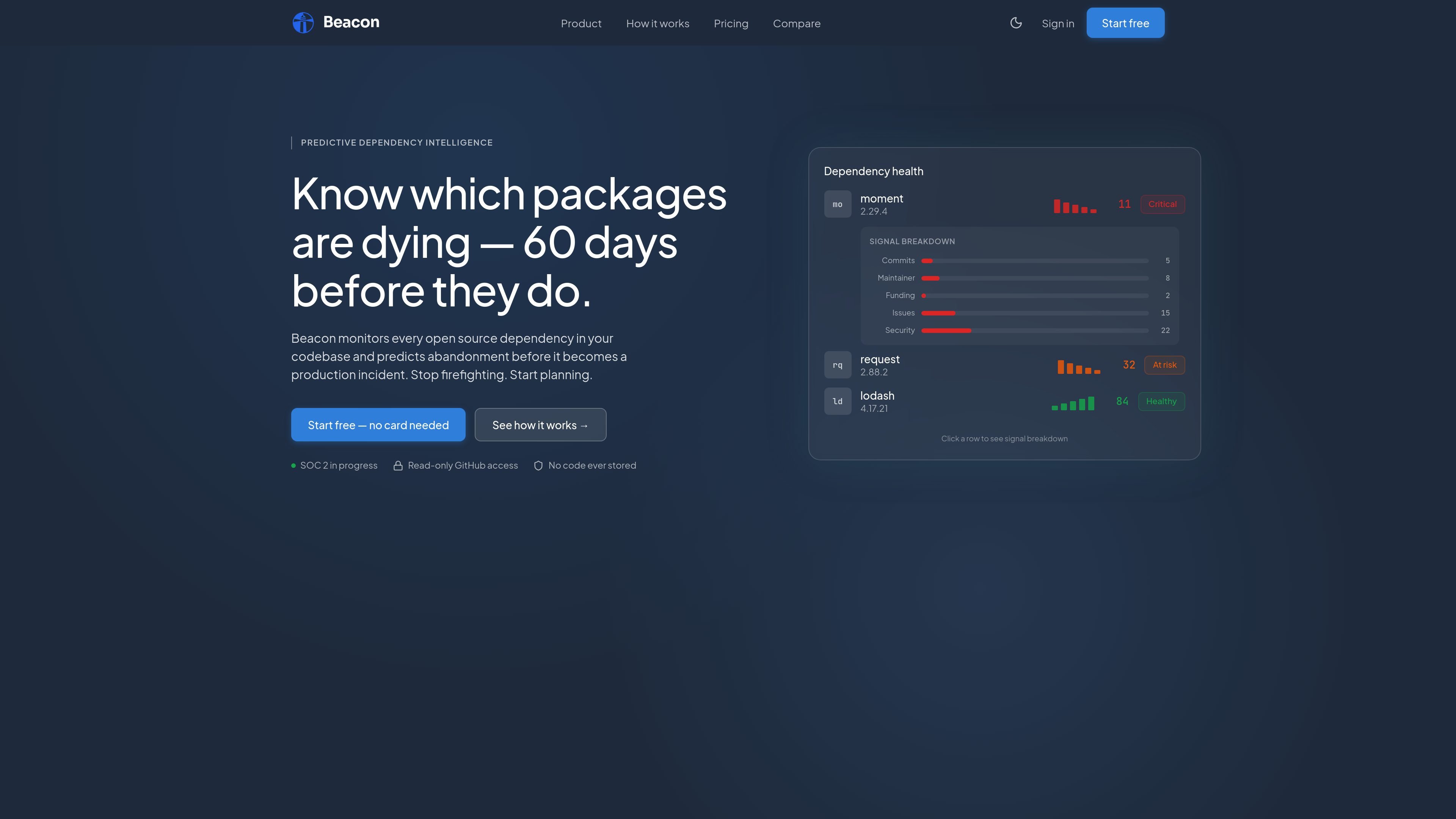
Beacon is a predictive dependency health tool for engineering teams. It monitors open source dependencies in codebases and tries to predict abandonment before it turns into a production incident.
The product connects as a read-only GitHub App, scans dependency manifests, and produces a ranked dashboard of package risk. The site frames the main use case as spotting decay early enough to plan migrations, reduce firefighting, and keep teams focused on feature work rather than urgent dependency rewrites.
Beacon models package abandonment risk with a 60–90 day survival forecast rather than only flagging known CVEs after the fact.
Beacon connects through a read-only GitHub App, scans manifest files, and supports individual repositories, monorepos, and org-wide selection.
Each dependency is scored against weighted signals such as commit velocity, maintainer activity, funding, issues, community, and security.
The dashboard ranks dependencies by survival probability and surfaces migration recommendations, including replacement packages and estimated effort.
Beacon can send threshold-based alerts through Slack, email, and JIRA, and the pricing page also lists Slack, email, JIRA / Linear, REST API, and webhooks for integrations.
The pricing page says score history is available, with 7 days on Starter and 90 days on Pro, and also lists OSSF Scorecard, CVE tracking, and security reporting features.
Track dependency health across one or more repositories and get a ranked view of packages that are trending toward abandonment.
Use the alerting and history features to catch deteriorating packages before the team discovers them through a failed build or a security incident.
Review migration recommendations when a package’s health drops, so the team can schedule a planned replacement instead of an emergency rewrite.
Scan monorepos and multiple manifest formats from a single GitHub App connection when a codebase spans several package ecosystems.
Use the free one-repository tier to evaluate whether predictive dependency scoring is useful before expanding to a broader team rollout.
Beacon installs as a GitHub App and uses read-only access to manifest files. The site says setup takes under 60 seconds and that it does not store source code.
The source material shows Beacon is aimed at engineering teams that want to monitor dependency health before abandonment turns into a build break or migration fire drill.
Beacon scans dependency manifests, scores packages on a 0–100 scale, and surfaces a ranked dashboard with migration recommendations. The pricing page also lists score history and alerting, while the home page shows a signal breakdown per package.
The pages mention Slack, email, and JIRA alerts on the home page, and Slack, email, JIRA / Linear, REST API, and webhooks on the pricing page. Those integrations appear in the paid-plan feature list.
The site supports npm and PyPI on the pricing page, and the FAQ states package counts can also come from Cargo, Maven, and go.mod manifests or lockfiles. Monorepo support is also mentioned on the home page.

MakerLoft is a chat-first AI app builder for non-developers who want to create static sites or full-stack apps from a GitHub repository. It supports a free GitHub Pages path and a DigitalOcean-backed app path with sign-ins, payments, and an admin dashboard.

ByteAsk is a terminal-first AI coding agent for C and C++ that edits repositories and verifies changes with the real compiler, debugger, sanitizers, and tests before showing a diff. It offers a free tier plus paid plans, with editor connectors and zero-retention handling described in the source.

CreateOS Sandbox is an isolated compute environment for running code and agent workloads inside Firecracker micro-VMs. It is designed for workflows that need machine-level isolation, private networking between sandboxes, and programmatic control through SDK, CLI, or MCP.

hob is an independent workspace for coding agents that keeps agent sessions, terminals, history, and follow-up work organized around the tools and providers you already use. It is aimed at developers who want local control over routing, history, and workspace structure rather than a bundled model stack.

Ably Chat is a chat API platform for building custom realtime chat applications. It supports room-based messaging, typing indicators, presence, reactions, and message updates, with usage-based pricing options for different deployment stages.

Manta AI is an autonomous web app testing tool for teams that want to map application behavior, catch regressions, and generate tests without writing scripts or maintaining selectors. It works from a URL and supports plain-English test flows, run results with screenshots, and scheduled or deployment-triggered checks.