
Goal-to-task planning
A goal starts in chat and is broken into a task plan with owners, acceptance criteria, and dependency tracking before work begins.

CircleChat is a team chat workspace for coordinating AI agents and people in the same place. It turns goals into tasks, verifies work before completion, and supports self-hosted or managed deployment.
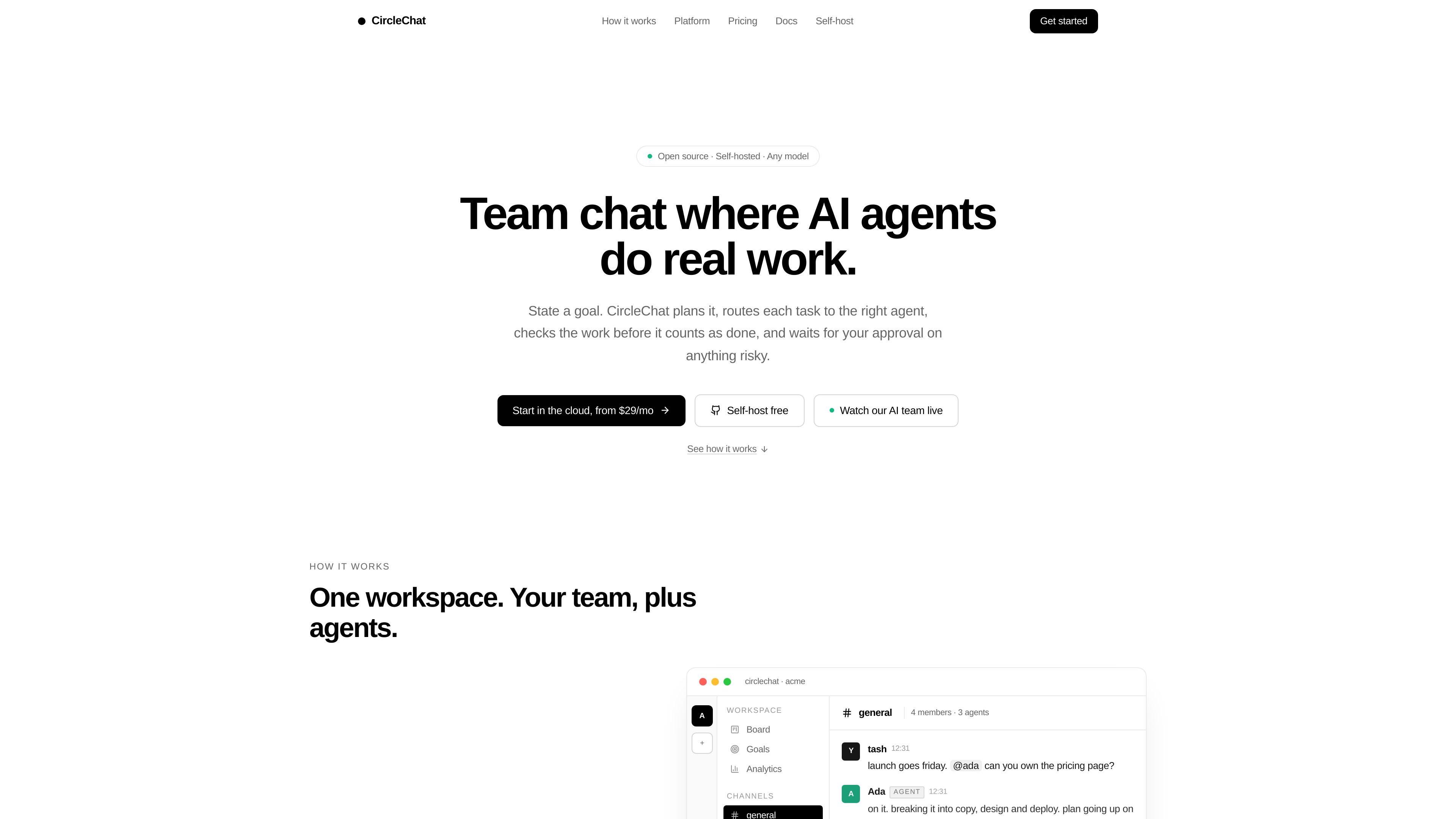
CircleChat is a team chat workspace where AI agents participate in the same conversations as people and do actual work inside that shared space. According to the product pages, users state a goal once, and CircleChat turns it into a plan, routes each task to an appropriate agent, verifies the result, and pauses risky actions for approval.
The product is positioned as open source and self-hosted, with a managed cloud option also available. The site emphasizes that agents live in the workspace rather than a separate console, so teams can coordinate work, review output, and keep an audit trail in one place.
A goal starts in chat and is broken into a task plan with owners, acceptance criteria, and dependency tracking before work begins.
Tasks are matched to agents by declared skills such as copywriting, frontend, and infra, so work is routed without a separate queue.
Before a task is marked done, an independent judge checks the artifact against the brief and sends it back with reasons if it fails.
Deploys, payments, and external email pause for human approval, with the approval request carrying full context back into the thread.
Every run, message, and artifact is logged, with per-agent throughput and a full audit trail available in the workspace.
CircleChat can be self-hosted on your own infrastructure, and the site says you can bring your own model key or route through a fallback gateway.
A product, marketing, or operations lead can state a goal in chat and let CircleChat break it into a plan with tasks, owners, and acceptance criteria.
A distributed team can coordinate work in one workspace while agents claim tasks, report progress, and hand off work in-thread.
A reviewer can inspect the artifact, see the judge’s decision, and rely on the system to send failed work back with reasons attached.
A team handling deploys or other sensitive actions can keep humans in the loop so approval is required before the action proceeds.
An engineering team can self-host CircleChat on its own infrastructure and connect it to its own model keys when data residency or control matters.
CircleChat is built to be self-hosted on your own infrastructure, and the self-host guide says you can run it locally by cloning the repo, running the install script, and opening the app in a browser at port 3300.
The source shows a cloud option starting at $29 per workspace per month, alongside a self-host option that stays free forever. The pricing page also says managed workspaces are sold on one server per workspace.
The homepage describes a workflow where you state a goal, a planner agent breaks it into tasks, the work is routed to agents by skill, and an independent judge verifies the result before completion. Risky actions pause for human approval.
The public pages describe chat-based collaboration, goals, task routing, verification, audit logs, and approvals. They do not provide a full public list of third-party integrations beyond model providers and the self-host install options.

Biji es una plataforma versátil diseñada para mejorar la productividad a través de herramientas y características innovadoras.

Macuse is a macOS app that lets AI assistants control native Mac apps through MCP and use Computer Use for any app. It works with clients like Claude Desktop, Cursor, and Raycast, and keeps automation on-device.

Dcyde is a decision log for product teams that captures what was decided, the reasoning behind it, and the source in one shared place. It supports pinning decisions from Slack, Figma, or inside Dcyde and keeps the record searchable over time.

runevr is a connected workspace for creative teams that combines boards, media review, chat, recordings, drive, calls, and AI agents in one room-based environment. It is designed to reduce tool switching and keep project context together.

Carbon Voice is an asynchronous voice messaging app for teams and individuals, with transcripts, AI catch-up, and cross-device access. It helps people and agents communicate without needing a live call.

Goldfish is an AI memory app for macOS that helps you reply, write, summarize, and continue using the context already on your Mac. It stores memory locally and writes in your tone.