
Per-agent isolation
HAR turns a repository into isolated worktrees so each coding agent gets its own slot, branch, ports, and database where needed. That separation is meant to prevent agents from colliding on shared state.

HAR is an open-source, agent-agnostic framework for multi-agent coding workflows. It helps teams run several coding agents in parallel, with deterministic verification and an evidence trail for review.
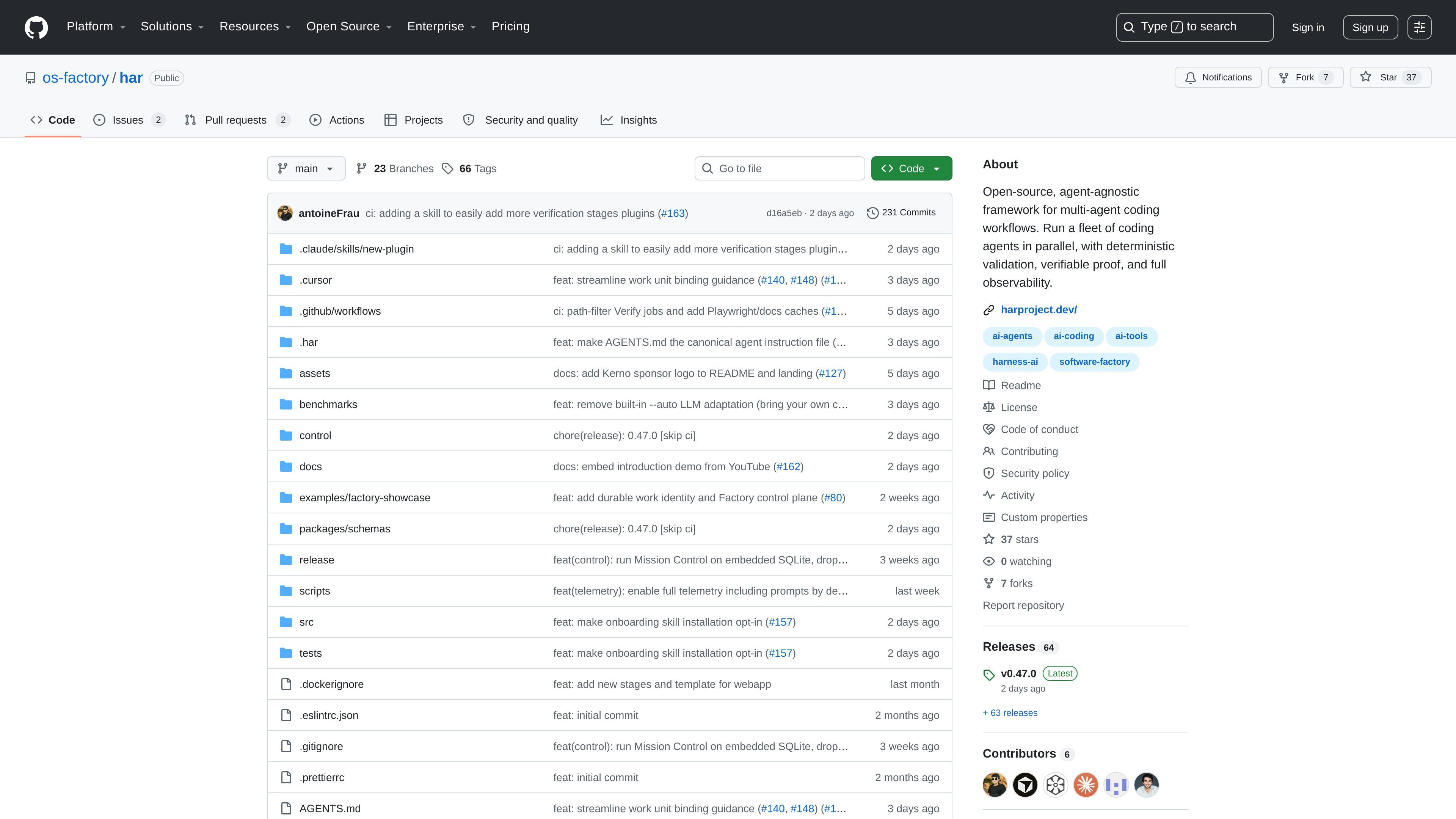
HAR is an open-source framework for multi-agent coding workflows. It is designed to help teams run several coding agents in parallel inside the same repository while keeping the setup isolated, the verification steps repeatable, and the results reviewable.
According to the README, HAR works as a core harness plus a local dashboard and plugin ecosystem. It supports Claude Code, Cursor, Codex, and other MCP agents, and it centers the workflow on a machine-readable contract stored in the repository itself.
HAR turns a repository into isolated worktrees so each coding agent gets its own slot, branch, ports, and database where needed. That separation is meant to prevent agents from colliding on shared state.
The workflow follows repeatable stages for discovery, launch, verification, and teardown. The project’s own checks run through the same pipeline each time, which makes the process more consistent across runs.
A full verification records evidence such as logs, artifacts, and a validated tree hash tied to the exact code that passed. This gives reviewers a way to inspect what actually ran.
HAR is available as both a CLI and an MCP server, so it can be driven from the terminal or by agent tools that speak MCP. The README also frames it as agent-agnostic.
Mission Control provides a local dashboard for tracking repositories, worktrees, runs, validations, and artifacts in one place. That makes it easier to monitor multiple parallel tasks.
The docs mention a plugin system that extends HAR with framework-specific verification bundles such as Playwright and RocketSim. This keeps the harness adaptable to different project stacks.
Use HAR when several coding agents need to work in the same repository at once without sharing a checkout, branch, or runtime state. Its slot-based isolation is meant to keep those sessions separate.
Use it when you need a reviewable record of what the agent actually verified. HAR’s deterministic checks and evidence trail help connect a passing run to the exact code that was tested.
Use it for teams that want a shared repository contract instead of scattered setup notes in README files, agent prompts, and CI scripts. The contract lives in the repo and is read by supported agents in the same way.
Use Mission Control when you want one local view of multiple repositories, worktrees, runs, validations, and artifacts. That is useful when coordinating several active coding tasks across projects.
Use the plugin system when a project needs framework-specific checks or custom stages, such as Playwright- or RocketSim-based validation bundles. This helps adapt the harness to different project workflows.
HAR is a framework for multi-agent coding workflows. It helps turn a repository into isolated worktrees with a repeatable launch, verify, and teardown flow for coding agents.
The README says HAR works with Claude Code, Cursor, Codex, and any MCP agent. It is described as agent-agnostic rather than tied to one model or editor.
The repository documentation presents HAR as a core harness available as both a CLI and an MCP server, plus Mission Control, a local dashboard for tracking repositories, worktrees, runs, validations, and artifacts.
HAR’s docs emphasize an evidence trail from deterministic verification, including logs, artifacts, and a validated tree hash, so reviewers can inspect what ran instead of relying only on an agent’s self-report.
The source material does not show a full integration catalog or environment matrix on the product page. It does say HAR is extensible through plugins and supports MCP-based agent workflows.

ByteAsk is a terminal-first AI coding agent for C and C++ that edits repositories and verifies changes with the real compiler, debugger, sanitizers, and tests before showing a diff. It offers a free tier plus paid plans, with editor connectors and zero-retention handling described in the source.

Manta AI is an autonomous web app testing tool for teams that want to map application behavior, catch regressions, and generate tests without writing scripts or maintaining selectors. It works from a URL and supports plain-English test flows, run results with screenshots, and scheduled or deployment-triggered checks.

Hoplite is a cloud coding agent platform for teams that want to run software tasks in isolated sandboxes with repository context and imported local setup. It offers published Pro, Scale, and Enterprise plans.

CreateOS Sandbox is an isolated compute environment for running code and agent workloads inside Firecracker micro-VMs. It is designed for workflows that need machine-level isolation, private networking between sandboxes, and programmatic control through SDK, CLI, or MCP.

hob is an independent workspace for coding agents that keeps agent sessions, terminals, history, and follow-up work organized around the tools and providers you already use. It is aimed at developers who want local control over routing, history, and workspace structure rather than a bundled model stack.

SonOf connects to your repo and PM tool, audits the codebase and surrounding product context, and turns approved work into shipped tickets with senior engineering review. It is aimed at founders and engineering leaders who need backlog help without hiring a full team immediately.