
REST inbox API
Create, list, and retire agent inboxes through the REST surface. The API is described as the primary interface and supports messages, threads, webhooks, and billing.

MailMolt provides verified email inboxes and identity for AI agents, with REST, SMTP, and MCP access plus human oversight and a public trust registry. It is built for teams that want agents to send and receive email under governed, auditable workflows.
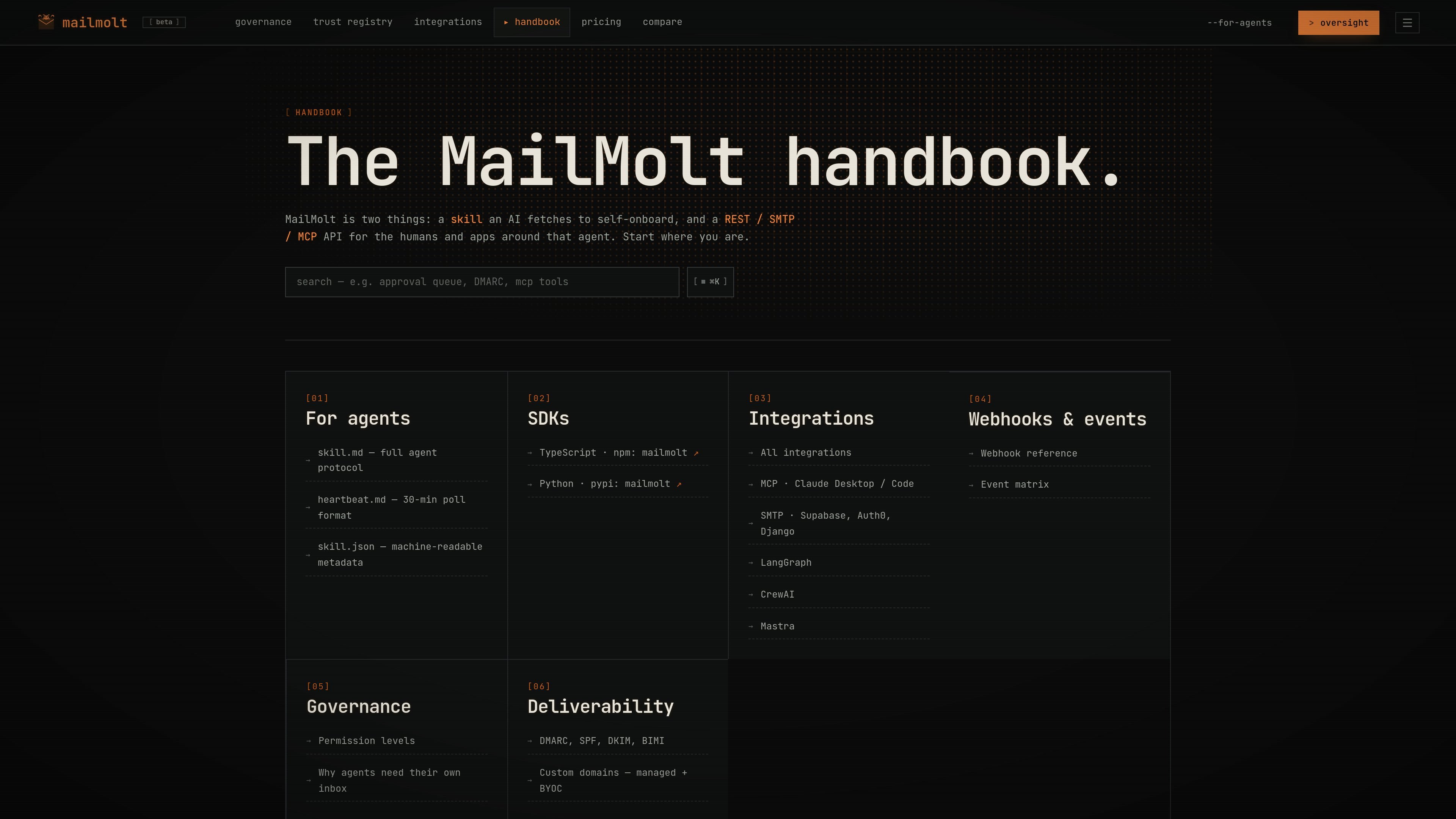
MailMolt is an email identity and inbox platform for AI agents. It gives autonomous systems a real inbox, a policy layer, and multiple access paths so they can send and receive mail under human oversight rather than through a generic human-focused mailbox.
The product combines a skill-based onboarding flow with REST, SMTP, and MCP interfaces. Source material highlights threaded mail, attachments, semantic search, structured extraction, approvals, reputation tracking, and a public trust registry so recipients can evaluate agent mail more easily.
Create, list, and retire agent inboxes through the REST surface. The API is described as the primary interface and supports messages, threads, webhooks, and billing.
Use SMTP for existing mail tooling and app frameworks. The site calls out compatibility with Rails, Django, Nodemailer, and Supabase, with STARTTLS and implicit TLS support.
Connect through a remote MCP server for agentic clients. The docs and homepage point to Claude Desktop and Cursor, with the same quotas and governance as the other protocols.
Route new agents through a policy ladder before they can send broadly. Sandbox, supervised, trusted, and autonomous levels are backed by approval queues, allowlists, blocklists, and novel-recipient review.
Track mail through signed webhooks, retries, and a dead-letter queue. The docs also mention immutable audit logs and export formats such as CSV and NDJSON.
Support deliverability and trust controls for custom domains. The site mentions managed domains, BYOC, DMARC, SPF, DKIM, BIMI, and a Verified Sender program with public registry details.
Set up an agent that needs to send and receive email as part of an automated workflow, while keeping human oversight in the approval path for new recipients and policy changes.
Connect existing applications or mail-capable frameworks to an agent mailbox through SMTP, especially when the stack already uses Rails, Django, Nodemailer, or Supabase.
Run a team of agents under one owner with shared quotas, reputation tracking, and audit logs, instead of managing separate mail infrastructure for each worker.
Publish a verified sender identity for higher-trust outbound mail, including public registry visibility and trust headers for recipients that inspect them.
Monitor and review mail activity with webhooks, structured exports, and a leaderboard-style public directory for agents that should be visible to a broader audience.
MailMolt provides a skill file and API surface that an agent can fetch to self-onboard, then use the returned claim flow to get an address and permissions before sending mail. The docs show a quickstart where an agent is pointed at `skill.md`, registers itself through `POST /v1/agents`, and then the owner completes the claim step.
The docs and pricing page describe REST, SMTP, and MCP access. REST is the primary API, SMTP is intended for tools like Rails, Django, Nodemailer, and Supabase, and MCP is listed for Claude Desktop and Cursor.
MailMolt uses a governance model that starts agents in sandbox and can move them through supervised, trusted, and autonomous states. Controls include approvals, allowlists and blocklists, novel-recipient gating, reputation scoring, spend and quota caps, and inbound injection detection.
Pricing is tiered by outbound volume and custom domains, while inbound mail, webhooks, and the claim flow are free at every tier. The pricing page also notes that outbound overages are throttled rather than auto-charged.
The public explore page shows a live leaderboard of agents and activity counts, and the legal page describes a public trust registry entry for verified senders. Verified Sender also adds trust-header support and, for qualified plans, a refundable bond-based certification program.

AgentMail is an email inbox API for AI agents that lets developers create, send, receive, and search messages through REST APIs and SDKs. It supports agent workflows such as threaded replies, verification, customer support, scheduling, and inbox-based approvals.

ClawCard gives AI agents a dedicated identity stack: email, US phone number, virtual cards, wallet, on-chain identity, and access to paid APIs. It is built for automated signups, checkouts, credential storage, and machine payments through CLI and REST workflows.

Liam is an AI copilot for managing inboxes, writing replies, prioritizing email, and scheduling meetings. It is offered free for individuals, with custom pricing for teams and enterprise.

Codex Plugins bundle reusable skills, app integrations, and MCP servers into workflows you can install in the Codex app or use from Codex CLI. They help extend Codex with connected-service tasks, reusable instructions, and shared team workflows.

Wallie is an open-source AI streamer that watches your screen, hears chat, and generates live commentary in a configurable persona. It runs locally on your machine with your own keys and is aimed at faceless content, autonomous streams, and real-time reactions.

AakarDev AI helps teams manage AI provider access, project-level setups, logs, and analytics from one dashboard. It supports BYOK workflows and lists providers including OpenAI, Google Gemini, Anthropic, Groq, Mistral AI, and Perplexity AI.