
Pipeline-based classification
Turns classification into a staged workflow that moves data from ingest through OCR, merge, classify, risk screening, compliance, and ERP sync.

MarkIt is an enterprise trade compliance platform for customs classification, audit-ready records, and ERP-connected compliance workflows. It is aimed at institutional teams that need structured, reviewable trade data and repeatable classification processes.
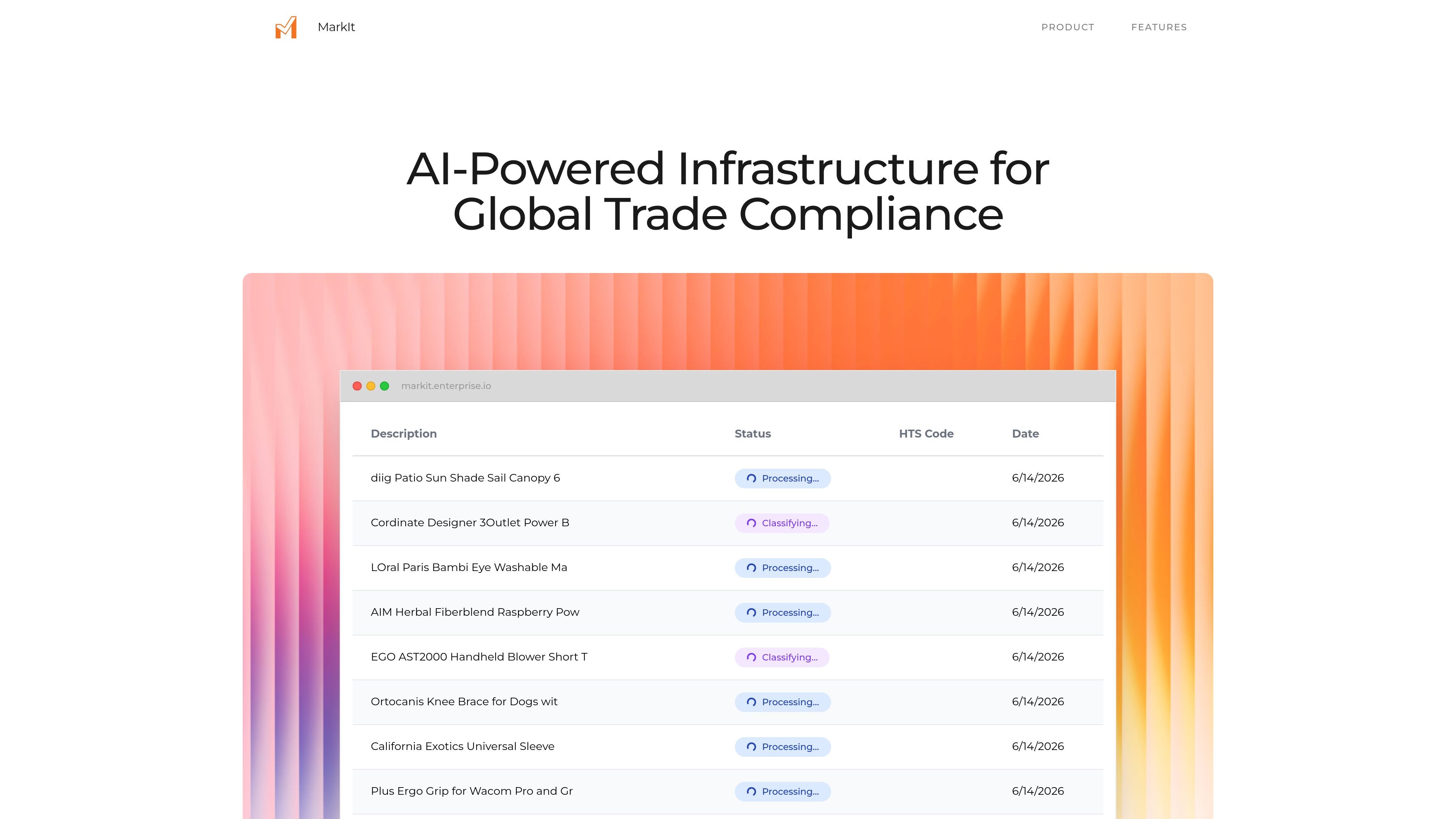
MarkIt is an enterprise trade compliance platform focused on customs classification and related compliance workflow management. The homepage positions it as a unified data platform for global trade compliance, with an emphasis on structured, auditable, and defensible handling of classification work.
The product appears to combine document ingestion, OCR, classification, risk screening, compliance rules, and ERP synchronization in a single pipeline. The site shows live operational views for classification queues, confidence scores, and processing states, indicating a system designed for institutional teams that need reviewable trade data and repeatable workflows.
Turns classification into a staged workflow that moves data from ingest through OCR, merge, classify, risk screening, compliance, and ERP sync.
Uses OCR on text and tables to help process source documents before classification.
Surfaces HS prediction and classification outputs for trade items, with status and confidence shown in the live interface.
Keeps records of classification decisions for audit and review, with the homepage calling out immutable records and CF-28/29 report generation.
Connects to ERP environments through API integration and references SAP/Oracle in the workflow display.
Shows operational monitoring elements such as processed counts, pending items, queue status, and risk score.
Teams handling large volumes of import or trade documents can use the staged pipeline to move files from ingestion and OCR into classification and review.
Compliance and audit teams can use the system’s immutable records and report generation to preserve decision history for regulatory review.
Operations teams can monitor pending items, processed counts, risk score, and queue status to keep classification work moving.
Enterprises with ERP dependencies can sync classification output into existing systems through the API and the SAP/Oracle references shown on the homepage.
The homepage presents MarkIt as an enterprise trade compliance platform focused on customs classification, auditability, and ERP sync. The source does not describe a public self-serve signup flow.
The site shows a live pipeline with ingest, OCR text, OCR table, merge, classify, HS prediction, risk screening, rules, compliance, and ERP sync stages, suggesting a workflow built around review and classification of trade data.
The homepage explicitly references SAP/Oracle and API integration, but it does not provide a full integrations list or implementation details.
No pricing information is available from the provided site content. The pricing URL returns a 404 page.

Struere is an AI-native platform for turning spreadsheet data into structured operational software with dashboards, alerts, and automations. It is aimed at teams that want to replace manual spreadsheet workflows without building custom tools from scratch.

Goldfish is an AI memory app for macOS that helps you reply, write, summarize, and continue using the context already on your Mac. It stores memory locally and writes in your tone.

Lasso is an ecommerce product data platform for enriching catalog records, processing supplier files, generating product content, and monitoring competitors. It combines a web app with a REST API, SDK, and MCP server for teams and developers.

ArtDeck is a visual reference board app for iPhone, iPad, and Mac that lets artists collect mixed reference material on one canvas and study it with ToolBox lenses. It works offline, supports optional iCloud sync, and is sold as a one-time purchase with no account required.

Codex Plugins bundle reusable skills, app integrations, and MCP servers into workflows you can install in the Codex app or use from Codex CLI. They help extend Codex with connected-service tasks, reusable instructions, and shared team workflows.

garden-md is an open-source Node.js CLI that turns meeting transcripts into a local company wiki. It links entities across transcripts, keeps the original text intact, and renders the result as a browsable wiki.