MoveFast icon

MoveFast

MoveFast is a production-ready Next.js SaaS starter with auth, billing, email, database, admin, and launch pages. It is aimed at founders, agencies, and product teams that want a credible SaaS base without wiring the core stack from scratch.

MoveFast

Production-ready Next.js SaaS starter

MoveFast is a production-ready Next.js SaaS starter for teams that want to launch a new product without assembling the core application, billing, and launch scaffolding from scratch. The starter combines authentication, database options, payments, email, admin tools, and public product pages in one codebase.

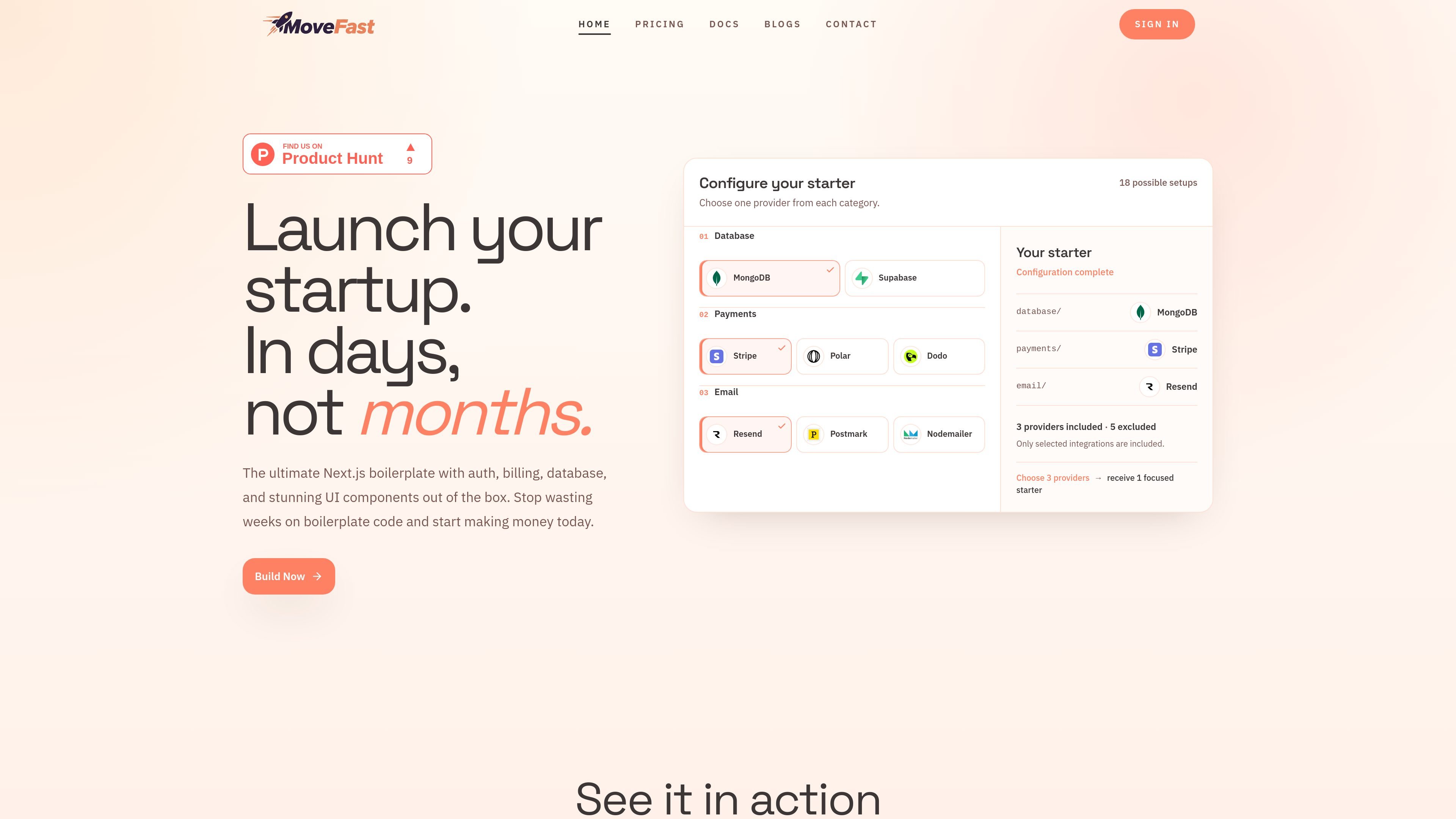
The source describes a focused setup process: choose a database, payment provider, and email provider, then start building on top of the generated starter. It is positioned for founders, agencies, and product teams that need a credible SaaS base for launch, validation, or client delivery.

Core capabilities

Modern application foundation

The stack is centered on Next.js 16+ with App Router, React 19, TypeScript, Tailwind CSS, shadcn/ui, and a responsive light theme. It also includes SEO foundations so the starter is ready for a public-facing product site.

Authentication flows

Authentication is built with Auth.js and supports email/password, magic links, profiles, and account settings. That gives teams a working identity layer before they add product-specific features.

Database choices

You can generate the starter with either MongoDB and Mongoose or Supabase and Prisma. This lets teams match the database layer to their preferred stack without rebuilding the core app structure.

Payment infrastructure

Billing is available with Stripe, Polar, or Dodo Payments for one-time and subscription flows. The starter also includes normalized webhooks, billing history, and portal support where available.

Admin and launch control

Operational tooling includes an admin dashboard with user management, waitlist controls, invitations, growth metrics, and user impersonation. This helps teams manage the product after launch instead of adding internal tools later.

Email and launch pages

The starter includes transactional email templates through React Email, wired to Resend, Postmark, or Nodemailer. It also ships with documentation, blog, contact, privacy, terms, and cookie policy pages.

Common workflows

  • Founders shipping an MVP

    Start with a working SaaS foundation when the goal is to ship the first version quickly. The starter gives you auth, billing, data, and launch pages so the team can focus on the product’s differentiating features.

  • Agencies delivering SaaS builds

    Use the starter as a repeatable base for client projects that need a polished product shell without rebuilding the same infrastructure each time. It can reduce the effort spent on auth, payments, and operational tooling.

  • Product teams validating an MVP

    Keep the scaffolding serious enough for real buyers while iterating on onboarding and the website. This is useful when a team wants to validate a product without leaving the impression of a rough prototype.

  • Teams managing staged launches

    Begin with invite-only access and a waitlist, then switch to open signup later. That makes the starter useful for launch sequencing when the access model changes over time.

Pros and Cons

Pros

  • Combines the main SaaS foundations in one starter: auth, billing, email, database, admin, and launch pages.
  • Offers provider choice for database, payments, and email, so teams can match the starter to their stack.
  • Includes launch-oriented surfaces such as waitlists, invite access, open signup controls, and public product pages.
  • Covers both product operations and public-facing pages, reducing the amount of separate scaffolding needed before launch.
  • Ships with lifetime access and future updates according to the pricing page.

Cons

  • The source does not provide a dedicated integration matrix for every provider combination, so exact supported pairings may need to be confirmed during setup.
  • Pricing is presented as a lifetime license, but the page does not give a deeper breakdown of support scope or update cadence beyond lifetime access and updates.

FAQ

What is already included in the starter?

The starter includes authentication, payments, waitlist and invite flows, admin tools, blog and SEO pages, email templates, analytics hooks, and the legal pages needed for a launch-ready product.

Can I choose my own database, email, and payment providers?

Yes. You can choose the database, payment, and email providers that fit your product before you start building.

Will it run locally if I do not configure every provider immediately?

Yes. The setup is designed so optional services do not block local development, allowing you to configure integrations as needed.

Is this only for invite-only products?

Yes. The starter supports both invite-led access and open signup, so you can begin with a waitlist-driven launch and later relax the gate without rebuilding flows.

Does the starter help with conversion, not just engineering?

Yes. The landing page, pricing flow, signup path, and trust signals are wired together so early customers get a complete experience instead of disconnected pages.

Quick Facts

Category
Developer Tool
Primary platform
Next.js
Base stack
App Router, React 19, TypeScript, Tailwind CSS, shadcn/ui
Database options
MongoDB with Mongoose or Supabase with Prisma
Payment options
Stripe, Polar, or Dodo Payments
Source domain
movefa.st

Alternativas a MoveFast

Make Real icon

Make Real

Make Real is a Next.js app that turns hand-drawn wireframes into working HTML prototypes using the tldraw SDK and AI models. It helps users sketch on a canvas, generate code, and review the result in an embedded preview.

Speculos icon

Speculos

Speculos is a deployment tool for Claude Code that publishes what you built to a shareable URL. It supports private, org-wide, or public apps and adds team controls for company domains, data connections, and customer-cloud deployments.

ByteAsk icon

ByteAsk

ByteAsk is a terminal-first AI coding agent for C and C++ that edits repositories and verifies changes with the real compiler, debugger, sanitizers, and tests before showing a diff. It offers a free tier plus paid plans, with editor connectors and zero-retention handling described in the source.

CreateOS Sandbox icon

CreateOS Sandbox

CreateOS Sandbox is an isolated compute environment for running code and agent workloads inside Firecracker micro-VMs. It is designed for workflows that need machine-level isolation, private networking between sandboxes, and programmatic control through SDK, CLI, or MCP.

hob icon

hob

hob is an independent workspace for coding agents that keeps agent sessions, terminals, history, and follow-up work organized around the tools and providers you already use. It is aimed at developers who want local control over routing, history, and workspace structure rather than a bundled model stack.

Prompty Town icon

Prompty Town

Prompty Town is a web product that turns a link into a building in a small internet city. It appears to let users buy a tile, add a prompt, and publish the result alongside other buildings.

MoveFast - AI Tool, Features, Use Cases & Alternatives | UStack