
Isolated project sessions
Runs agents in a Linux micro-VM on a copy-on-write clone, while keeping the real project folder out of the session.

Mudroom runs coding agents in an isolated Linux VM or Docker/Podman environment on a clone of a project, then shows their changes as a diff for selective review and application. It supports several coding agents and command-line workflows across macOS, Linux, and Windows.
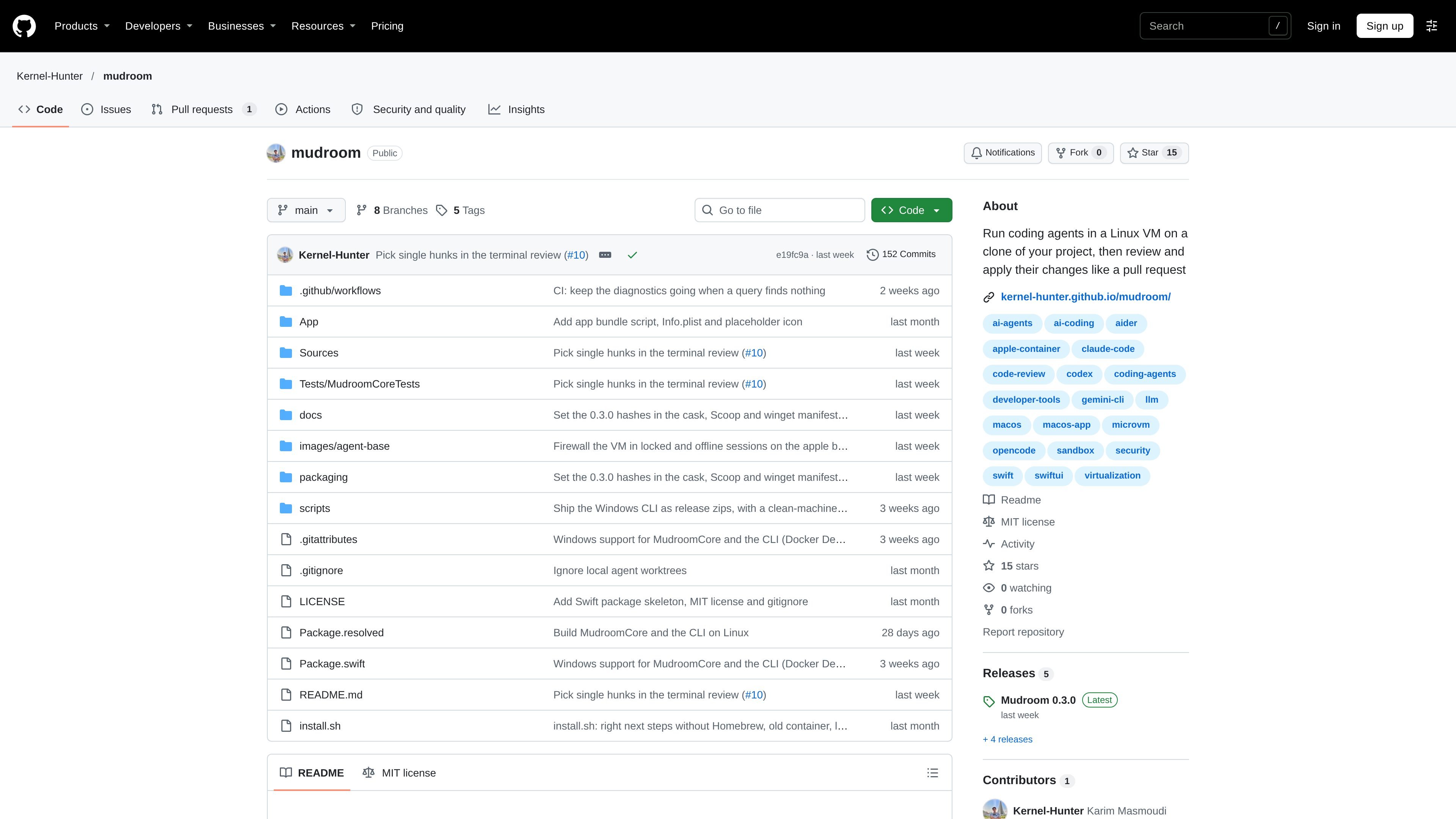
Mudroom is a developer tool for running coding agents against an isolated copy of a project. It places an agent in a Linux micro-VM or a Docker/Podman-based environment rather than mounting the user's real folder, which is intended to make permission-disabled agent workflows easier to review before they affect the source project.
After an agent finishes, Mudroom presents the resulting changes as a diff. Users can apply the complete change set, selected files, individual hunks, or nothing, and can undo an application later. The project is an early prototype, so its documentation warns that rough edges and breaking changes are possible.
Runs agents in a Linux micro-VM on a copy-on-write clone, while keeping the real project folder out of the session.
Restricts outbound access to hosts the user allows, with a network-check command for Docker and Podman environments.
Supports Claude Code, Codex, Gemini CLI, opencode, Aider, and arbitrary commands, with agent sign-in and API-key setup.
Presents completed work as a diff and lets users apply all changes, selected files, selected hunks, or no changes.
Provides a macOS app and CLI on Apple-silicon Macs, plus a CLI for Linux, Windows, and Intel Macs using Docker or Podman.
The CLI can select Apple, Docker, or Podman backends explicitly or automatically, and sessions remember their backend.
Run an agent with permission prompts disabled while keeping it away from the working folder, then inspect the proposed patch before changing the project.
Give an agent a bounded set of approved network destinations when tasks require package downloads, APIs, or other remote resources.
Use the diff view to accept a complete implementation, select only particular files or hunks, or reject the result without modifying the project.
Run the same general workflow from the macOS app or CLI, or use Docker and Podman on Linux, Windows, and Intel Macs where the app is unavailable.
Mudroom runs coding agents in a Linux micro-VM on Apple-silicon Macs, and through Docker or Podman on Linux, Windows, and Intel Macs. The real project folder is not mounted into the session.
On an Apple-silicon Mac running macOS 26 or later, use the install script or Homebrew cask, complete setup, build the agent image, sign in to an agent, and create a session. Linux, Windows, and Intel Mac users use the CLI with Docker or Podman.
The README lists Claude Code, Codex, Gemini CLI, opencode, and Aider, and also says Mudroom can run any command. Agent sign-in and API-key configuration are part of the setup workflow.
When a session ends, Mudroom shows the changes as a diff. You can apply all changes, selected files, selected hunks, or none, and undo an apply later.
Mudroom is identified by its maintainers as an early prototype, so users should expect rough edges and breaking changes. The macOS application is ad-hoc signed and not notarized, and Windows binaries are not code-signed.

ByteAsk is a terminal-first AI coding agent for C and C++ that edits repositories and verifies changes with the real compiler, debugger, sanitizers, and tests before showing a diff. It offers a free tier plus paid plans, with editor connectors and zero-retention handling described in the source.

GitBot is a local browser-based workspace for creating reusable coding bots powered by Claude Code, Codex, or OpenCode. It helps developers run those agents across repository folders with persistent threads and configurable permissions.

Ghost es un asistente de IA para terminal para chatear, generar código y ejecutar tareas en la línea de comandos. Incluye modelos gratuitos, es compatible con Linux, macOS y Windows, y es de código abierto.

Vi3ecode is a maintained development environment for working with AI coding agents. It keeps project context, terminal, Git, memory, flows, review, and communication connected around the agent you already use.

CreateOS Sandbox is an isolated compute environment for running code and agent workloads inside Firecracker micro-VMs. It is designed for workflows that need machine-level isolation, private networking between sandboxes, and programmatic control through SDK, CLI, or MCP.

hob is an independent workspace for coding agents that keeps agent sessions, terminals, history, and follow-up work organized around the tools and providers you already use. It is aimed at developers who want local control over routing, history, and workspace structure rather than a bundled model stack.