
Code-aware vendor diffing
Indexes the endpoints and response fields your code actually reads, rather than tracking every vendor change indiscriminately.

Oxpecker monitors vendor API and spec changes against the endpoints and fields your code actually uses, then opens a pull request when a relevant change is detected. It is aimed at teams that want focused dependency-change tracking inside CI rather than a broad changelog feed.
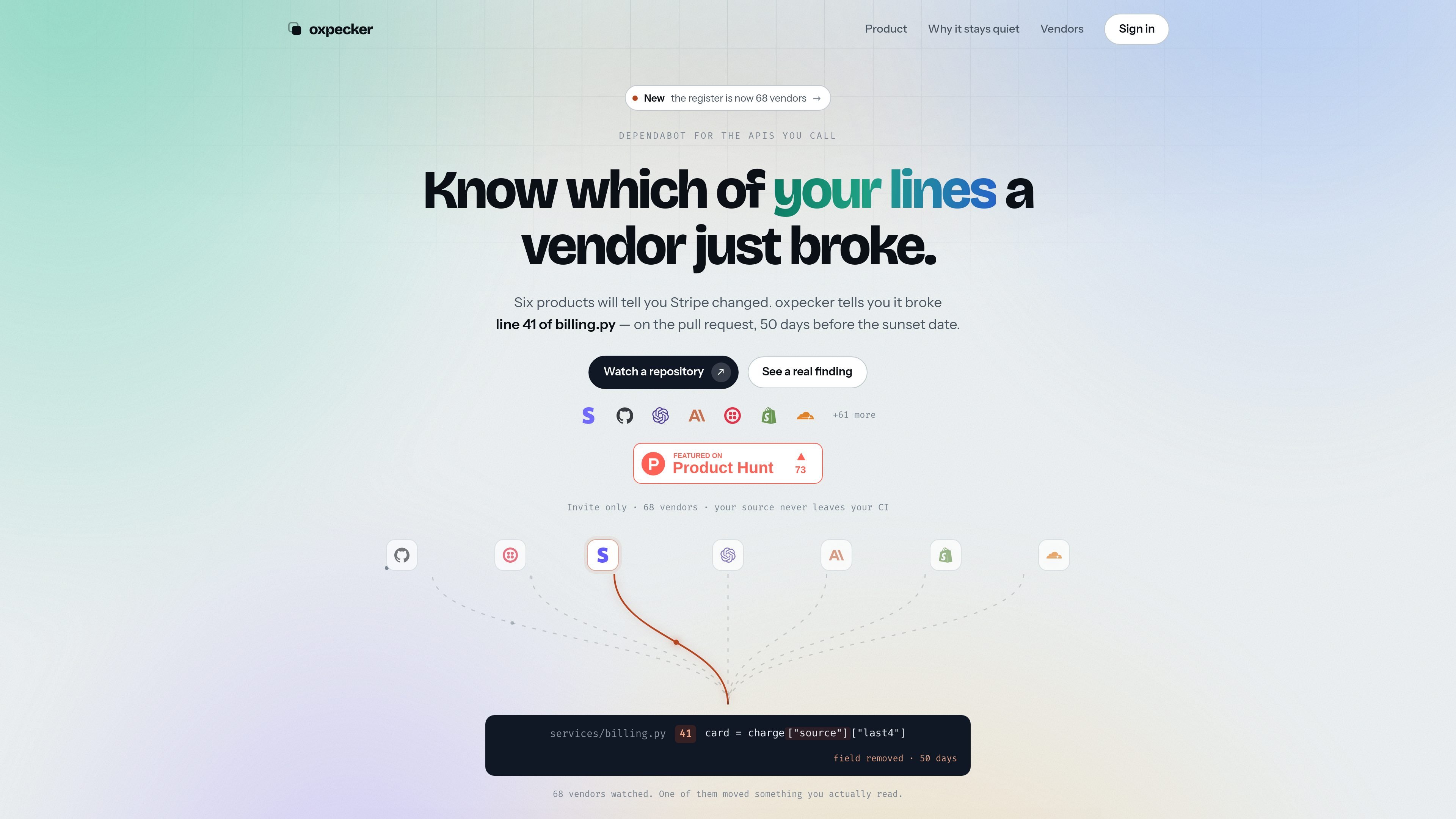
Oxpecker is a developer tool for monitoring vendor API and spec changes against the parts of your codebase that actually use those vendors. Instead of reporting every upstream change, it compares published specs and highlights the changes that affect the lines your repository depends on.
The homepage says it watches 68 vendors and that the source never leaves your CI. When a relevant change is detected, the product opens a pull request so the impact can be reviewed before a vendor sunset date or before the change reaches production.
Indexes the endpoints and response fields your code actually reads, rather than tracking every vendor change indiscriminately.
Diffs published vendor specs on a schedule and flags changes that land on watched lines in your repository.
Surfaces breakage in the pull request before the sunset date, so the change can be reviewed before it affects production.
Describes a workflow where it opens a pull request adding one file, rather than auto-merging changes into a repository.
Shows a register of watched vendors and the endpoints, SDKs, or spec sources associated with them.
Emphasizes silence unless a relevant change lands, which keeps noise focused on code paths that matter to the repository.
Teams that rely on third-party APIs can watch for breaking changes in the specific request/response fields their services actually consume, rather than reading every vendor changelog manually.
Repositories with CI-driven development can treat vendor changes as code changes, using the pull request as the review point before anything merges.
Organizations that depend on several vendors at once can keep a single register of watched systems, from payments and messaging to infrastructure and analytics.
Developers who need to know whether a provider change affects an endpoint, parameter, or response field can use the diff output to focus on the impacted lines instead of the full vendor spec.
Oxpecker watches the APIs and vendor specs that your code already uses, then highlights changes that affect those watched lines. The homepage describes it as surfacing breakage in the pull request before the sunset date.
The site says a repository review opens a pull request that adds one file. That change is reviewable before it merges, and nothing is auto-merged.
The register page shows a broad vendor list that includes APIs and products such as Stripe, OpenAI, GitHub, Slack, Twilio, Cloudflare, and others. The homepage says 68 vendors are watched.
The public pages do not document pricing. The pricing URL returns 404 on the site provided in the evidence.

ByteAsk is a terminal-first AI coding agent for C and C++ that edits repositories and verifies changes with the real compiler, debugger, sanitizers, and tests before showing a diff. It offers a free tier plus paid plans, with editor connectors and zero-retention handling described in the source.

Manta AI is an autonomous web app testing tool for teams that want to map application behavior, catch regressions, and generate tests without writing scripts or maintaining selectors. It works from a URL and supports plain-English test flows, run results with screenshots, and scheduled or deployment-triggered checks.

CreateOS Sandbox is an isolated compute environment for running code and agent workloads inside Firecracker micro-VMs. It is designed for workflows that need machine-level isolation, private networking between sandboxes, and programmatic control through SDK, CLI, or MCP.

hob is an independent workspace for coding agents that keeps agent sessions, terminals, history, and follow-up work organized around the tools and providers you already use. It is aimed at developers who want local control over routing, history, and workspace structure rather than a bundled model stack.

Ably Chat is a chat API platform for building custom realtime chat applications. It supports room-based messaging, typing indicators, presence, reactions, and message updates, with usage-based pricing options for different deployment stages.

ClawTick is an AI agent automation platform for scheduling jobs from the CLI, dashboard, or REST API. It is aimed at developers and teams running LangChain, CrewAI, webhook, or custom agent workflows that need monitoring, alerts, and logs.