
Clear anti-distraction messaging
The campaign centers on short, visually direct stickers aimed at people absorbed in their phones. The message is designed to be noticed quickly in everyday spaces.

A free public-art sticker campaign by Image Not Found that comments on smartphone distraction and can be requested, downloaded as SVG, printed, or adapted locally.
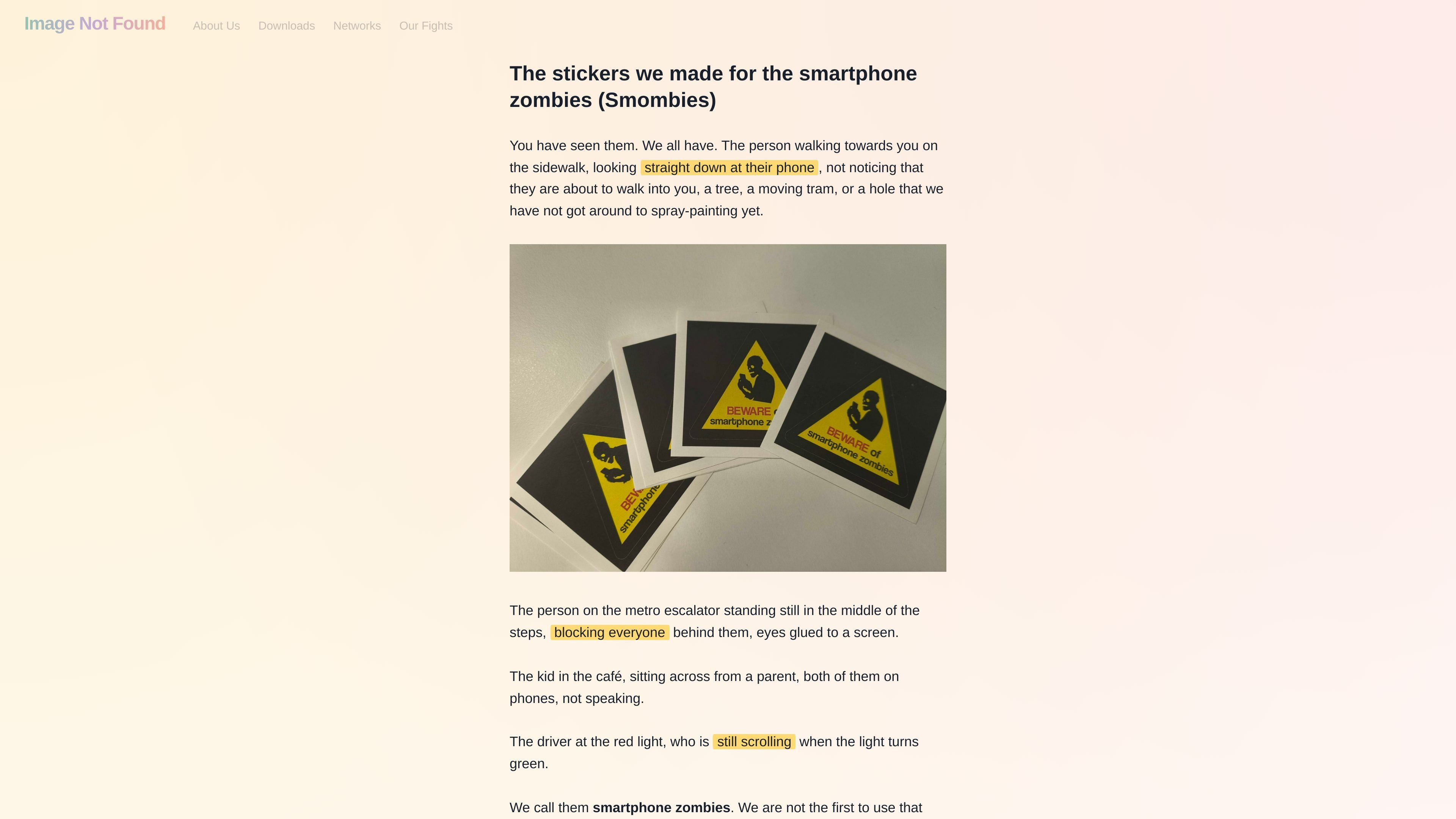
The stickers we made for the smartphone zombies is a public-art sticker campaign by Image Not Found. It uses a blunt, short-form message to call attention to compulsive phone use in everyday places such as sidewalks, transit, cafés, and streets.
The project is presented as an artivist intervention rather than a commercial product. The creators print the stickers, give them away for free at selected events, and also provide an SVG file so others can print, adapt, and distribute their own versions.
The campaign centers on short, visually direct stickers aimed at people absorbed in their phones. The message is designed to be noticed quickly in everyday spaces.
The site provides an SVG file for the smartphone-zombies sticker, so supporters can print their own copies instead of waiting for a mailed batch.
The creators say people can design their own version in their own language, which makes the format adaptable for local communities and contexts.
The stickers are small enough to place on laptops, notebooks, lamp posts, bathroom mirrors, or café tables, which makes them easy to deploy in ordinary environments.
The project was shared at free and open-source software events and given away for free, indicating a distribution model based on handouts rather than a store checkout.
The project documents where stickers have turned up and invites people to send photos, suggesting an informal, participatory circulation model.
People who want to share a simple reminder about phone use can place the stickers where passersby will see them during ordinary routines.
Supporters can print the SVG themselves and distribute stickers locally, which is useful for community groups or individuals running small grassroots actions.
Because the project invites redesign and translation, it can be adapted for events or audiences in different languages and cultural settings.
The creators mention free and open-source software events as a distribution channel, making the stickers a fit for tech community gatherings and related meetups.
People who want a low-friction art intervention can use the stickers on personal items or shared surfaces that fit the project’s suggested placements.
The stickers are free to request, and the site says the creators will send them to you without asking you to sign up for anything. It also offers the SVG print file for people who want to run their own batch.
Yes. The source says you can download the SVG file, print your own stickers, and even design your own version in your own language.
They are intended for places where people will notice them in daily life, such as laptops, notebooks, lamp posts, bathroom mirrors, and café tables. The project also says the stickers were taken to free and open-source software events and handed out there.
The campaign is for the Image Not Found collective, which describes itself as a small art collective working in artivism and public-space interventions. The stickers are one part of a broader practice that also includes pothole painting and public experiments.
The site only confirms that stickers have been spotted in Bulgaria, Czechia, Belgium, and Sweden, and that the list is still growing. It does not provide a complete distribution map.

MacSpoof es un cambiador de MAC para macOS: cambia o aleatoriza tu MAC Wi‑Fi para reconectar y reducir el registro de identidad en redes públicas.

NomNak es una app gratuita para iPhone para descubrir restaurantes con recomendaciones de amigos, guardar lugares, crear tu pasaporte gastronómico y buscar ciudades.

Ctrl+Shift+3 is a calm, text-first community platform with a chronological feed, profiles, RSS, and private groups called Clicks. It is built for reading, posting, and joining smaller communities without algorithmic ranking or vanity counts.

Hexel Editor is a macOS hex editor for opening, searching, inspecting, and editing binary files. It is aimed at developers, reverse engineers, and security researchers who need structured byte-level analysis on the Mac.
TyeGit es un cliente Git nativo para desarrolladores que buscan control rápido y preciso de staging, commits, ramas y remotos en Windows, macOS y Linux.

Servey lets you mirror and control a Mac from an iPhone or iPad, with a real terminal and automatic local-or-remote connectivity. It is aimed at people who want full Mac access on mobile without VPN or port forwarding.