
Provision agent context
Centralizes specifications, user journeys, decisions, and product behavior in a workbook that agents can read before implementation.

Dezycro is an operations layer for teams using AI coding agents such as Claude Code and Cursor. It provisions product context, directs work in progress, verifies implementations against specifications, and records decisions without uploading, cloning, or indexing the repository.
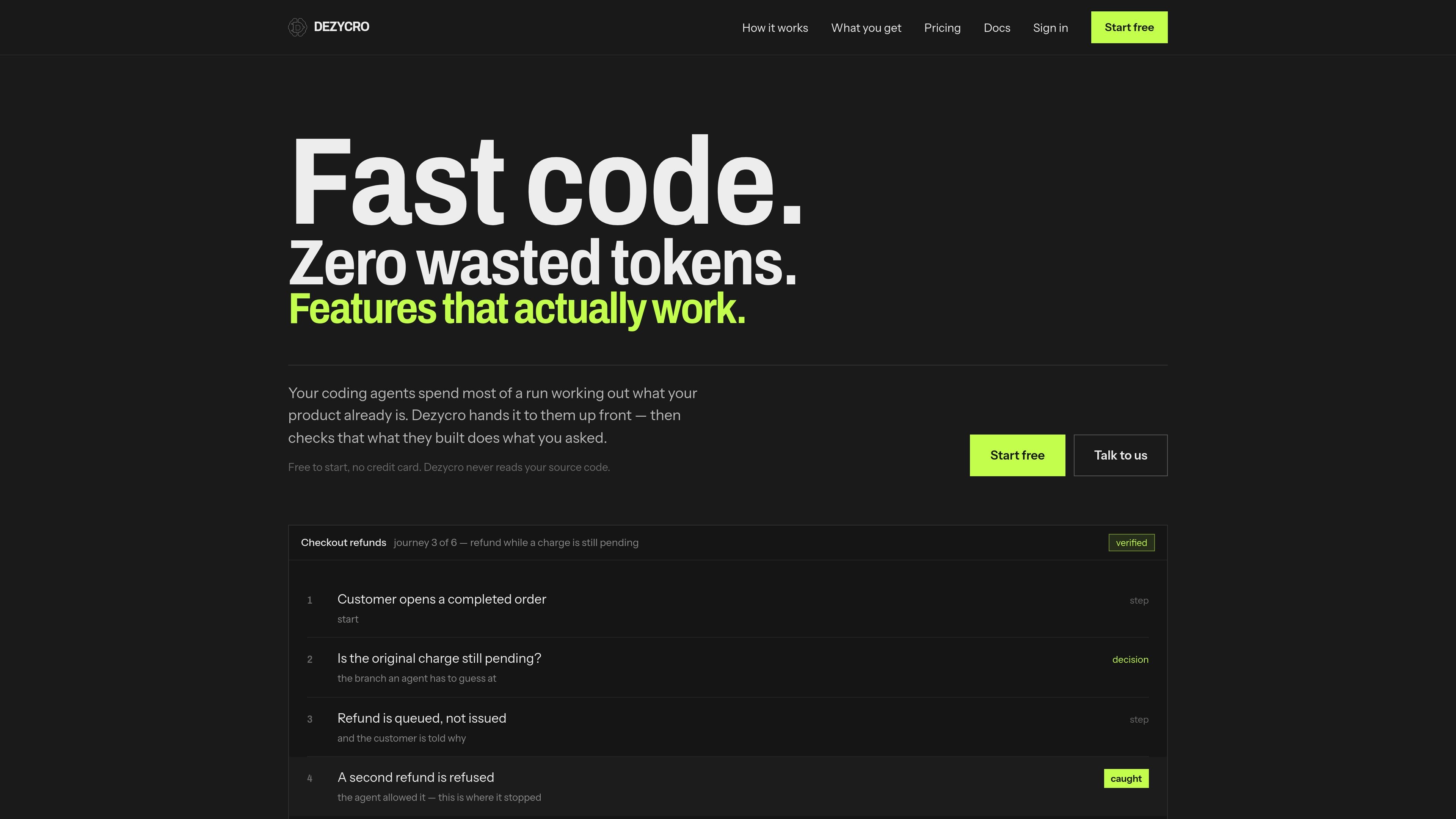
Dezycro is an operations layer for teams building software with AI coding agents such as Claude Code and Cursor. It organizes the context and controls around agent-assisted development so agents can work from product specifications and observable behavior instead of rediscovering the product on each pass.
Its workflow combines four stages in one workbook: Provision gives agents specifications, journeys, decisions, and product behavior; Direct lets users issue feature-level instructions while work is running; Verify generates checks from the specification and compares them with the built product; and Observe records decisions, assumptions, tasks, blockers, commits, and verification evidence. Dezycro says it does not read, upload, clone, or index source code, and that the workbook can be exported in full.
Centralizes specifications, user journeys, decisions, and product behavior in a workbook that agents can read before implementation.
Provides a per-feature command inbox for sending new instructions and invalidating stale work while an agent is running.
Generates checks from the product specification, runs them against the built product, and identifies disagreements between intended and observed behavior.
Records decisions, assumptions, tasks, and blockers in one workbook, linking the work to commits and verification evidence.
Uses specifications and observable interfaces such as endpoints and OpenAPI rather than accessing the repository itself; the source says repositories are not uploaded, cloned, or indexed.
Allows teams to use their own OpenAI, Anthropic, or Bedrock API key on every listed tier.
Before an agent begins a feature, a team can provide its specifications, journeys, decisions, and behavioral context in a form the agent reads up front.
When requirements change during implementation, users can send feature-level instructions and invalidate stale work without continuously supervising the terminal.
Teams can turn their product promises into checks and run those checks against the built product to find mismatches between requirements and behavior.
A team can keep assumptions, decisions, tasks, blockers, commits, and verification results together when coordinating agent-assisted development.
Organizations that do not want a repository uploaded to the service can use the stated specification- and interface-based workflow, while retaining an exportable workbook of their records.
Dezycro is designed for teams building with AI coding agents such as Claude Code and Cursor. The available source does not specify additional supported agents or integrations.
Dezycro works from specifications, product decisions, observable behavior, endpoints, and the OpenAPI surface. It does not read, upload, clone, or index the repository source code.
The workflow is organized into four stages: Provision, Direct, Verify, and Observe. Context is prepared before an agent starts, instructions can be sent while it runs, generated checks compare behavior with the specification, and work records are kept in a workbook.
Dezycro provides a workbook containing specifications, decisions, tasks, assumptions, blockers, commits, and verification evidence. The workbook can be exported in full.
Dezycro can be started for free without a credit card. The source also lists Pro, Team, and Enterprise offerings; the available page text does not establish further plan limits beyond the stated Team seat minimum and Enterprise features.

ByteAsk is a terminal-first AI coding agent for C and C++ that edits repositories and verifies changes with the real compiler, debugger, sanitizers, and tests before showing a diff. It offers a free tier plus paid plans, with editor connectors and zero-retention handling described in the source.

Manta AI is an autonomous web app testing tool for teams that want to map application behavior, catch regressions, and generate tests without writing scripts or maintaining selectors. It works from a URL and supports plain-English test flows, run results with screenshots, and scheduled or deployment-triggered checks.

CreateOS Sandbox is an isolated compute environment for running code and agent workloads inside Firecracker micro-VMs. It is designed for workflows that need machine-level isolation, private networking between sandboxes, and programmatic control through SDK, CLI, or MCP.

GitBot is a local browser-based workspace for creating reusable coding bots powered by Claude Code, Codex, or OpenCode. It helps developers run those agents across repository folders with persistent threads and configurable permissions.

hob is an independent workspace for coding agents that keeps agent sessions, terminals, history, and follow-up work organized around the tools and providers you already use. It is aimed at developers who want local control over routing, history, and workspace structure rather than a bundled model stack.

SonOf connects to your repo and PM tool, audits the codebase and surrounding product context, and turns approved work into shipped tickets with senior engineering review. It is aimed at founders and engineering leaders who need backlog help without hiring a full team immediately.