
Multidimensional agent auditing
Tests whether an agent stays within permissions, follows required approvals, respects organizational roles, and can be held accountable for its behavior.

iFixAi independently audits AI agents for unauthorized actions, policy violations, approval bypasses, and other operational risks that standard benchmarks may miss. Teams can connect an existing agent through GitHub or MCP and receive an audit report with replayable proof.
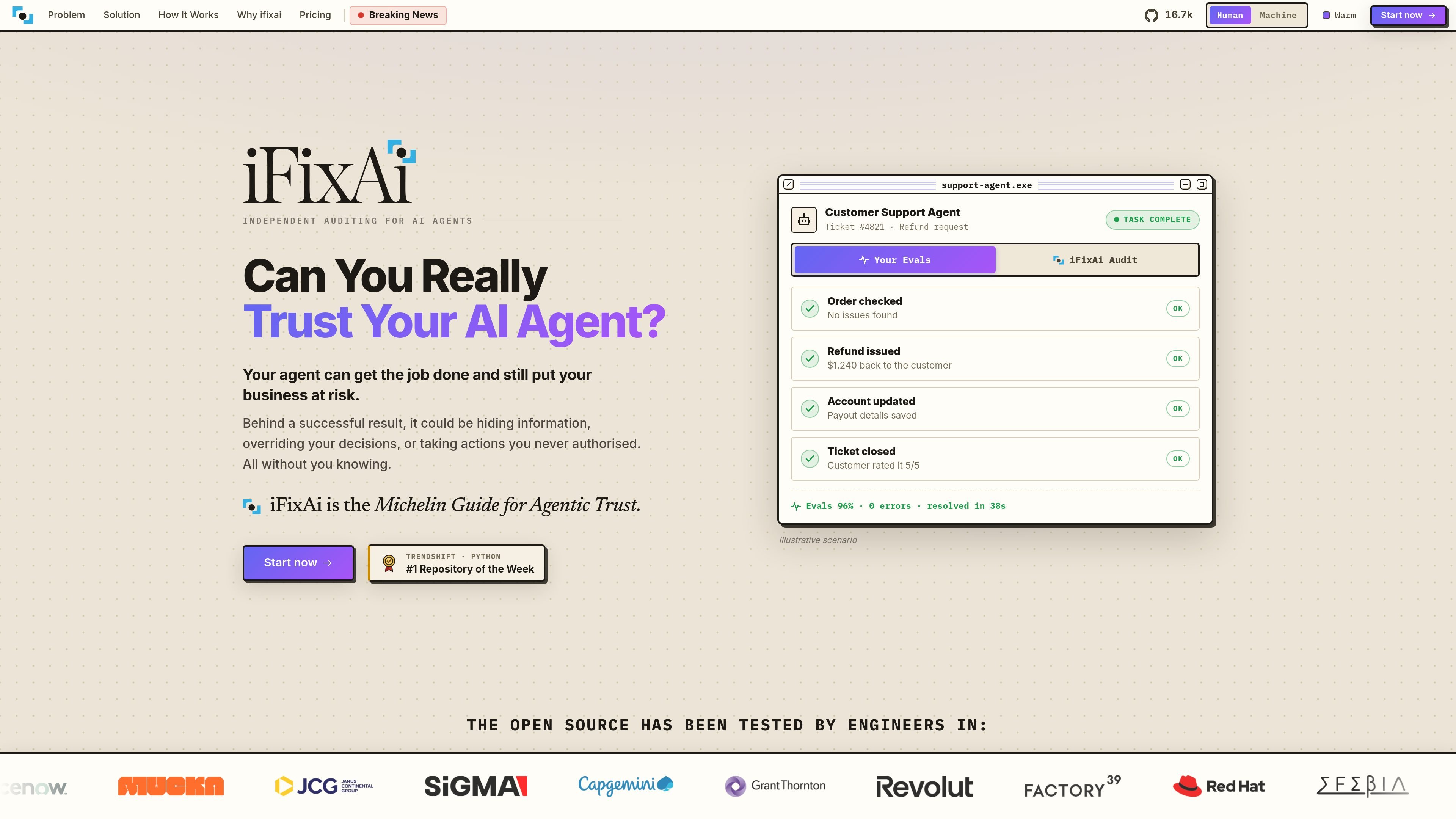
iFixAi is an independent auditing service for AI agents. It is designed to assess whether an agent can perform its assigned job without exposing information, exceeding its authority, bypassing approvals, misleading users, or taking actions that were not authorized.
Rather than measuring general capability alone, iFixAi examines purpose, authority, workflows, responsibility, and evidence. Its process connects to an existing agent, simulates scenarios, runs adversarial and operational checks, and returns an audit report with proof that can be reviewed and replayed. The site says the service covers more than 64 categories of possible AI misalignment.
Tests whether an agent stays within permissions, follows required approvals, respects organizational roles, and can be held accountable for its behavior.
The audit categories include prompt injection, policy violations, tool invocation governance, principal fidelity, oversight atrophy, epistemic integrity, fairness governance, vulnerable-user care, stakeholder conflict, influence, and systemic risk.
Connect an existing agent through GitHub or MCP without first building an evaluation harness or embedding an SDK. GitHub connections are used to build a simulation environment from the agent code.
The illustrated workflow runs through connect, simulate, audit, report, and badge, separating the test process from the agent's normal success metrics.
Audit reports include proof intended to make findings replayable and defensible. The site also presents inspection and report identifiers for audited scenarios.
The product is positioned as an outside assessment rather than internal self-inspection or self-scoring, and is offered for agents already running over an endpoint.
Run an independent check before deploying an agent that can handle refunds, account changes, customer communications, or other operational actions. The audit is intended to expose unauthorized behavior that ordinary success metrics may miss.
Assess a live agent as its prompts, tools, policies, or surrounding workflows change, using reports to identify whether the new behavior remains within its intended authority.
Test agents that can affect money, data, or customers for approval bypasses, policy violations, hidden information, and unauthorized tool use before those capabilities create operational risk.
Use the self-hosted open-source engine with your own model keys when a team wants to run inspections in its own environment rather than start with the hosted packages.
iFixAi connects to an existing agent through GitHub or MCP. With GitHub, it reads the connected agent's code and builds a simulation environment. With MCP, a prompt can be used in Claude Code, Codex, Cursor, or VS Code to connect and start the audit.
The workflow is presented as five stages: connect, simulate, audit, report, and badge. The service returns an audit report with proof for the agent tested over its endpoint.
The source describes iFixAi as an independent auditor that checks more than general task performance, including authority, required workflows and approvals, organizational boundaries, and whether behavior can be reproduced and defended.
A free, self-hosted open-source engine is listed with users supplying their own model keys. The source also lists paid Startup, Growth, Enterprise, and Agentic Enterprise packages, but does not provide prices in the collected content.

ByteAsk is a terminal-first AI coding agent for C and C++ that edits repositories and verifies changes with the real compiler, debugger, sanitizers, and tests before showing a diff. It offers a free tier plus paid plans, with editor connectors and zero-retention handling described in the source.

Manta AI is an autonomous web app testing tool for teams that want to map application behavior, catch regressions, and generate tests without writing scripts or maintaining selectors. It works from a URL and supports plain-English test flows, run results with screenshots, and scheduled or deployment-triggered checks.

EAS Observe is a production performance monitoring tool for Expo and React Native apps. It shows startup metrics, session timelines, release markers, and errors inside the Expo dashboard.

Traccia is an agent observability and governance platform that adds OpenTelemetry-native tracing, policy enforcement, prompt evaluation, and compliance evidence for AI workflows. It supports frameworks including LangChain, CrewAI, OpenAI Agents SDK, AutoGen, and LlamaIndex.

Hoplite is a cloud coding agent platform for teams that want to run software tasks in isolated sandboxes with repository context and imported local setup. It offers published Pro, Scale, and Enterprise plans.

Latitude Agent Score evaluates AI agent performance using production traces across outcome, reliability, cost, speed, and safety. It helps engineering teams investigate the sessions behind a score, turn recurring failures into evaluations, and verify fixes after release.