
OpenAI-compatible access
Use a single OpenAI-compatible base URL and API key to call supported models through standard chat-completions style requests.

JellyNet is an agentic API marketplace for buying and selling AI and API access. Buyers use an OpenAI-compatible interface and agent payment flows, while suppliers can earn from unused keys or spare resources.
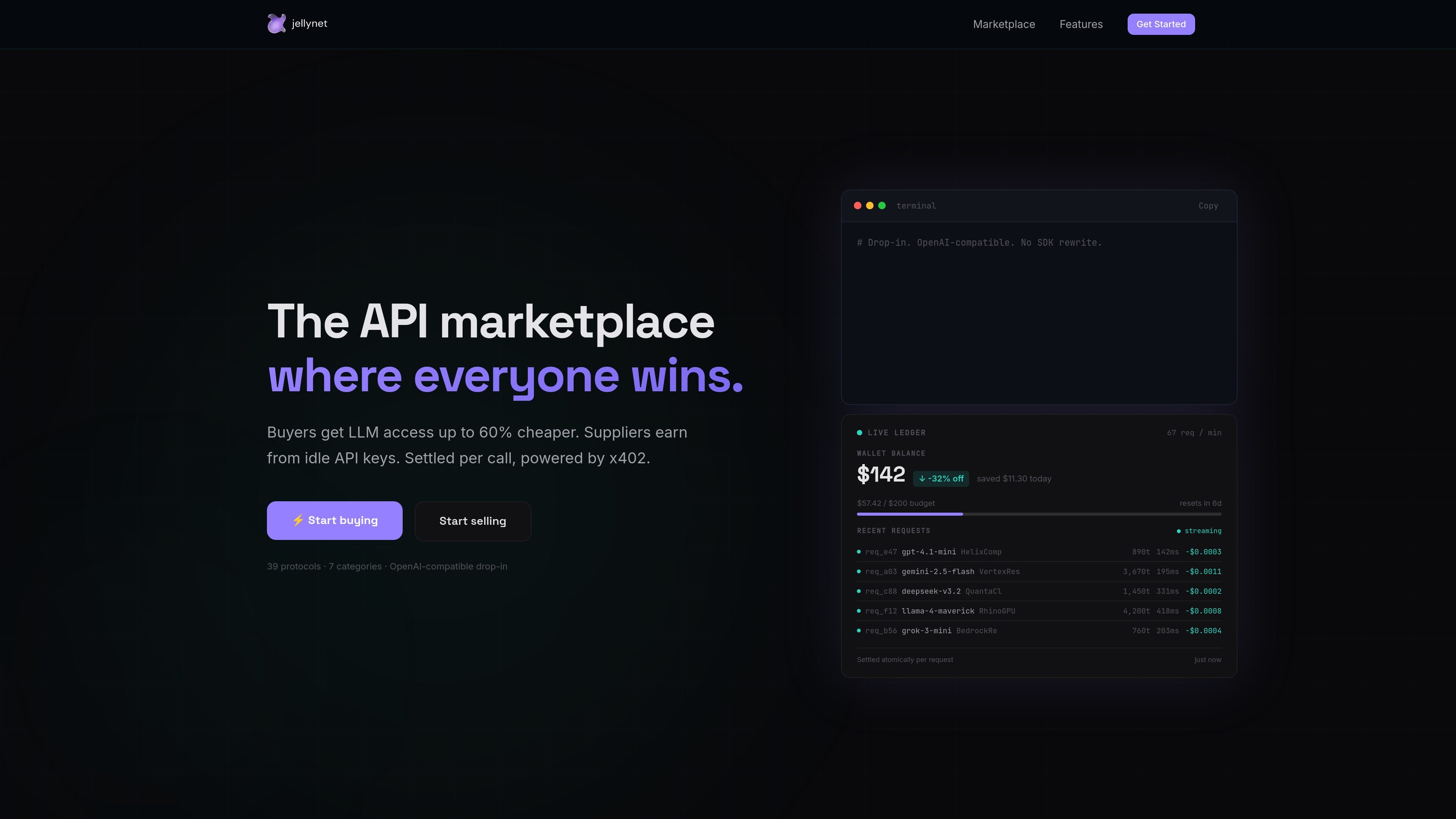
JellyNet is an agentic API marketplace for buying and selling access to AI and API resources. Its homepage positions the product as a way for buyers to access LLMs at lower per-token cost while suppliers earn from idle keys or other spare resources.
The public site emphasizes OpenAI-compatible requests, x402-based payment settlement, and a marketplace model that supports both human checkout via Stripe and agent checkout via USDC on Solana. The result is a single interface for request-by-request access to multiple providers and protocols, with usage shown in a ledger-style dashboard.
Use a single OpenAI-compatible base URL and API key to call supported models through standard chat-completions style requests.
Submit requests with x402 payment headers, receive a 402 response, pay in USDC on Solana, and retry with payment proof.
See request-level activity in a live ledger with balances, recent requests, and budget tracking shown in the dashboard preview.
Work across a broad model and protocol catalog that the site summarizes as 40 protocols across text, image, audio, and embedding.
Connect through common developer tools and SDKs, including the OpenAI SDK, Anthropic SDK, Vercel AI SDK, Cursor, Claude Code, and other OpenAI-compatible clients.
Let sellers list unused API keys, IP addresses, or spare compute and receive per-request earnings from marketplace usage.
An app or agent can call supported models through a standard OpenAI-compatible endpoint without changing its existing client stack.
A builder can send a request, receive a 402 payment-required response, pay with x402, and retry automatically in a single round trip.
A resource owner can list an unused API key or spare compute, set a price in the dashboard, and earn from per-request usage.
A team can monitor request spend, remaining balance, and recent usage from the dashboard-style ledger view while controlling a budget.
A developer can access multiple providers and protocols from one marketplace instead of wiring each vendor separately.
JellyNet provides an agentic API marketplace where buyers can access LLMs and other APIs through a single OpenAI-compatible interface and pay per request. The site says agents can use x402 payment flows, while buyers can also use Stripe.
The site describes sellers listing unused API keys, IP addresses, or spare compute in the marketplace. Buyers or agents then consume those resources per request, and suppliers earn from consumed usage.
The homepage shows an x402 flow where a client receives an HTTP 402 response, pays the exact USDC amount on Solana, and retries the request with payment proof. This suggests agent workflows are supported without a separate account setup in that flow.
The public page says JellyNet works with OpenAI SDK, Anthropic SDK, Vercel AI SDK, Cursor, Claude Code, and any OpenAI-compatible client.
The site includes a pricing section on the homepage and a separate pricing URL that currently returns 404, so the available public evidence only confirms per-request settlement and that buyers can start with $1 free credit.

AakarDev AI helps teams manage AI provider access, project-level setups, logs, and analytics from one dashboard. It supports BYOK workflows and lists providers including OpenAI, Google Gemini, Anthropic, Groq, Mistral AI, and Perplexity AI.

AgentMail is an email inbox API for AI agents that lets developers create, send, receive, and search messages through REST APIs and SDKs. It supports agent workflows such as threaded replies, verification, customer support, scheduling, and inbox-based approvals.

Arduino VENTUNO Q is an edge AI computer for AI and robotics applications. It combines AI inference and deterministic control on a single board and is designed to work with Arduino App Lab.

Devin is an AI coding agent and software engineer that helps developers and engineering teams plan and execute complex software tasks. It is available through desktop, cloud, JetBrains, and CLI surfaces, with plans for individuals, teams, and enterprises.

Open Computer Use is an open-source Computer Use service wrapped as MCP for macOS, Linux, and Windows. It helps AI agents and MCP clients run desktop automation workflows through client setup commands or manual MCP configuration.

Lasso is an ecommerce product data platform for enriching catalog records, processing supplier files, generating product content, and monitoring competitors. It combines a web app with a REST API, SDK, and MCP server for teams and developers.