
Synchronized source and preview
A code editor and rendered Markdown preview appear side by side. Editing either surface updates the other for all collaborators, with cursors included.

Markdoc is a collaborative Markdown editor with synchronized source and rendered preview, real-time co-editing, comments, suggestions and version history. It connects to GitHub gists and repositories for opening files and publishing commits, and requires a GitHub account.
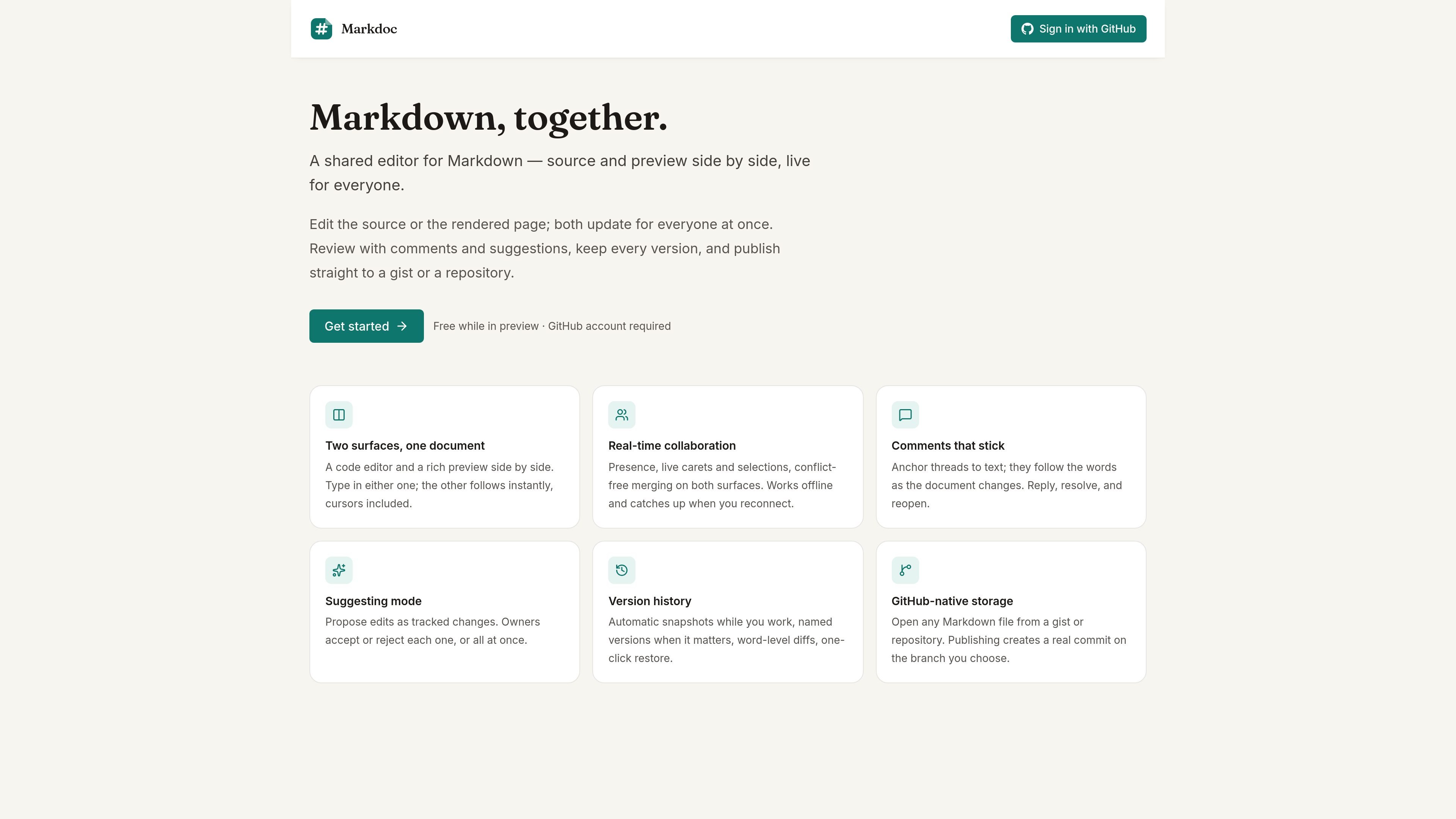
Markdoc is a collaborative Markdown editor for teams or individuals who need to write, review and maintain Markdown documents together. It combines a code-oriented source editor with a rendered preview, keeping both views synchronized as people edit.
The product supports live collaboration, anchored review threads, tracked suggestions and version history. Markdown files can be opened from GitHub gists or repositories, then published as commits to a chosen branch. The homepage describes offline editing with synchronization after reconnection.
A code editor and rendered Markdown preview appear side by side. Editing either surface updates the other for all collaborators, with cursors included.
Presence indicators, live carets and selections support simultaneous editing, while conflict-free merging handles concurrent changes.
Threads can be anchored to text and continue to follow the relevant words as the document changes. Participants can reply, resolve and reopen threads.
Suggesting mode records proposed edits as tracked changes. Document owners can accept or reject suggestions individually or all at once.
Automatic snapshots, named versions, word-level diffs and one-click restore provide a record of document changes.
Markdown files can be opened from GitHub gists or repositories, and publishing creates a commit on a selected branch.
Draft and refine README files, documentation pages or other Markdown files while viewing source syntax and the rendered result together.
Work on the same document with collaborators who need to see presence, cursors and selections while changes are merged in real time.
Review proposed wording or structural changes without directly replacing the current text; owners can accept or reject tracked suggestions.
Discuss specific passages with threads that remain attached to the relevant words, even as the document evolves.
Recover or compare earlier states using snapshots, named versions, word-level diffs and one-click restore before publishing an update.
Markdoc is a shared Markdown editor with a code editor and rendered preview side by side. Changes made in either surface update for everyone in real time.
The source page says Markdoc works with GitHub authentication. It does not provide further setup or account requirements.
Users can open a Markdown file from a GitHub gist or repository. Publishing creates a real commit on a branch the user chooses.
Markdoc supports comments, replies, resolution and reopening, as well as suggesting mode where document owners can accept or reject tracked edits.
The homepage states that Markdoc works offline and catches up when the connection is restored. Other browser, device and platform limitations are not specified.

Biji est une plateforme polyvalente conçue pour améliorer la productivité grâce à des outils et des fonctionnalités innovants.

hob is an independent workspace for coding agents that keeps agent sessions, terminals, history, and follow-up work organized around the tools and providers you already use. It is aimed at developers who want local control over routing, history, and workspace structure rather than a bundled model stack.

Dcyde is a decision log for product teams that captures what was decided, the reasoning behind it, and the source in one shared place. It supports pinning decisions from Slack, Figma, or inside Dcyde and keeps the record searchable over time.

runevr is a connected workspace for creative teams that combines boards, media review, chat, recordings, drive, calls, and AI agents in one room-based environment. It is designed to reduce tool switching and keep project context together.

Carbon Voice is an asynchronous voice messaging app for teams and individuals, with transcripts, AI catch-up, and cross-device access. It helps people and agents communicate without needing a live call.

BotBoard is a task-management layer for AI agents that helps teams assign work, track progress, and review output. It supports CLI, MCP, and HTTP connections for tools like OpenClaw, Codex, Claude Code, and Cursor.