
Script-native 3D generation
Nova3D generates 3D assets as executable construction procedures rather than a single merged mesh. The README says the pipeline writes Blender-native Python scripts and returns a structured GLB with named parts.

Open-source Flutter client for nova3d.xyz that generates part-aware 3D assets from text prompts or reference images. It returns structured GLB output with named parts and supports browser-based review and editing.
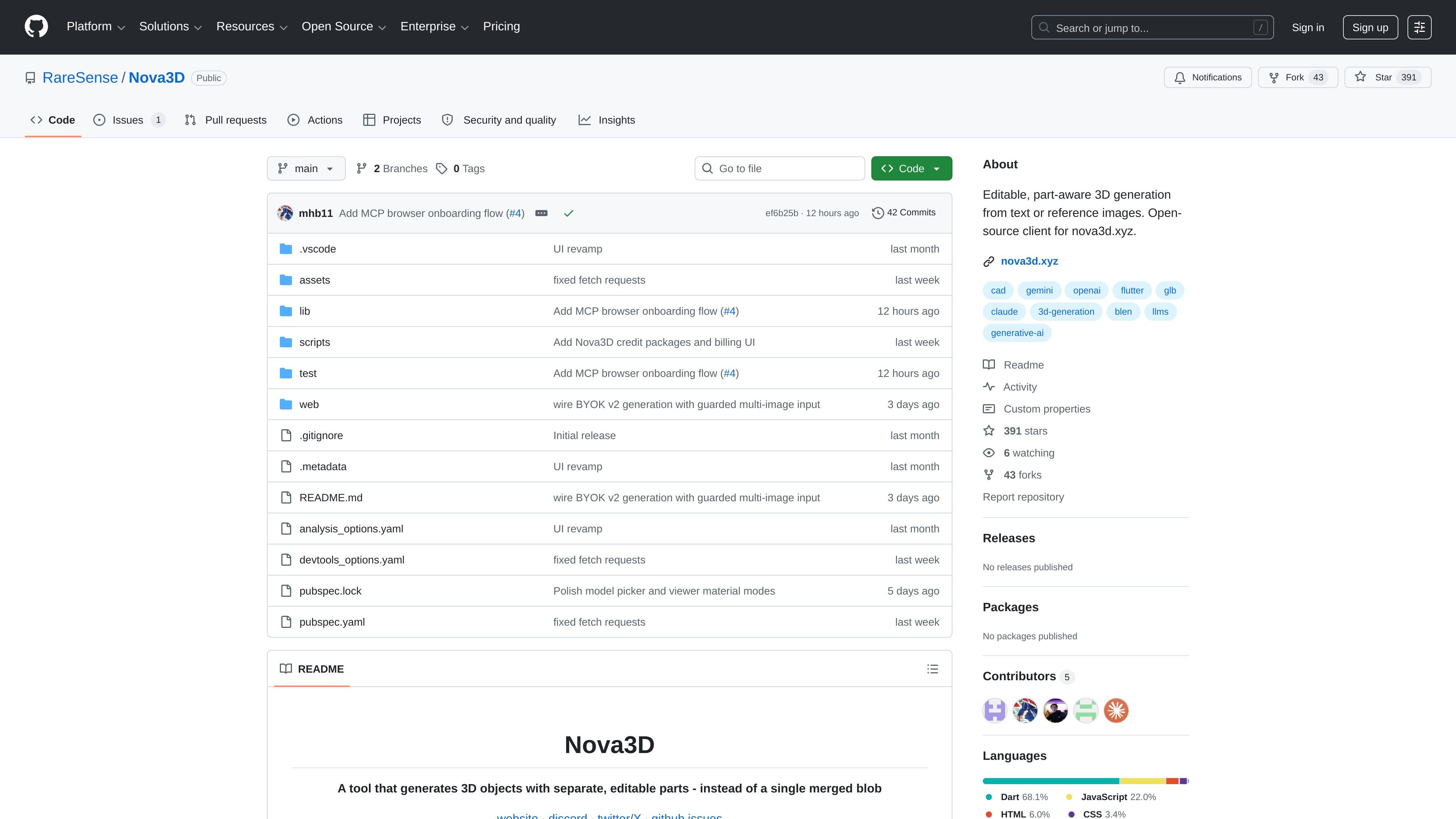
Nova3D is an open-source client for nova3d.xyz that focuses on editable, part-aware 3D generation from text prompts or reference images. It is built with Flutter/Dart and is designed to run as a web app, with the README showing a local development flow that opens the UI in a browser.
Instead of outputting a single merged mesh, Nova3D generates structured 3D assets as executable construction procedures. The README says the pipeline writes Blender-native Python scripts and returns structured GLB files with named, separately addressable parts, making the result more suitable for component-level inspection, regeneration, restyling, articulation, and export.
The project positions this workflow as an alternative to diffusion-based image-to-3D systems that lose part boundaries and to OpenSCAD-style CSG workflows that can be more limited for organic forms, hierarchy, materials, and structural editability. Nova3D’s client connects to a hosted service by default, while also allowing custom backend configurations for self-hosted setups.
Nova3D generates 3D assets as executable construction procedures rather than a single merged mesh. The README says the pipeline writes Blender-native Python scripts and returns a structured GLB with named parts.
Generated assets preserve separate components that can be addressed individually. This supports part-level inspection and editing instead of flattening everything into one object.
The client supports both text prompts and reference images. The README describes the workflow as prompt-to-code or image-to-code, with images used to guide spatial logic.
The web client includes a built-in Three.js editor with transform tools, snapping, and material editing. The README also notes local browser caching for model history.
Nova3D is tied to a backend service but can be pointed at a custom API endpoint. The README says the default build uses nova3d.xyz and supports `API_BASE_URL` for self-hosted backends.
The generation pipeline is model-agnostic at the client layer. The README says users can switch between Claude 3.5, GPT-4o, or Gemini 1.5 Pro in settings.
Generate a 3D concept from a short text prompt when you want named parts rather than a fused mesh. The README shows a prompt-driven workflow that returns structured geometry.
Use a reference image to guide the spatial layout of a model. The repository explicitly calls out reference-image support for steering the generated script.
Edit a specific component, such as a handle or panel, without rebuilding the entire object. Nova3D is designed for surgical part-level changes and hierarchy-aware structure.
Inspect, adjust, and export generated assets in the browser. The bundled Three.js viewport supports transform tools, snapping, and material editing for interactive review.
Run the client against your own service endpoint if you are not using the default hosted backend. The README documents `API_BASE_URL` for custom deployments.
Nova3D is an open-source Flutter/Dart client for nova3d.xyz. The README says it connects to a closed-source hosted service by default, and it can also be pointed at a custom backend with `API_BASE_URL` if you are building your own service.
The repository describes the client as built with Flutter/Dart. For local use, it runs as a web app with Flutter 3.24+ and the README shows `flutter run -d web-server --web-hostname 0.0.0.0 --web-port 5555`.
According to the README, you sign in with Google or email, add an API key in Settings, and choose a provider such as OpenRouter, OpenAI, Anthropic, or Gemini before generating.
The README says Nova3D produces structured GLB output with named, separately addressable parts and can attach reference images to guide the generated script.
The repository does not publish a standalone pricing page for Nova3D. The client is described as connecting to the nova3d.xyz hosted service, while the GitHub pricing page only confirms GitHub's own plans and does not define Nova3D pricing.

promptoMANIA est un générateur de prompts d'art AI qui aide les utilisateurs à créer des prompts détaillés pour divers modèles de diffusion de texte à image.

Le générateur de peinture AI est un logiciel en ligne qui génère automatiquement des œuvres d'art en fonction des descriptions textuelles fournies par les utilisateurs.

Prompty Town is a web product that turns a link into a building in a small internet city. It appears to let users buy a tile, add a prompt, and publish the result alongside other buildings.
Creativly is a web-based AI creative studio for generating visual concepts, mockups, and stylized images from short inputs. It is aimed at designers, creators, and entrepreneurs who want fast visual ideation without writing long prompts.

DeepMotion is a web-based AI motion capture and 3D animation platform with Animate 3D for video-to-animation and SayMotion for text-to-animation. It helps creators and teams generate motion in a browser and export results in common production formats.
Edgee is an AI gateway for coding agents and LLM-powered apps. It compresses token traffic, routes requests across models, and provides observability and team controls to help reduce cost and keep sessions running.