
Local-first workspace memory
Keeps agent context in the workspace by default, so state stays local instead of moving into a hosted memory service.

OpenDream is a local-first memory layer for AI agents that keeps context portable, scoped, source-linked, and reviewable across sessions. It is aimed at repo-based workflows where agents need durable context without losing traceability.
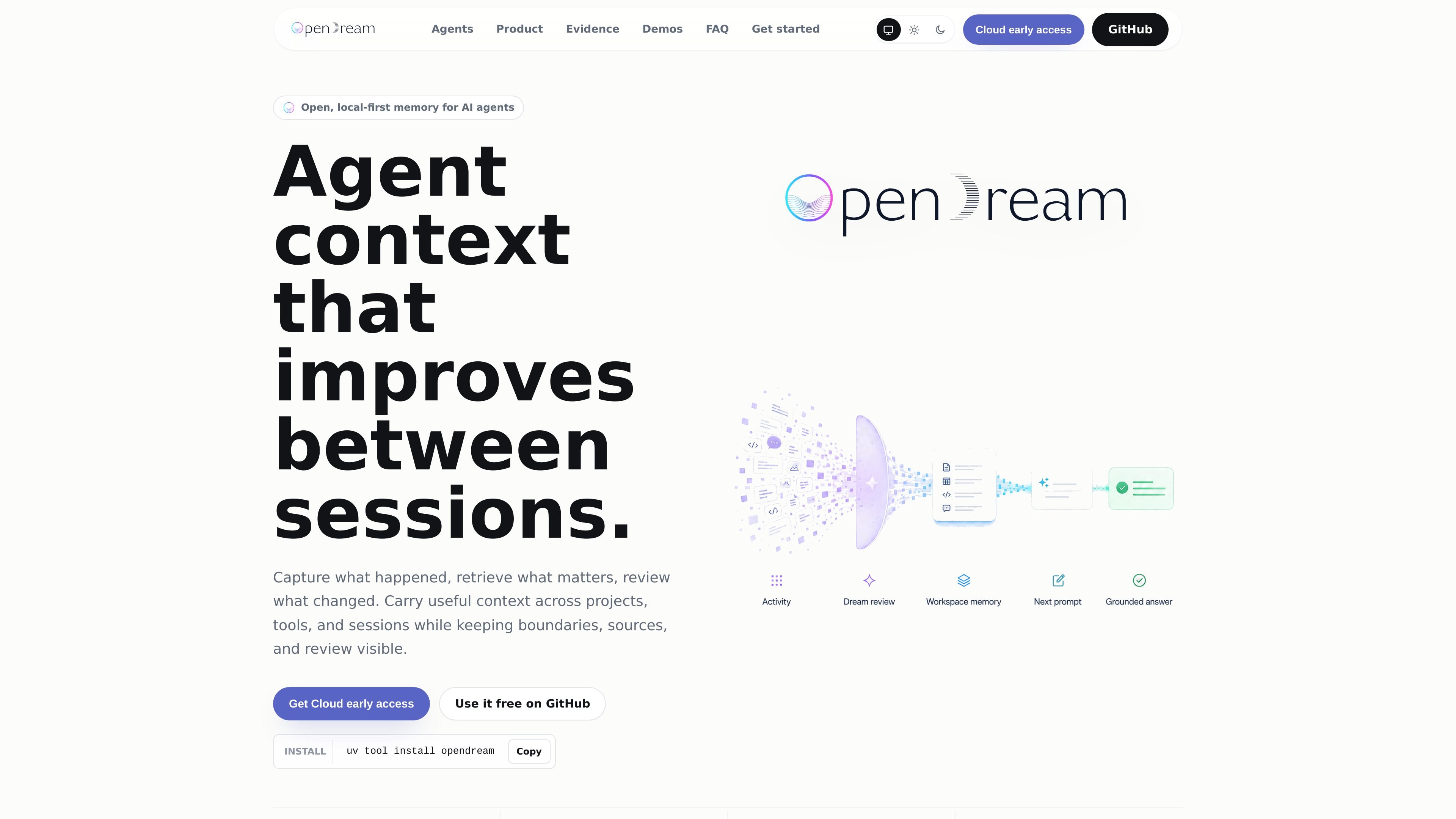
OpenDream is a local-first memory layer for AI agents that helps context improve between sessions. The product is positioned as “agent context that improves between sessions,” with a focus on keeping useful information portable, scoped, source-linked, and reviewable.
The page presents OpenDream as workspace memory for long-running agent work in repositories. It captures what happened, preserves the parts that matter, and lets later sessions recover reviewed context instead of relying on stateless retrieval or hidden prompts. This makes it suited to workflows where agents need continuity, attribution, and inspection before memory becomes trusted.
The product is shown alongside install and verification commands, and the site highlights support for Codex, Claude Code, Gemini CLI, and similar repo-based agent flows. The emphasis is not on broad general-purpose knowledge storage, but on durable context for code and research work that can be checked before it is promoted.
Keeps agent context in the workspace by default, so state stays local instead of moving into a hosted memory service.
Links memories to events, reports, and source notes, making it easier to trace where recalled context came from.
Lets uncertain updates be inspected before they are promoted into durable memory.
Surfaces runs, retrievals, prompt context, review decisions, and workspace health in a readable browser UI.
Supports a shared memory plane for multiple agents working in the same repository across sessions.
Includes install and verification commands for a local workflow, with a visible open-source package and docs path.
Use OpenDream when a coding agent needs to pick up a repo task after a pause and recover the prior state, constraints, and next step without rereading the entire history.
Use it in repositories where multiple agents contribute over time and you want a shared, attributable memory plane for prompts, runs, and review decisions.
Use it when you want the next prompt to include only reviewed, source-linked context rather than raw notes or stale observations.
Use it to inspect retrievals, selected memories, exclusions, and safety checks before trusting agent-generated context.
Use it for local repo instructions and workspace memory that stays on the machine instead of being pushed into a hosted memory product.
OpenDream is designed for local-first, workspace-scoped agent memory. The source describes it as memory that can be kept portable, source-linked, scoped, and reviewable across sessions.
The page shows a local install flow with `uv tool install opendream`, plus commands such as `opendream init --workspace .`, `opendream verify activation-capture --workspace . --targets configured`, and `opendream status --workspace .`.
OpenDream is presented as useful for cross-session repo memory, multi-agent repos, reviewable state, and supported agent workflows such as Codex, Claude Code, Gemini CLI, and Copilot-style repo instructions.
OpenDream emphasizes that memories stay linked to their source events and review decisions before promotion, so later sessions can inspect what was selected and why.

Goldfish is an AI memory app for macOS that helps you reply, write, summarize, and continue using the context already on your Mac. It stores memory locally and writes in your tone.
SignalLEMO is a B2B lead intelligence and outreach platform for field-service and specialized service teams. It helps users find prospects, draft outreach, and track pipeline activity in one place.

Lasso is an ecommerce product data platform for enriching catalog records, processing supplier files, generating product content, and monitoring competitors. It combines a web app with a REST API, SDK, and MCP server for teams and developers.

Biji est une plateforme polyvalente conçue pour améliorer la productivité grâce à des outils et des fonctionnalités innovants.

Struere is an AI-native platform for turning spreadsheet data into structured operational software with dashboards, alerts, and automations. It is aimed at teams that want to replace manual spreadsheet workflows without building custom tools from scratch.

garden-md is an open-source Node.js CLI that turns meeting transcripts into a local company wiki. It links entities across transcripts, keeps the original text intact, and renders the result as a browsable wiki.