
Playbook-based scoring
Scores calls against your chosen methodology rather than a generic coaching template. The homepage specifically mentions MEDDPICC, BANT, SPIN, or a pasted custom playbook.

Playcall is an open-source call intelligence tool that scores sales conversations against your playbook and the buyer context. It is aimed at sales teams and reps who want self-hostable, evidence-based coaching and rep-adherence scoring.
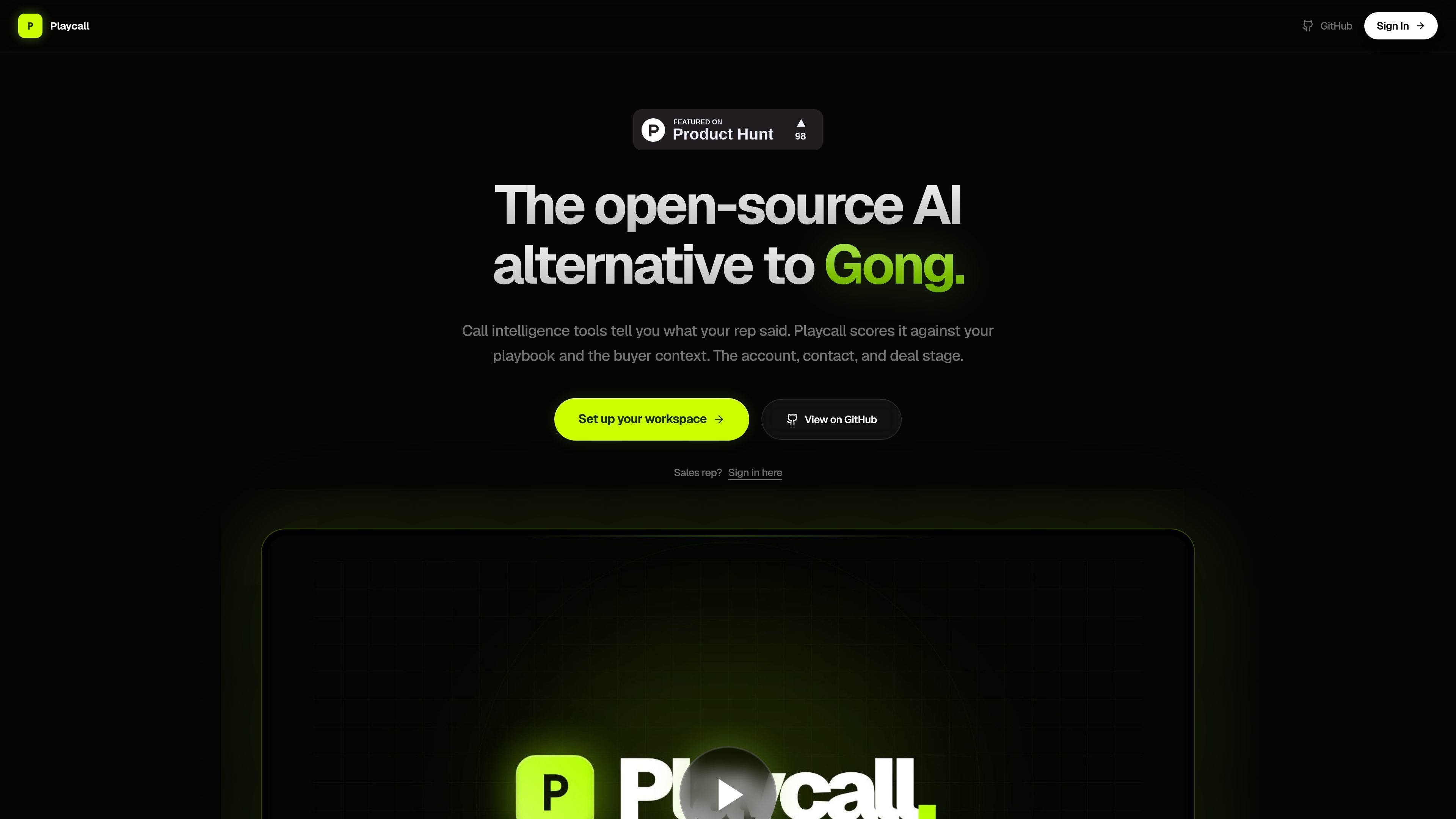
Playcall is an open-source call intelligence product that evaluates sales conversations against a team’s playbook and the buyer context. Rather than only summarizing what a rep said, it scores the call based on methodology, deal stage, contact role, and the evidence captured in the conversation.
The homepage positions Playcall as a self-hostable alternative to Gong for teams that want rep-level adherence scoring, call-specific loss reasons, and coaching recommendations tied to the next drill. The product also indicates that teams can sign in with one-time codes to create or join a workspace, while the homepage provides a deployment guide for running an instance on your own infrastructure.
Scores calls against your chosen methodology rather than a generic coaching template. The homepage specifically mentions MEDDPICC, BANT, SPIN, or a pasted custom playbook.
Uses company stage, contact role, and deal context to influence each scorecard, so feedback reflects the buyer situation rather than only the transcript.
Surfaces loss reasons and objection patterns from what was actually said in calls, helping teams see why deals stall and where recurring objections appear.
Returns coaching drills alongside the score, so feedback can turn into a next action for the rep instead of only a diagnostic report.
Supports self-hosting and open-source deployment, with a guide that references running the product on your own infrastructure and spinning up an instance on Vercel and Supabase.
Shows a Bring Your Own Key model and lists supported LLM providers on the homepage, including OpenAI, Anthropic, Gemini, Mistral, Groq, Cohere, Perplexity, and Together AI.
A sales leader can score calls against the team’s chosen framework, then review where reps are adhering to or missing the playbook.
A rep can get feedback that reflects the deal stage and buyer role, which is useful when the same call would be judged differently in different contexts.
A team can inspect recurring objection themes and loss reasons to understand why deals are stalling before they close.
An operator can paste an existing methodology into the product to generate a scoring rubric when the team does not already have a formal framework.
An infrastructure-minded team can run the product on its own stack instead of relying on a hosted vendor, which aligns with the self-hosted positioning on the homepage.
Playcall is set up from the workspace creation flow on the pricing/auth page, where users can sign in with a one-time code and either create a workspace or join an existing team. The homepage also links to a deployment guide for self-hosting.
The homepage says Playcall is a self-hostable, open-source call intelligence tool. It is designed to be deployed on your own infrastructure, with a guide that mentions Vercel and Supabase for a free spin-up path.
Playcall scores calls against a playbook and buyer context. The homepage says it can use frameworks like MEDDPICC, BANT, or SPIN, and also supports pasting in your own playbook to generate a rubric.
The source materials do not show a published pricing table. The pricing page describes a one-time-code sign-in flow for creating or joining a workspace, but it does not list plan names or prices.
The homepage frames Playcall for sales teams and reps who want rep-level adherence scoring, deal-stage-aware feedback, and coaching drills based on call evidence.

MeetStream is a meeting bot API for Zoom, Google Meet, Microsoft Teams, and Webex. It helps developers record, stream, and analyze meetings programmatically, with usage-based pricing and a $5 free credit to start.

QuickQuill is a macOS dictation and transcription app that runs locally on the device. It helps users record meetings, transcribe audio, generate summaries, and export notes without using a cloud service.

Tackly is a browser-based AI notetaker that maps spoken ideas, meeting discussion, and pasted transcripts into structured boards. It supports solo voice notes, live meeting capture, transcript import, board-scoped follow-up questions, and export to PNG, SVG, or Markdown.

Liam is an AI copilot for managing inboxes, writing replies, prioritizing email, and scheduling meetings. It is offered free for individuals, with custom pricing for teams and enterprise.

Tactiq is an AI note taker for Google Meet, Zoom, and Microsoft Teams that transcribes meetings live and turns them into summaries, action items, and follow-up outputs. It is built around a Chrome extension and supports team workflows through sharing and integrations.

garden-md is an open-source Node.js CLI that turns meeting transcripts into a local company wiki. It links entities across transcripts, keeps the original text intact, and renders the result as a browsable wiki.