
Dataset-based benchmarking
Upload real inputs and expected outputs, keep the dataset fixed across runs, and score every candidate on the same tasks.

Promptic is a GenAI optimization platform for developers and teams building LLM applications. It benchmarks prompts, models, and agent workflows on user-provided data, using quality, cost, and latency metrics to guide optimization and validation.
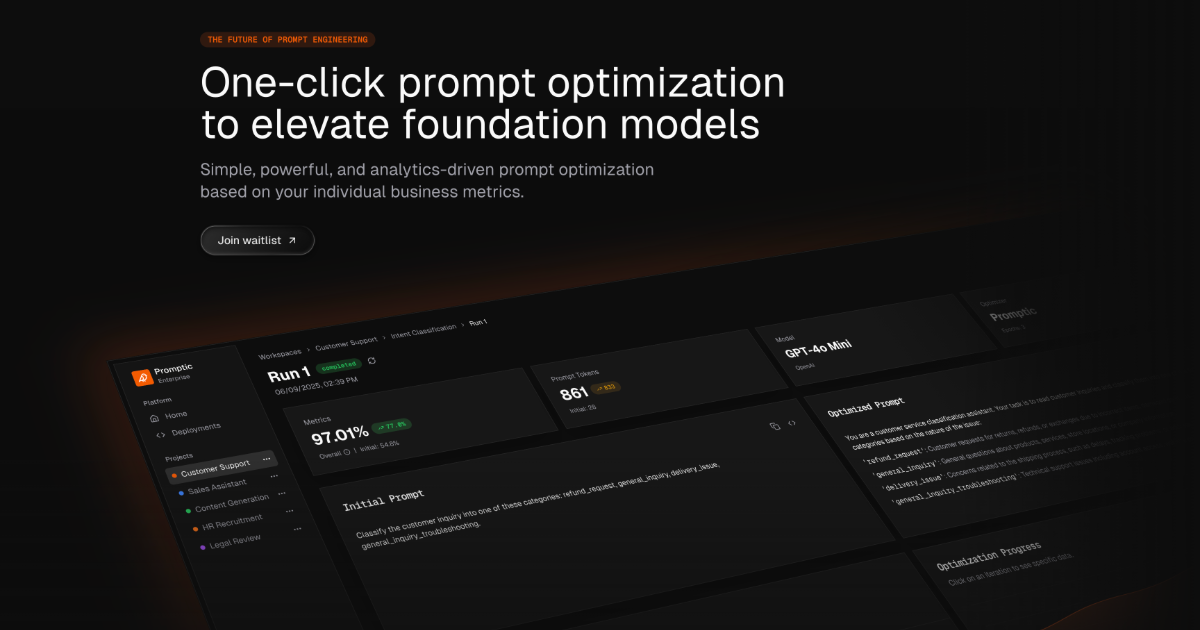
Promptic is a GenAI optimization platform for teams that need to evaluate and improve LLM prompts, models, and agent workflows. It uses a user's real inputs and expected outputs as a fixed evaluation dataset, then benchmarks candidates against selected KPIs such as quality, cost, and latency.
The platform combines OpenTelemetry-native tracing with automated optimization. Teams can review model and workflow behavior, identify where candidates succeed or fail, compare trade-offs, and ship a configuration that fits their stated priorities. Supported optimization areas described on the site include prompt tuning, model selection, agent architecture, information extraction, and tool use.
Upload real inputs and expected outputs, keep the dataset fixed across runs, and score every candidate on the same tasks.
Set quality, cost, and latency objectives, then compare candidate configurations using the metrics relevant to the application.
Automatically tune prompts, models, agent architectures, extraction workflows, and tool selection according to the supplied data and constraints.
Capture LLM calls, tool calls, and workflow steps through OpenTelemetry, including span-level token, cost, and latency information.
Inspect failing traces and compare alternatives before implementing a change, with results and evaluation evidence recorded for validation.
The pricing page lists API/SDK access on Team, Business, and Enterprise plans, enabling teams to include Promptic in development and production workflows.
Compare prompt variants or foundation models on a representative dataset, then select the option that meets a team's quality target without overlooking cost and latency.
Evaluate router-based, tool-first, or single-agent designs against the same cases and inspect failing traces before changing the implementation.
Tune extraction workflows for structured outputs such as invoice fields by testing candidate configurations against expected results.
Measure tool-selection behavior and investigate incorrect or repeated tool calls to improve how an agent chooses and uses tools.
Use trace data and recorded evaluation evidence as part of a development workflow, with API/SDK access available on applicable paid plans and enterprise deployment options for larger organizations.
Promptic starts with a fixed dataset of real inputs and expected outputs. Users select KPIs such as quality, cost, and latency, then benchmark candidates against the same data before reviewing findings and shipping a selected configuration.
Promptic can capture LLM calls, tool calls, and workflow steps through OpenTelemetry. Traces include information such as tokens, cost, latency, model, and provider for recorded spans.
The platform can optimize prompts, model choices, agent architectures, information-extraction workflows, and tool selection against a user's data and KPIs. The exact optimization scope depends on the use case.
The pricing page lists Free, Team, Business, and Enterprise plans. Team and Business add capabilities such as optimization, evaluations, tracing, and API/SDK access, while Enterprise supports custom terms and deployment options including Private Cloud or BYOC.
Yes. Promptic supports comparing candidate models and includes model access through either user-provided model keys or, on applicable paid plans, optional managed model usage billed separately.

AakarDev AI helps teams manage AI provider access, project-level setups, logs, and analytics from one dashboard. It supports BYOK workflows and lists providers including OpenAI, Google Gemini, Anthropic, Groq, Mistral AI, and Perplexity AI.

ByteAsk is a terminal-first AI coding agent for C and C++ that edits repositories and verifies changes with the real compiler, debugger, sanitizers, and tests before showing a diff. It offers a free tier plus paid plans, with editor connectors and zero-retention handling described in the source.

CreateOS Sandbox is an isolated compute environment for running code and agent workloads inside Firecracker micro-VMs. It is designed for workflows that need machine-level isolation, private networking between sandboxes, and programmatic control through SDK, CLI, or MCP.

GitBot is a local browser-based workspace for creating reusable coding bots powered by Claude Code, Codex, or OpenCode. It helps developers run those agents across repository folders with persistent threads and configurable permissions.

hob is an independent workspace for coding agents that keeps agent sessions, terminals, history, and follow-up work organized around the tools and providers you already use. It is aimed at developers who want local control over routing, history, and workspace structure rather than a bundled model stack.

Ably Chat is a chat API platform for building custom realtime chat applications. It supports room-based messaging, typing indicators, presence, reactions, and message updates, with usage-based pricing options for different deployment stages.