
Diff review
Examines committed or working-tree changes and can operate in read-only mode before any mutation is allowed.

SWARMFORGE is an agentic CI/CD gate that reviews code diffs, fixes confirmed findings in isolated sandboxes, re-reviews changes, and requires repository checks before publishing pull requests. It supports local CLI use and GitHub Actions with Codex/GPT, OpenRouter, local models, or Claude Code.
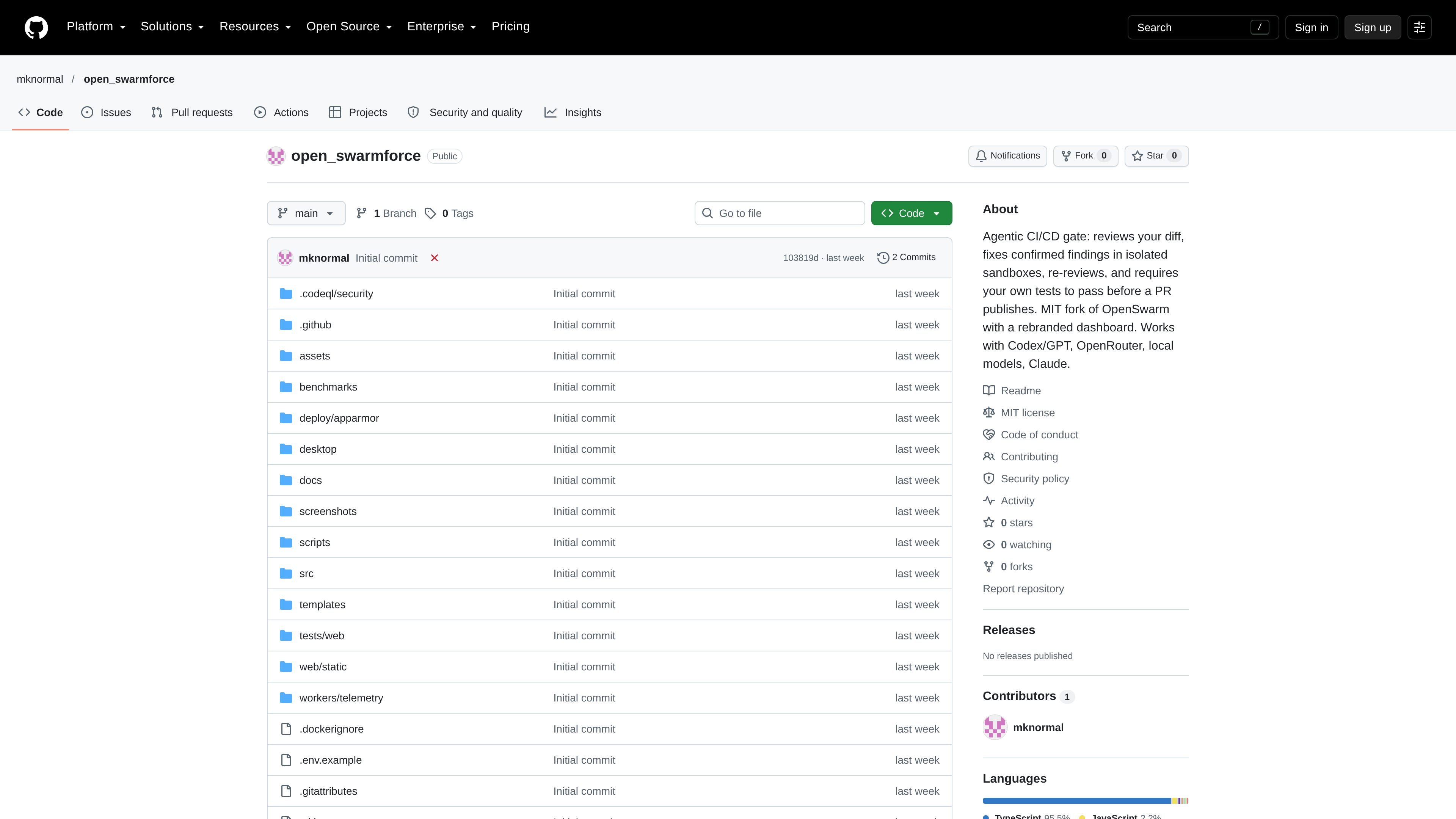
SWARMFORGE is an agentic CI/CD gate for reviewing code changes before they are merged or published as a pull request. It evaluates a committed or working-tree diff, can fix confirmed findings in isolated sandboxes, reviews the resulting changes again, and requires configured repository checks to pass before the PR publication step.
The project is a frontend-focused fork of OpenSwarm: the upstream CLI, daemon, agent pipeline, provider adapters, task state, and execution infrastructure remain in place, while this fork changes user-facing branding, dashboard presentation, metadata, and documentation. It can be used locally through the CLI or from the included GitHub Action; its Linear-backed autonomous daemon and notification integrations are optional rather than prerequisites for the merge gate.
Examines committed or working-tree changes and can operate in read-only mode before any mutation is allowed.
Groups confirmed findings and applies fixes inside isolated sandboxes, keeping implementation work separate from the main working tree.
Runs another review after changes are made, then applies repository checks as a deterministic gate before pull-request publication.
Supports Codex/GPT, OpenRouter, local models through Ollama or LM Studio, and Claude Code through an opt-in CLI integration.
Includes a GitHub Action for pull-request workflows, while the CLI supports local review and broader daemon or task execution modes.
Can store task outcomes as per-repository knowledge and recall them in later prompts; this capability is part of the optional orchestration layer.
Run a read-only review against current changes before committing to identify issues without allowing the tool to modify the workspace.
Use the fix flow on a pull request so confirmed findings are implemented in isolated sandboxes, reviewed again, and checked before publication.
Connect a preferred hosted or local model provider when teams need to use Codex/GPT, OpenRouter, Ollama, LM Studio, or an authenticated Claude Code CLI.
Use the optional daemon with Linear or the local issue store to coordinate tasks, leases, worktrees, and worker-reviewer-tester-documenter pipelines across repository work.
Run the included GitHub Action in CI while keeping the same review-gate behavior available from the local CLI.
SWARMFORGE reviews a committed or working-tree diff, optionally fixes confirmed findings in isolated sandboxes, re-reviews the result, and then requires repository checks to pass before publishing a pull request. It can also run locally before a commit.
The repository documents support for OpenAI Codex/GPT, OpenRouter models, local models through Ollama or LM Studio, and Claude Code through the claude -p CLI as an opt-in provider. Provider authentication can be configured with the setup wizard or manually.
For a quick local review, the README shows the openswarm review command. The documented flow includes read-only review with openswarm review --path . --read-only and a fix-and-verify flow with openswarm review --max --fix --path .. The repository also includes a GitHub Action for pull-request use.
The review gate is designed to run repository checks after the review and fix cycle; those checks are required before a pull request is published. The exact checks depend on the repository configuration and are not specified in the supplied evidence.
The core review gate can be used without the optional Linear-backed autonomous daemon, notifications, or long-term repository memory. The README describes a local SQLite issue store as an alternative task backend, while Linear is available as an optional orchestration layer.

ByteAsk is a terminal-first AI coding agent for C and C++ that edits repositories and verifies changes with the real compiler, debugger, sanitizers, and tests before showing a diff. It offers a free tier plus paid plans, with editor connectors and zero-retention handling described in the source.

GitBot is a local browser-based workspace for creating reusable coding bots powered by Claude Code, Codex, or OpenCode. It helps developers run those agents across repository folders with persistent threads and configurable permissions.

Exodus is a free developer tool that audits an application repository, compares its current deployment with a Google Cloud Run design, and creates an ordered migration plan for a coding agent. It also helps plan new products for Cloud Run with architecture and cost estimates.

Manta AI is an autonomous web app testing tool for teams that want to map application behavior, catch regressions, and generate tests without writing scripts or maintaining selectors. It works from a URL and supports plain-English test flows, run results with screenshots, and scheduled or deployment-triggered checks.

Ghost est un assistant IA en terminal pour discuter, générer du code et lancer des tâches en ligne de commande. Modèles gratuits, Linux, macOS, Windows, open source.

Vi3ecode is a maintained development environment for working with AI coding agents. It keeps project context, terminal, Git, memory, flows, review, and communication connected around the agent you already use.