
Markdown-defined roles
Daemons are defined with simple `.md` files that live in a repository. The file captures the role, watch conditions, routines, deny rules, schedule, policy, and output format so behavior is explicit and portable.

Charlie Labs provides always-on AI daemons defined in Markdown files that work proactively across tools like Slack, Linear, GitHub, and Sentry. It is aimed at teams that want recurring maintenance, triage, and reporting work handled continuously with explicit approval controls.
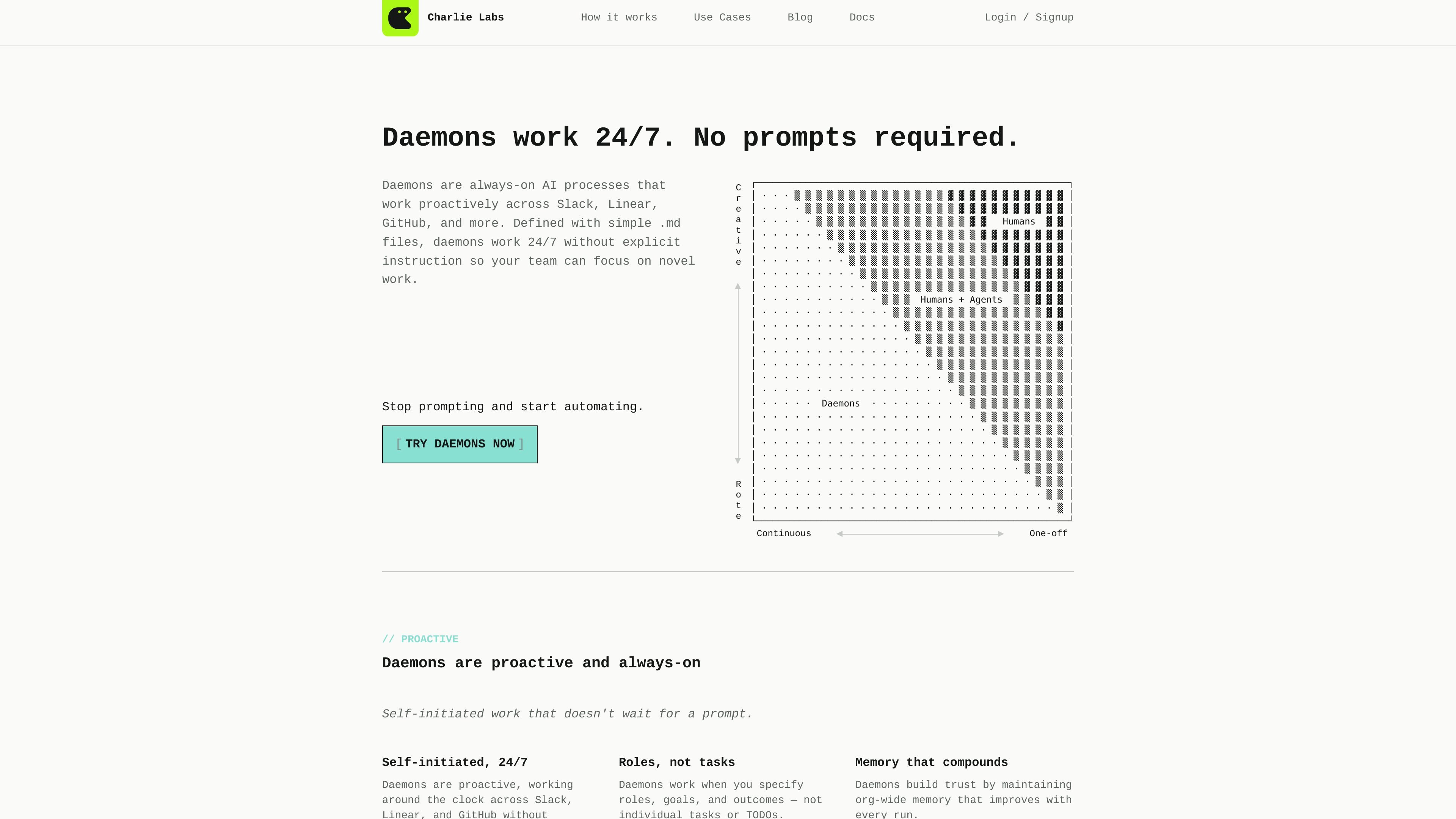
Charlie Labs provides daemons: always-on AI processes that run proactively without prompts and are defined in simple Markdown files. The product is positioned for teams that want recurring operational and engineering work handled continuously across systems like Slack, Linear, GitHub, and Sentry.
The core idea is to describe a role once — including what the daemon watches, what it should do, what it must not do, and when it should ask for approval — then let it run with a guarded execution loop. That loop covers intake, context gathering, planning, execution, verification, reporting, and continued monitoring so routine work can move forward without constant manual prompting.
Pricing is organized around workspace usage limits rather than monthly credits. The published plans include a free tier, a Starter plan, and a Team plan, with overage available when a workspace needs more throughput than its included limits allow.
Daemons are defined with simple `.md` files that live in a repository. The file captures the role, watch conditions, routines, deny rules, schedule, policy, and output format so behavior is explicit and portable.
Daemons can watch for signals from systems such as GitHub, Linear, Slack, and Sentry, then convert those signals into scoped work. The execution model is designed around intake, context building, plan setting, execution, verification, and reporting.
The workflow includes approval gates for high-impact or broader changes. Routine updates can run automatically inside policy boundaries, while riskier actions pause for a clear human decision.
Each run produces durable artifacts such as run records, working context, code updates, checks, linked task IDs, and completion reports. The goal is to leave a visible trail from signal to final state.
Daemons are built for recurring maintenance rather than one-off prompts. The home page describes them as proactive, always-on processes that keep PRs, issues, ownership, priorities, code, dependencies, docs, and runbooks from drifting.
The pricing page notes unlimited team members and no maximum number of daemons on the listed plans. That makes the model suitable for shared workspace usage rather than per-seat workflow gating.
Use a daemon to keep pull requests review-ready by watching for PR activity, suggesting missing context, and posting review-oriented updates without requiring a person to prompt it each time.
Use a daemon to watch issue trackers for recurring signals, apply labels, or keep statuses and ownership aligned so triage does not stall between human check-ins.
Use a daemon to keep dependencies, documentation, runbooks, or other recurring assets current as the codebase and workflow change over time.
Use a daemon to turn incoming signals into verified updates, comments, or follow-up tasks while preserving checkpoints and approval gates for riskier changes.
Use a daemon as a shared workspace helper that benefits the whole team after one setup, rather than a one-off assistant for a single person.
Charlie daemons are defined in Markdown files and are designed to run with explicit roles, watch conditions, routines, deny rules, and schedules. The source pages show that they can be a good fit when a team wants recurring maintenance, triage, or reporting work handled continuously rather than as one-off prompts.
The source pages show daemons operating across systems such as Slack, Linear, GitHub, and Sentry. The home page also describes them as working proactively across Slack, Linear, GitHub, and more.
The pricing page says plans are based on daily and weekly Charlie usage limits, not monthly credits. If a workspace hits its limits, it can buy overage credits or upgrade; otherwise usage pauses until the limits reset.
Yes. The pricing page says unlimited team members are included on the listed plans, and the home page describes a shared, team-wide benefit from adding a daemon once.
The how-it-works page shows that daemons can pause for approval on higher-impact, broader, or riskier changes. Routine metadata updates can run automatically, while edits with greater scope or risk require a human decision.

Redline is a budgeting tool for Claude Code that paces sessions to stay within time, token, cost, or plan-percentage limits. It uses Claude Code’s native hooks and statusline to help sessions finish with a usable result instead of stopping abruptly.

Macuse is a macOS app that lets AI assistants control native Mac apps through MCP and use Computer Use for any app. It works with clients like Claude Desktop, Cursor, and Raycast, and keeps automation on-device.

ByteAsk is a terminal-first AI coding agent for C and C++ that edits repositories and verifies changes with the real compiler, debugger, sanitizers, and tests before showing a diff. It offers a free tier plus paid plans, with editor connectors and zero-retention handling described in the source.

Goldfish is an AI memory app for macOS that helps you reply, write, summarize, and continue using the context already on your Mac. It stores memory locally and writes in your tone.

CreateOS Sandbox is an isolated compute environment for running code and agent workloads inside Firecracker micro-VMs. It is designed for workflows that need machine-level isolation, private networking between sandboxes, and programmatic control through SDK, CLI, or MCP.

Biji è una piattaforma versatile progettata per migliorare la produttività attraverso strumenti e funzionalità innovative.