
URL-to-structured-output scraping
HasData accepts a URL and returns clean structured data, including JSON or Markdown, so teams can feed results directly into applications or AI workflows.

HasData is a web scraping service that turns public website URLs into structured data for pipelines, applications, and AI workflows. It offers API-based scrapers, no-code scrapers, and output formats including JSON and Markdown.
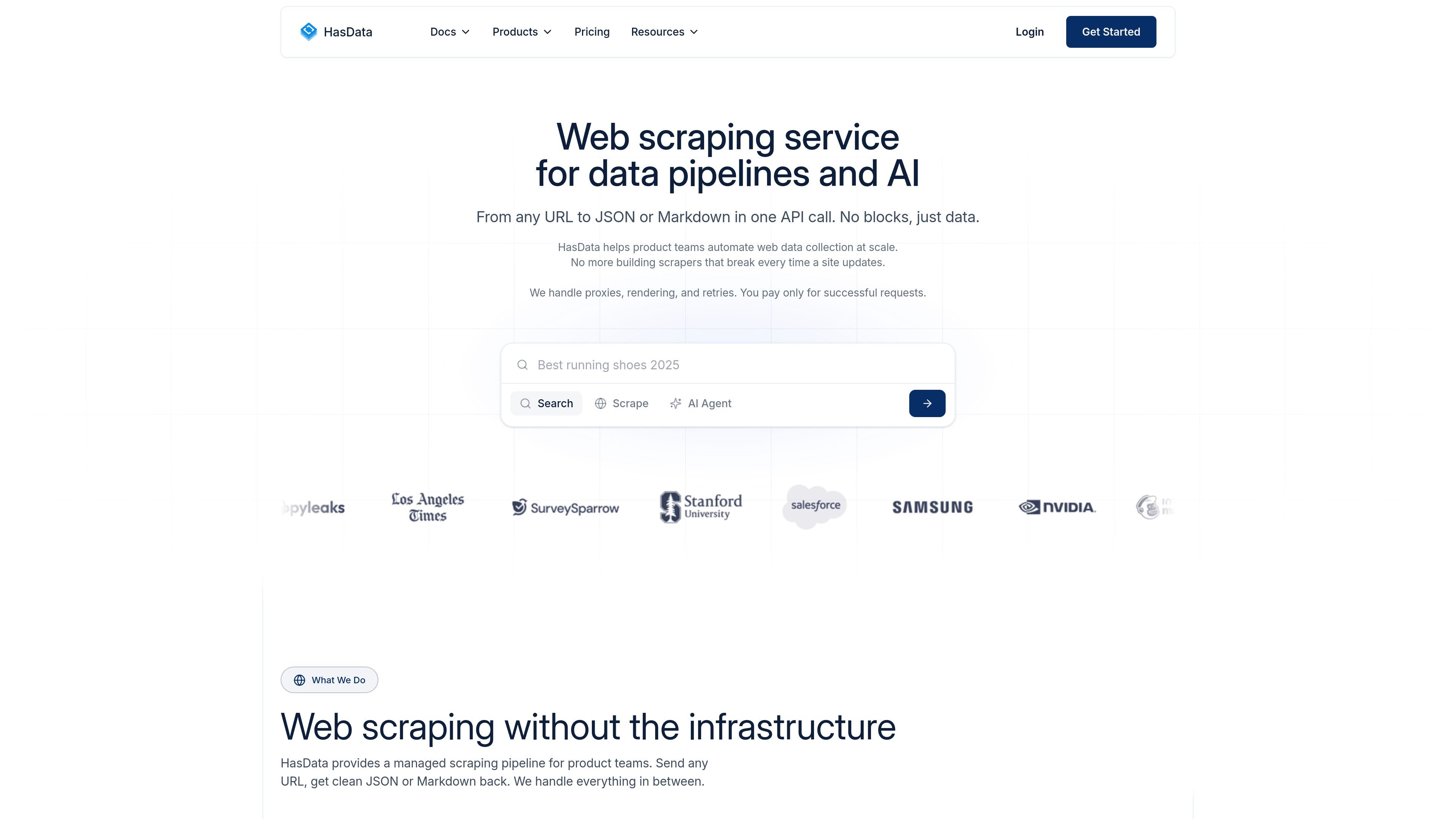
HasData is a web scraping service for collecting public data from websites and turning it into structured output for data pipelines and AI workflows. Its main API accepts a URL and can return JSON, Markdown, HTML, or plain text, while specialized scraper APIs target common sources such as search, maps, products, travel, and marketplaces.
The platform is designed to remove much of the infrastructure normally involved in scraping. The site says it handles browser rendering, proxy rotation, retries, CAPTCHA handling, and output formatting, so teams can focus on using the data rather than maintaining scrapers.
HasData accepts a URL and returns clean structured data, including JSON or Markdown, so teams can feed results directly into applications or AI workflows.
The service handles headless browser rendering for JavaScript-heavy sites, including modern front-end frameworks such as React, Angular, and Vue.
Requests use a managed proxy system with rotation, geo-targeting, and IP management, reducing the need to configure infrastructure manually.
The API includes AI-based parsing and structured extraction rules to adapt to sites with different layouts without custom CSS or XPath selectors.
The platform supports automatic retries and CAPTCHA handling so failed requests and common anti-bot barriers are handled in the service rather than in the client code.
Alongside APIs, HasData offers no-code scrapers for popular sources with scheduling and exports to CSV, XLSX, or JSON.
Build pipelines that pull public website data into applications or analytics systems without maintaining your own scraper infrastructure.
Use the web scraping API to extract content from pages that rely on client-side JavaScript or modern front-end frameworks.
Run specialized endpoints for search, maps, products, travel, or marketplace data when you need a structured source instead of a custom crawler.
Use no-code scrapers to configure recurring collection jobs for common websites and export the results as CSV, XLSX, or JSON.
Feed structured JSON or Markdown from public web pages into AI and LLM workflows where clean, model-ready input is important.
HasData turns a URL into structured JSON or Markdown through a single API call. The API can also return raw HTML or plain text, depending on the workflow you choose.
Yes. The pricing page lists both Scraper APIs and No-Code Scrapers under the same subscription model, and the FAQ snippet states that one subscription can be used across both.
The source pages say HasData provides Python and Node.js SDKs and supports webhooks, which makes it suitable for data pipelines and automated workflows.
The source pages show a free plan and a 30-day free trial for paid plans, with no credit card required for the trial. The site also offers 1,000 free API calls to start.
The pages describe both managed scraping via API and 30 no-code scrapers for popular websites. The no-code option is presented as a visual interface with scheduling and export options.

Happenstance is an AI-powered network search tool for finding people, mutual connections, and warm introductions across connected accounts. It supports individual use, shared team groups, and developer workflows through API, MCP, Slack, and other integrations.

Geekflare Web Scraping API is a developer-focused web scraping service that extracts content from dynamic pages and returns Markdown, HTML, JSON, or plain text. It is aimed at teams that need browser rendering, CAPTCHA handling, and proxy support without building that infrastructure themselves.

Claro Research Agent automates manual research in a table-based workflow for list enrichment, company research, document extraction, and pricing monitoring. It can run on its own or connect to the broader Claro platform for entity-aware, system-synced outputs.

Spidra is an AI web scraping API and playground for extracting structured data from websites that are hard to scrape with traditional tools. It helps developers and teams handle dynamic pages, CAPTCHAs, proxy rotation, and login-protected content with less manual setup.

Octen is a search infrastructure product for AI applications that need live web context, structured answers, and retrieval tools for agents, copilots, and chatbots. It combines search, extraction, multimodal retrieval, and developer access paths such as API, SDKs, Skills, MCP, and CLI.

Skayle is a content and AI search visibility platform that researches topics before writing, publishes structured content to a CMS, and tracks whether brands are cited in AI search. It is aimed at teams that want one system for publishing, schema-rich content, and visibility monitoring.