
Plain HTML form endpoint
Use a standard HTML form action with method POST. html.contact receives the submission, stores it, and sends email from your dashboard settings.

html.contact is a hosted backend for HTML forms that sends submissions to email without requiring you to run your own server. It supports attachments, recipient routing, spam screening, logs, exports, and API access for static sites, frameworks, no-code builders, and AI-built pages.
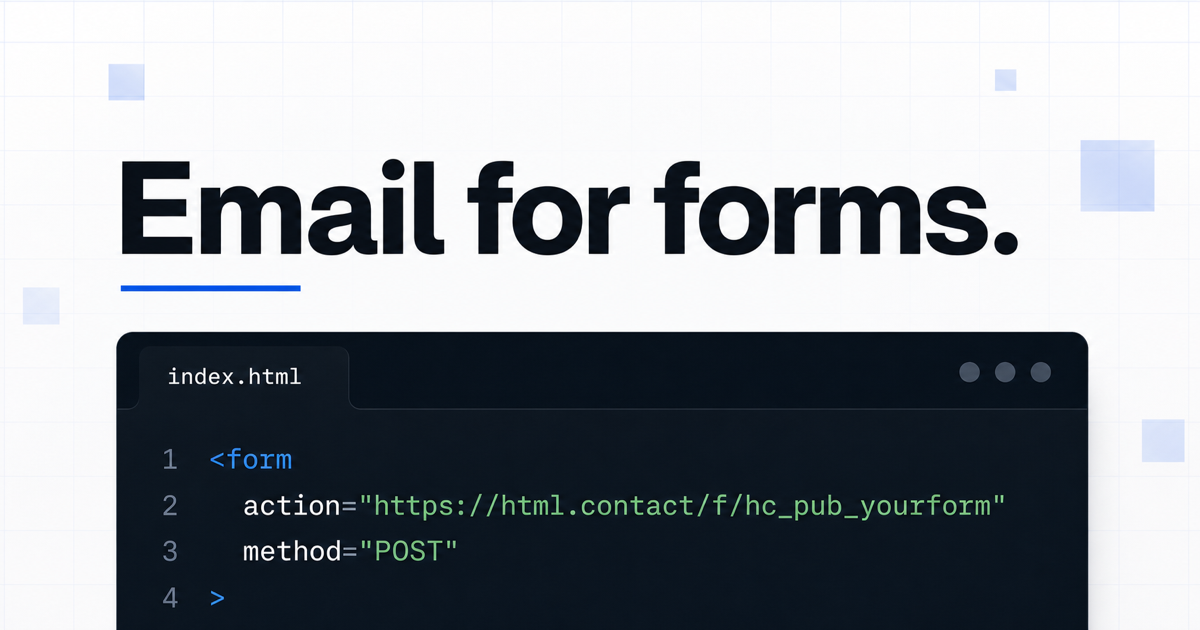
html.contact is a form-to-email backend for static sites, frameworks, no-code builders, and AI-built sites. It lets you point a plain HTML form at a hosted endpoint so submissions are received, checked, stored, and emailed without running your own server.
The product is positioned around shipping the real form setup early: attachments, To/CC/BCC routing, verified recipients, domain allowlists, spam screening, logs, exports, and API access are included from the start, while paid plans only increase accepted submission volume.
Use a standard HTML form action with method POST. html.contact receives the submission, stores it, and sends email from your dashboard settings.
Configure delivery to To, CC, and BCC recipients, with verified linked emails and reply-to handling mentioned on the site.
Accept one uploaded file per valid submission, with an attachment size limit of 4 MB.
Apply server-side spam screening, source checks, usage checks, and delivery-path checks before a submission counts against your plan.
Review submission logs and export data in CSV or JSON.
Use API submissions and API access for programmatic workflows, alongside public posts and private form/submission APIs mentioned on the homepage.
Embed a contact or lead form on a static site and route submissions directly to an inbox without building a backend service.
Connect forms in frontend frameworks such as Astro, Next.js, Nuxt, React, or Vue using a normal form action rather than a custom API route.
Use the hosted endpoint for client projects or launch pages where you want the real submission flow in place before volume becomes a billing issue.
Accept submissions from site builders and AI-generated pages that can set a POST endpoint directly, while keeping the browser code limited to the public form key.
No. The service receives a normal HTML form POST and handles the endpoint, source-domain checks, spam screening, email delivery, and logs without a backend route.
Yes. The pricing page says every plan includes one attachment per valid submission, up to 4 MB.
The page says a form submission can go to To, CC, and BCC recipients, and verified linked emails can be used for routing.
Yes. Submission logs, CSV and JSON exports, and API access are included on every plan.
Yes. The site says it works with plain HTML forms on static hosts, frameworks, no-code sites, and AI-built sites as long as you can set a POST form action.

ByteAsk is a terminal-first AI coding agent for C and C++ that edits repositories and verifies changes with the real compiler, debugger, sanitizers, and tests before showing a diff. It offers a free tier plus paid plans, with editor connectors and zero-retention handling described in the source.

CreateOS Sandbox is an isolated compute environment for running code and agent workloads inside Firecracker micro-VMs. It is designed for workflows that need machine-level isolation, private networking between sandboxes, and programmatic control through SDK, CLI, or MCP.

hob is an independent workspace for coding agents that keeps agent sessions, terminals, history, and follow-up work organized around the tools and providers you already use. It is aimed at developers who want local control over routing, history, and workspace structure rather than a bundled model stack.

Ably Chat is a chat API platform for building custom realtime chat applications. It supports room-based messaging, typing indicators, presence, reactions, and message updates, with usage-based pricing options for different deployment stages.

Make Real is a Next.js app that turns hand-drawn wireframes into working HTML prototypes using the tldraw SDK and AI models. It helps users sketch on a canvas, generate code, and review the result in an embedded preview.

Manta AI is an autonomous web app testing tool for teams that want to map application behavior, catch regressions, and generate tests without writing scripts or maintaining selectors. It works from a URL and supports plain-English test flows, run results with screenshots, and scheduled or deployment-triggered checks.