
Patient-mediated record retrieval
Retrieves patient records across EHRs and payers using the patient’s own right of access, then normalizes clinical and claims data into one record.

Hubble is a healthcare records retrieval platform that assembles patient records across EHRs, payers, and HIE networks. It supports patient-mediated access and beta provider-mediated access, with normalized output, permissioning, and audit trails built into the workflow.
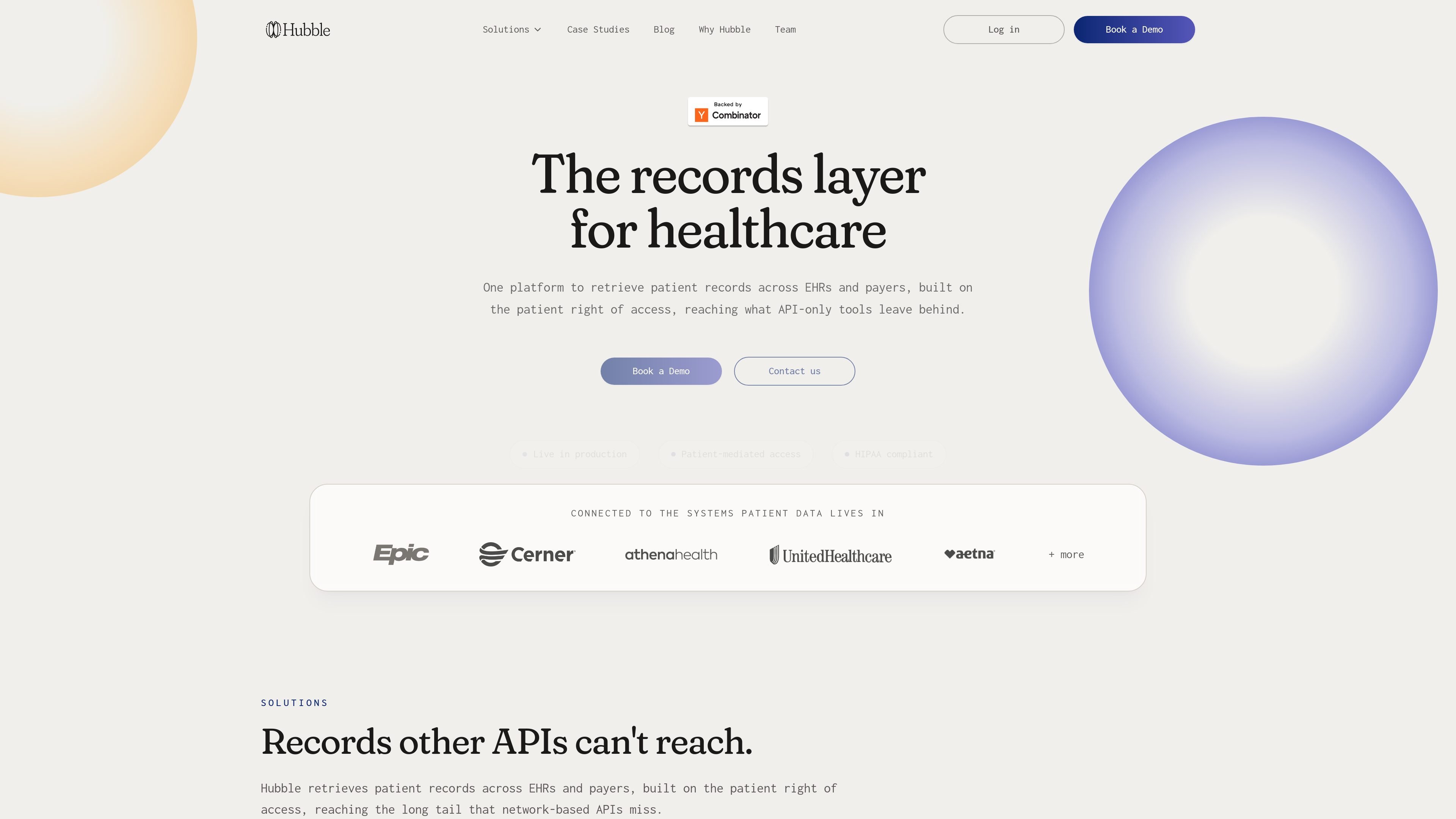
Hubble is a healthcare records retrieval platform that assembles patient records across EHRs, payers, and HIE networks. It is positioned as “the records layer for healthcare” and is built to reach sources that API-only tools often miss.
The platform supports two access models. Patient-mediated access uses the individual’s HIPAA right of access to retrieve and deliver records to the patient, while provider-mediated access, currently in beta, enables authorized read and write workflows for provider customers. In both cases, Hubble returns normalized records through a single platform and API, with auditability and permissioning built into the workflow.
Retrieves patient records across EHRs and payers using the patient’s own right of access, then normalizes clinical and claims data into one record.
Authorized read and write access for provider customers in beta, including workflows such as eligibility, benefits, prior authorization, scheduling, claims, and document upload.
Uses APIs where available and browser, voice, and fax agents where APIs do not cover the long tail, so sources can still be reached and assembled into a single record.
Returns structured output with deterministic IDs and a full audit trail, so retrieved data can be traced back to the originating system.
Runs with permissioning, logging, and HIPAA-compliant governance built into the retrieval flow from the start.
Connects to EHRs, payers, and HIE networks through one platform and one API, rather than separate integrations per system.
A patient-facing app or records workflow needs to gather clinical data, documents, claims, and coverage from multiple systems the individual has touched, then give the patient control over where the record is sent.
A provider product needs authorized read and write access into the EHRs and payer portals the provider organization already uses, for workflows such as eligibility checks, benefits, prior authorization, scheduling, claims, and document upload.
A clinical AI or healthcare SaaS team wants a single integration surface for fragmented healthcare data instead of building separate connections to each EHR, payer, or network source.
A legal, injury, disability, or workers’ compensation team needs patient records assembled through the patient’s own right of access and delivered in a normalized format for downstream review or sharing.
A product team needs access to harder-to-reach records that are not reliably available through API-only tools, including sources reached by browser, voice, or fax-assisted workflows.
Hubble supports patient-mediated access, where an individual verifies their identity, authorizes the request, receives their own record, and chooses where it goes next. It also supports provider-mediated access in beta, where a provider organization authorizes reads and writes into the systems it already uses.
The source pages say Hubble returns normalized records through one API, and for patient-mediated access it also mentions an MCP interface for agents. Provider-mediated access uses the same platform and API as patient-mediated access.
For patient-mediated access, the patient verifies identity to NIST IAL2 through a certified identity provider before any record is requested. The patient then authorizes the request using the HIPAA right of access.
Hubble says it retrieves records across EHRs, payers, and HIE networks, with direct electronic retrieval for platforms such as Epic and athenahealth, plus browser, voice, and fax agents for harder-to-reach sources.
The homepage says Hubble is live in production and HIPAA-compliant. The site also states that every action is permissioned, logged, and audit-ready.

Malyatko is a baby tracker for logging feeding, sleep, growth, teething, and milestones in one app. It works on iPhone, Apple Watch, and widgets, with no sign-up, offline use, and family sharing through iCloud.

MIRA vision develops synthetic-data-driven AI for pathology image analysis in medical diagnostics. Its website positions the product for teams that need privacy-compliant training data, automatic annotations, and controlled data generation.

Dyson Oral care centers on the CameraJet™ electric toothbrush with flosser, a camera-guided toothbrush that aims to precision-floss between teeth while you brush. The range also includes accessories, non-foaming toothpaste, and low-foaming mouth rinse.

Renight is a sleep-focused app that plays Monaural Beats before bed. It is aimed at people who want to improve the quality of limited sleep and wake up feeling more refreshed.

KeptWell is an AI medical document hub for families navigating serious illness. It helps people upload records, track changes, share a family view, and ask questions with citations back to the source material.

Soonr Health is a preconception health optimization app for couples preparing for pregnancy. It combines shared lifestyle tracking, cycle-based fertility guidance, and optional hormone measurements to help partners prepare together.