
AI answer monitoring
Track whether ChatGPT, Gemini, Google AI Overviews, Google AI Mode and Perplexity mention, recommend or cite a brand across the questions buyers ask.

Prefer is an AI visibility platform that shows how ChatGPT, Gemini, Google AI Overviews, Google AI Mode and Perplexity answer buyer questions about a brand. It helps marketers, agencies and multi-market teams analyze citations and competitors, prioritize improvements, and create content to address visibility gaps.
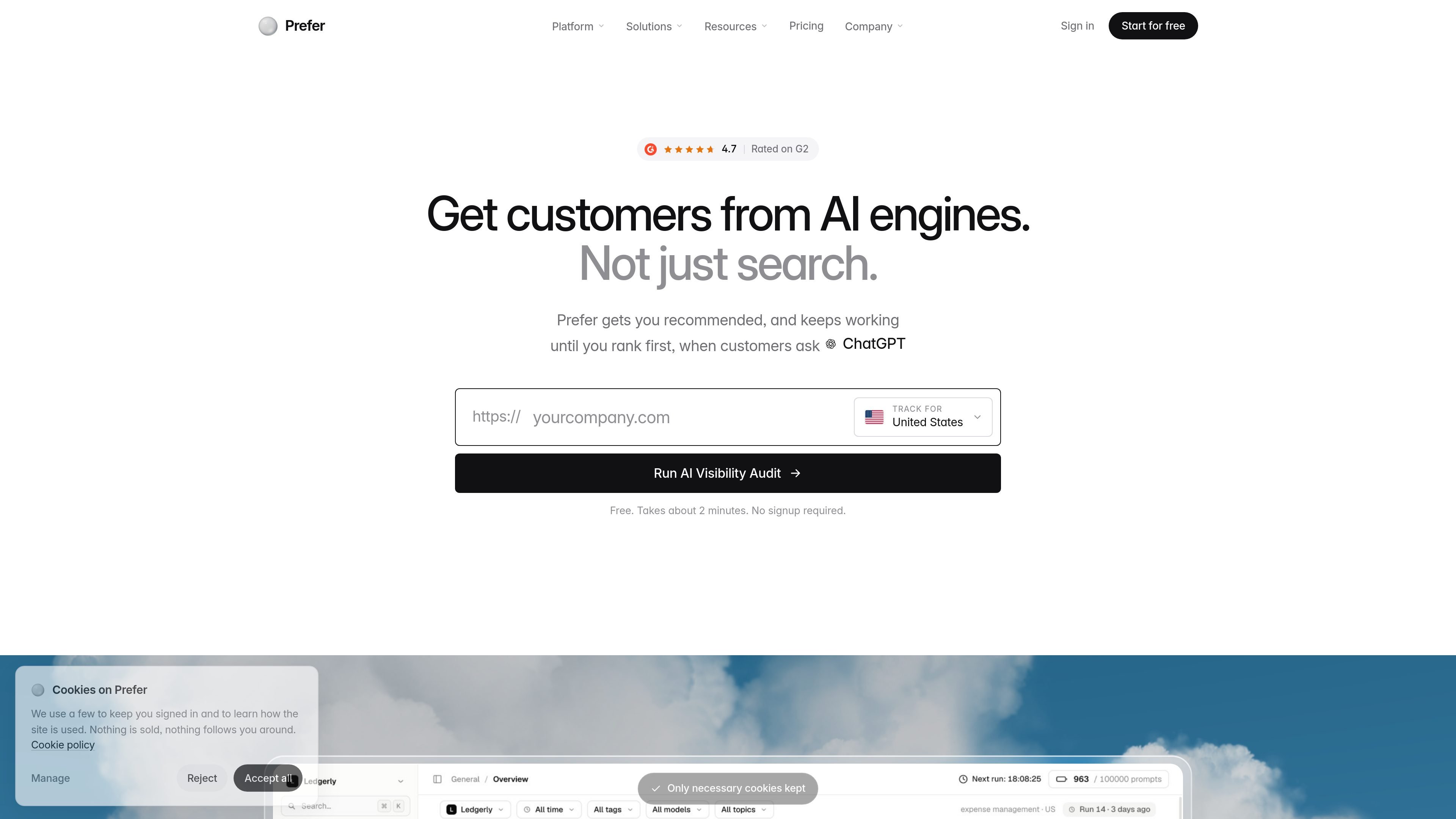
Prefer is an AI visibility platform for teams that want to understand how answer engines describe their brand and improve the likelihood of being recommended or cited. It monitors buyer questions across ChatGPT, Gemini, Google AI Overviews, Google AI Mode and Perplexity, recording mentions, citations, sentiment, share of voice and the sources behind each answer.
The platform combines measurement with execution. Teams can compare their visibility with named competitors, find gaps in the questions and sources that influence answers, and use prioritized actions, on-page recommendations and source-grounded content drafts to address those gaps. Prefer also includes analytics for AI-agent and crawler activity, plus API or MCP-based access options that vary by plan.
Track whether ChatGPT, Gemini, Google AI Overviews, Google AI Mode and Perplexity mention, recommend or cite a brand across the questions buyers ask.
Review the pages, domains, review sites and community sources that answer engines use, including where the brand is absent from the cited set.
Compare citation share, visibility, sentiment and positioning against named competitors on a question-by-question basis.
Turn visibility gaps into a ranked queue of on-page, content and technical tasks, with each action linked to the prompts it is intended to move.
Identify buyer questions and topics that the site is not being cited for, then create briefs and drafts grounded in the organization's own sources.
Monitor traffic and behavior from AI agents and crawlers that reach the website, helping teams connect answer-engine visibility with site activity.
A marketing team can establish which buyer questions produce mentions or citations, inspect the sources answer engines rely on, and assign prioritized on-page or content work to close the largest gaps.
An agency can report on client visibility against competitors and manage separate client workspaces. The agency offering described on the pricing page also includes white-label reporting and consolidated billing.
A brand operating in several markets can track the same buyer questions by country, compare regional visibility and identify where answer-engine coverage differs from its home market.
A content team can use missing topics and citation sources to create briefs or drafts for pages intended to answer specific buyer questions, then monitor later runs for changes.
A technical or growth team can examine visits and behavior from AI agents and crawlers, while querying visibility data through MCP or plan-dependent API connections.
Prefer measures ChatGPT, Gemini, Google AI Overviews, Google AI Mode and Perplexity. The pricing page says all five engines are included on every self-serve plan; Enterprise adds Qwen, DeepSeek API and Claude Sonnet 4 API.
A tracked prompt is one question in one country. The same question across three countries uses three prompt slots, while the five included engines are covered within that prompt slot.
Yes. Paid plans begin with a seven-day free trial and do not require a card. During the trial, tracking is capped at 30 prompts regardless of the plan being tested.
Prefer can track any of 197 selectable countries. The source notes that 20 major markets receive precise Google geolocation; in other markets, the market is stated in the question itself.
Prefer provides measures such as mentions, citations, sentiment, share of voice, source domains and competitor comparisons. Its Action Center connects recommended fixes to the prompts they are intended to improve, while content tools can produce drafts grounded in the product's source and citation data.

PromptScout tracks how ChatGPT, Gemini, Google AI Overviews, and Perplexity mention your brand or competitors, then pairs those results with source analysis and website audits. It helps teams decide what to fix in content, positioning, or site readiness next.

ClayHog è una piattaforma di visibilità nella ricerca AI per monitorare come i brand appaiono in ChatGPT, Gemini, Perplexity, Claude e Google AI Overviews. Un’unica dashboard per agenzie, marketing e SEO.

beehiiv is a newsletter platform for creators, publishers, and brands that want to build, grow, and monetize email newsletters and websites from one place. It offers a free Launch plan, plus paid tiers for more advanced growth, monetization, and support features.

Skayle is a content and AI search visibility platform that researches topics before writing, publishes structured content to a CMS, and tracks whether brands are cited in AI search. It is aimed at teams that want one system for publishing, schema-rich content, and visibility monitoring.

SaveMRR is a Stripe retention tool for SaaS teams that scans billing data for churn and MRR leaks, then automates recovery through dunning, cancel-save offers, win-back emails, and onboarding nudges. It is built for founders and bootstrapped teams using Stripe.

Hype is a web tool for finding trending YouTube topics by category, time range, and scoring mode. It helps creators spot emerging ideas, inspect source videos, and decide what to cover next.