
Static schema linting
Checks schemas against provider-specific constraint surfaces and reports violations with the exact JSON-Pointer path, violated keyword, and reason.

schemafit is a local-first CLI that lints JSON Schema, structured-output specs, and tool definitions against major LLM provider constraints. It helps teams fail CI before provider-specific schema issues reach production.
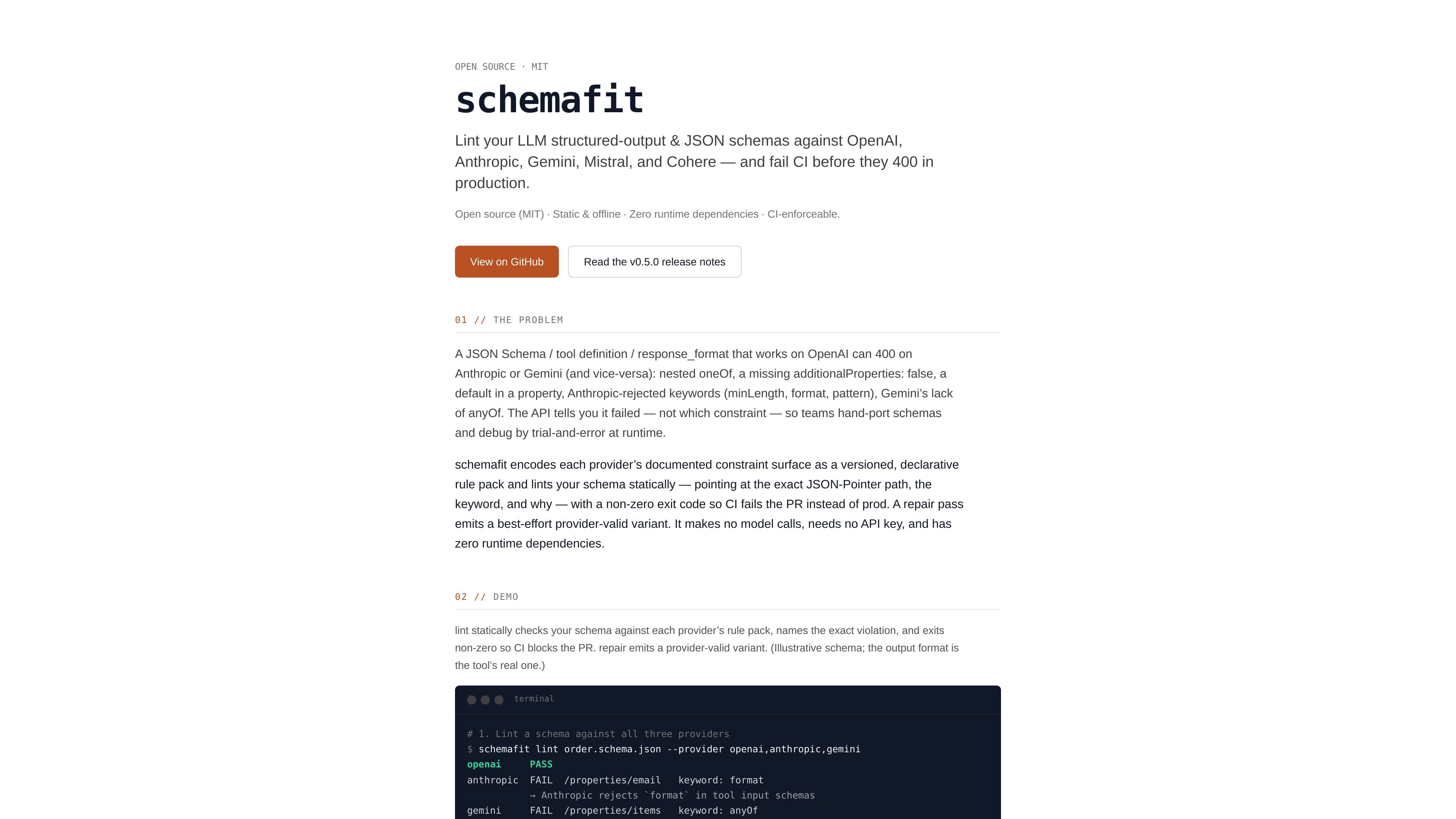
schemafit is a local-first CLI for checking structured-output, JSON Schema, and tool-definition payloads against the constraint surfaces of major LLM providers. The page positions it as a way to catch provider-specific schema failures before they reach production.
Instead of waiting for an API 400, schemafit flags the exact JSON-Pointer path, keyword, and reason for each violation, then exits non-zero so CI can fail the change. It also offers a best-effort repair pass, a provider listing command, and an optional live-verify mode for checking whether the static rule pack has drifted from current provider documentation.
Checks schemas against provider-specific constraint surfaces and reports violations with the exact JSON-Pointer path, violated keyword, and reason.
Encodes provider rules as declarative, versioned packs so the checks are reviewable and tied to documented constraints rather than ad hoc logic.
Fails with a non-zero exit code and can emit SARIF so violations can break CI and surface in GitHub code scanning.
Runs offline with no API key, no model calls, and zero runtime dependencies, which makes it easy to vendor and audit.
Includes a repair command that emits a best-effort provider-valid variant by stripping or rewriting offending keywords.
Provides a providers command and an optional live-verify mode to compare static packs with provider docs and detect drift.
Use schemafit in a build pipeline to catch schemas that would 400 on a target provider, so the pull request fails before the broken schema ships.
Run linting across a set of schemas when supporting several LLM vendors, so you can spot provider-specific keyword conflicts early.
Use the repair command to produce a provider-valid variant when a schema needs to be adapted for a particular API surface.
Generate SARIF output when you want schema violations to appear in GitHub code scanning or the Security tab.
Run the demo or lint commands from a fresh clone in a network-restricted environment, since the core workflow is offline and keyless.
It is a local-first CLI that lints schemas against the documented constraint surfaces of OpenAI, Anthropic, Gemini, Mistral, and Cohere. The source describes commands for linting, repairing, listing supported providers, and running a hermetic demo.
The source says it is static and offline, with no API key required and zero runtime dependencies. It can run from a fresh clone or after a single pip install.
Yes. The product description says lint exits with a non-zero code so CI can fail the build before a schema reaches production. It also mentions SARIF output for GitHub code scanning and the Security tab.
The page explicitly lists OpenAI, Anthropic, Gemini, Mistral, and Cohere as supported providers. It also says provider rule packs are versioned and grounded in documented constraints.
The page says a repair pass can emit a best-effort provider-valid variant of a schema by stripping or rewriting offending keywords while trying to preserve intent. It also notes an optional live-verify mode for drift detection in v0.5.

ByteAsk is a terminal-first AI coding agent for C and C++ that edits repositories and verifies changes with the real compiler, debugger, sanitizers, and tests before showing a diff. It offers a free tier plus paid plans, with editor connectors and zero-retention handling described in the source.

Manta AI is an autonomous web app testing tool for teams that want to map application behavior, catch regressions, and generate tests without writing scripts or maintaining selectors. It works from a URL and supports plain-English test flows, run results with screenshots, and scheduled or deployment-triggered checks.

CreateOS Sandbox is an isolated compute environment for running code and agent workloads inside Firecracker micro-VMs. It is designed for workflows that need machine-level isolation, private networking between sandboxes, and programmatic control through SDK, CLI, or MCP.

hob is an independent workspace for coding agents that keeps agent sessions, terminals, history, and follow-up work organized around the tools and providers you already use. It is aimed at developers who want local control over routing, history, and workspace structure rather than a bundled model stack.

Ably Chat is a chat API platform for building custom realtime chat applications. It supports room-based messaging, typing indicators, presence, reactions, and message updates, with usage-based pricing options for different deployment stages.

SonOf connects to your repo and PM tool, audits the codebase and surrounding product context, and turns approved work into shipped tickets with senior engineering review. It is aimed at founders and engineering leaders who need backlog help without hiring a full team immediately.