
Tri-agent sales workflow
Lead Qualifier, Pipeline Auditor, and Deal Closer agents coordinate prospect qualification, deal-risk review, and closing workflows. Users can choose human approval or Auto-Pilot execution for supported actions.

STRIV CRM is an autonomous B2B sales CRM for teams that need to qualify leads, monitor pipeline risk, and automate follow-up. It combines AI sales agents, inbound lead ingestion, multilingual Gmail drafts, and deal-based payment tools in a web workspace.
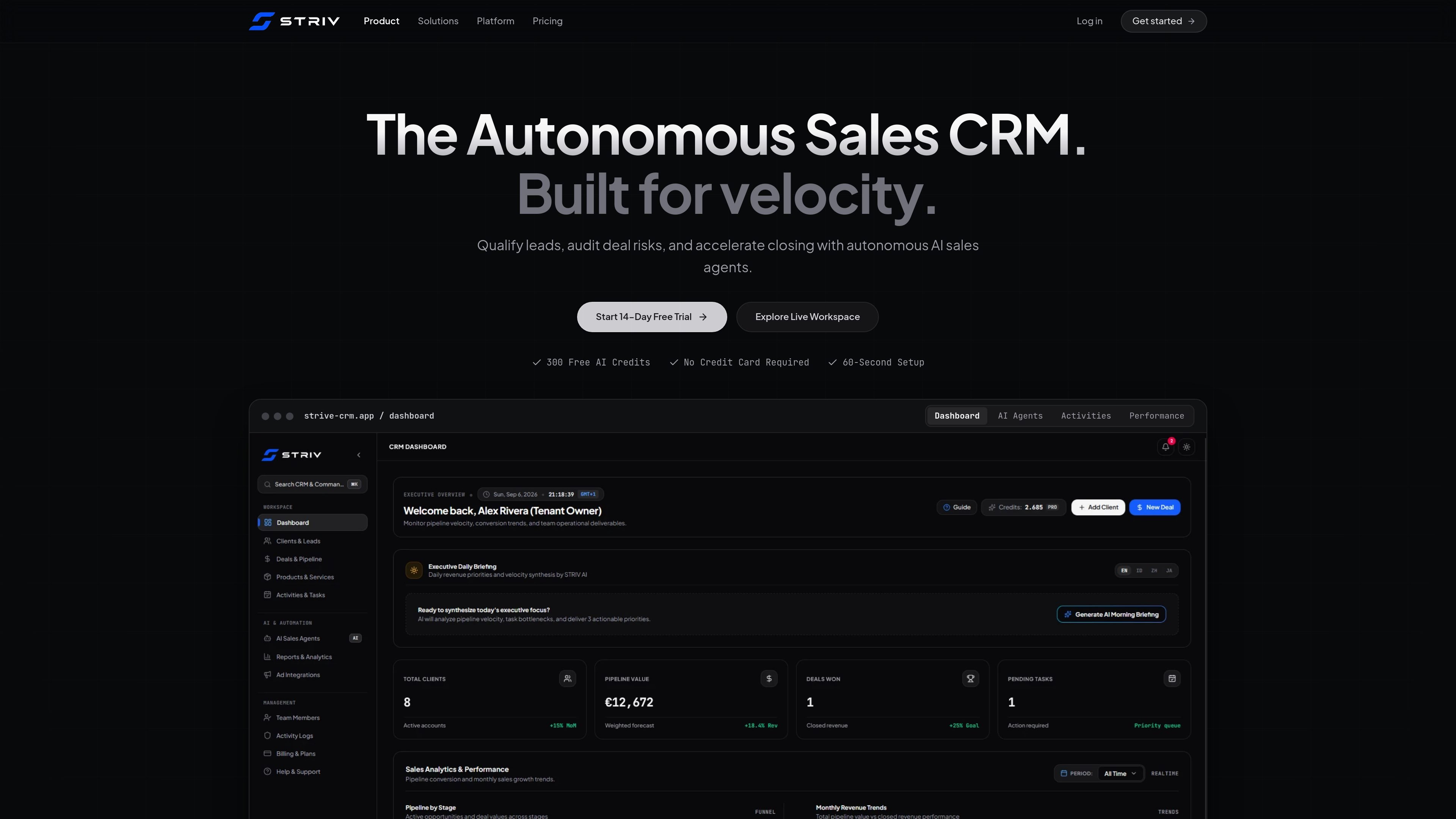
STRIV CRM is an autonomous B2B sales CRM for managing leads, deals, pipeline activity, and follow-up communication in one workspace. Its central workflow uses three specialized AI agents—a Lead Qualifier, Pipeline Auditor, and Deal Closer—to research prospects, review stalled or risky opportunities, and support closing actions.
The platform combines inbound lead capture, pipeline analytics, multilingual email drafting, and payment-link generation. It offers an Assisted mode with human approval and an Auto-Pilot mode for supported autonomous actions, while plans scale team seats, client and product capacity, and monthly AI credits.
Lead Qualifier, Pipeline Auditor, and Deal Closer agents coordinate prospect qualification, deal-risk review, and closing workflows. Users can choose human approval or Auto-Pilot execution for supported actions.
Meta Ads, Google Ads, and TikTok Ads webhooks can ingest inbound leads, while multimodal business-card scanning captures contact details without manual entry.
An inactivity radar identifies dormant deals, and executive daily briefings summarize pipeline health. Kanban analytics provide visibility into stage velocity, close probability, and team pacing.
The system creates context-aware follow-up drafts in English, Indonesian, Japanese, and Chinese, with language detection and one-click export to Gmail.
Deal cards can generate Lemon Squeezy payment links, while multi-currency margin controls help validate pricing and protect deal economics.
Workspace controls include role-based access, company-level tenant isolation, encrypted credential storage, GDPR export and hard-delete options, and per-member AI quota caps.
Capture inbound contacts from Meta, Google, and TikTok ad webhooks or scan business cards, then keep new prospects available for qualification in the CRM.
Use the Lead Qualifier to research and assess new accounts, then route the resulting information into a structured sales workflow instead of handling every initial review manually.
Monitor dormant opportunities with the inactivity radar and use pipeline health briefings and deal-stage analytics to decide which stalled deals need attention first.
Generate stage-aware, multilingual follow-ups after demos or other sales interactions and export the resulting draft directly to Gmail for review and sending.
Create a payment link from a deal card when an opportunity is ready to settle, with multi-currency margin controls available for supported deal workflows.
Every new workspace receives 300 free AI credits immediately at signup, with no credit card required. The service also provides a 14-day trial on its paid plans.
Assisted mode requires human approval before proposed tool actions mutate CRM data. Auto-Pilot mode allows the configured agents to execute supported actions autonomously, with deterministic tool bindings and permission checks.
The outreach engine generates email drafts in English, Indonesian, Japanese, and Chinese. It can detect language, adjust tone to the deal stage and buyer persona, and export a prefilled draft to Gmail.
STRIV states that workspaces use company-level tenant isolation, role-based access controls, encrypted credential storage, GDPR export and hard-delete features, and that customer data is not used to train public language models.
Plans include different team-seat, client, product-catalog, and monthly AI-credit allocations. The listed tiers are Starter, Pro, and Ultimate; the pricing page provides the current limits and support terms for each.

Podium is an AI lead generation and lead management platform for local businesses. It centralizes lead conversations, automated follow-up, reviews, payments, and booking, with a 24/7 AI Employee available as an add-on.

Ninjō AI is an AI sales agent platform for creators and agencies that qualifies leads, handles sales conversations, and supports multi-channel follow-up. It can also be controlled from Claude or ChatGPT through MCP for users who want to manage agents by chat.

Sumora is an autonomous outreach agent for finding, qualifying, warming, and booking leads through LinkedIn and Instagram. It helps users manage replies from one inbox while keeping final sends under review.

Salestrics is an AI-native CRM and revenue platform for startups. It combines pipeline management, workspace files, analytics, automations, finance, and team communication in one connected workspace.

Oppora AI is an outbound sales platform that automates lead finding, enrichment, outreach, inbox replies, and CRM sync. It is built for teams and operators who want to run repetitive sales workflows from one system instead of piecing together separate tools.

Wysera is an AI business platform that combines PostWyse for content and OpsWyse for CRM and revenue workflows, powered by the shared Wyse AI. It is built for solo operators, teams, and agencies that want approval-first automation across publishing, lead follow-up, and related operations.