
Complete file operations
Copy, move, delete, rename, fuzzy search, bulk operations, and image preview are called out on the site as core file-management capabilities.
superfile is a terminal file manager for developers and terminal-first users who want to handle common file operations from the command line. It combines a polished interface with panes, theming, hotkey customization, and plugin support.
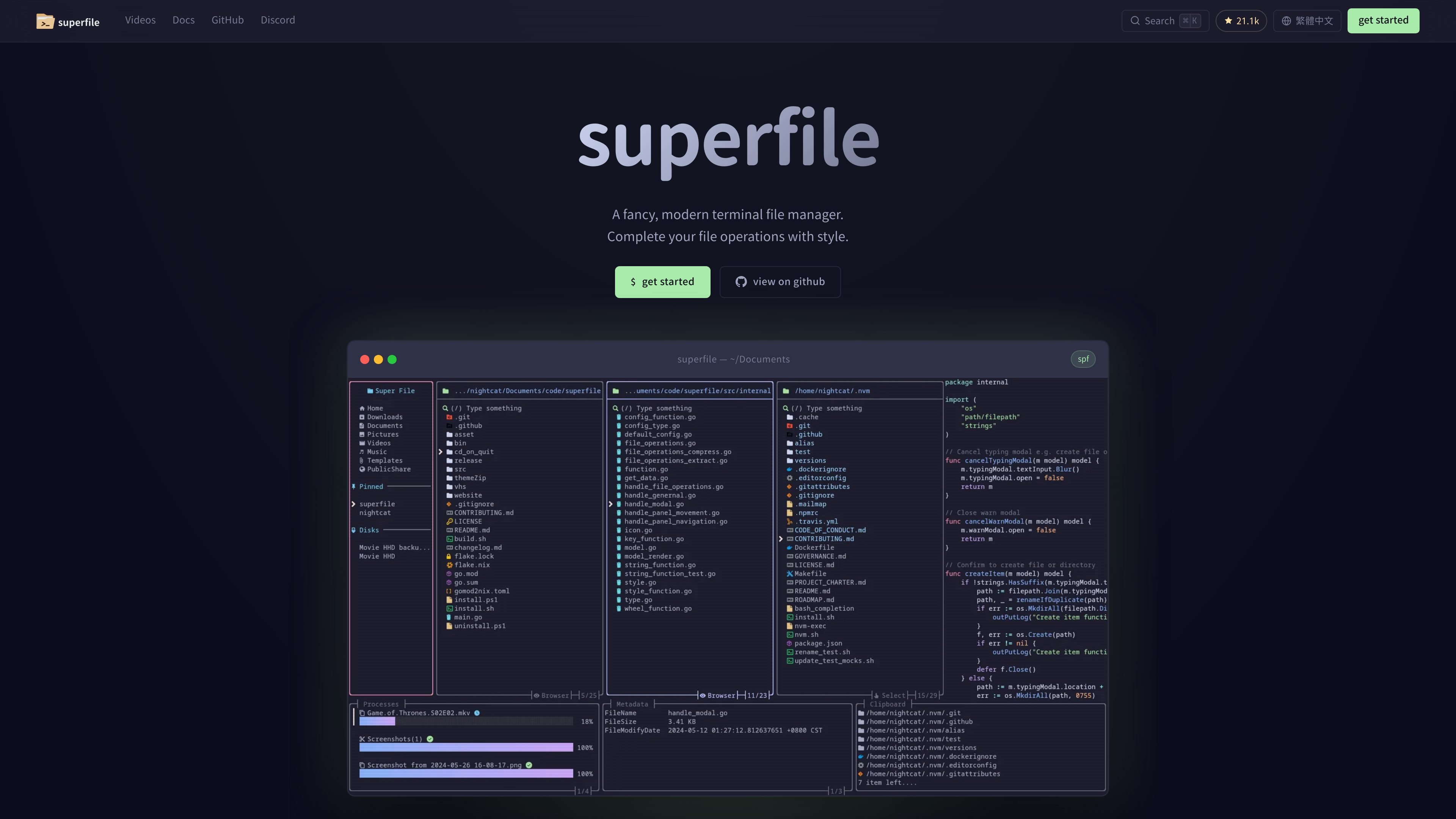
superfile is a terminal file manager for developers and other users who prefer working from the command line. It focuses on common file tasks such as copying, moving, deleting, renaming, searching, and handling items in bulk, while keeping those operations inside a terminal interface.
The product is built with Go and Bubble Tea and is positioned around a refined UI rather than maximum feature breadth. The site describes it as a good fit for straightforward file or directory work, especially for users who want a cleaner terminal workflow with panes, themes, hotkey customization, and plugin support.
Copy, move, delete, rename, fuzzy search, bulk operations, and image preview are called out on the site as core file-management capabilities.
The interface is described as carefully designed for readability and visual polish while still living entirely in the terminal.
Users can remap hotkeys, choose themes, and adjust borders and colors to match a preferred workflow.
Superfile supports multiple directory panes so you can work across locations and move files between panels.
The site mentions community plugins for Git status integration, system monitoring, and custom commands.
More than 20 built-in themes are listed, including Catppuccin, Nord, Tokyo Night, Dracula, Gruvbox, and Rose Pine.
Use superfile when you want to copy, move, rename, delete, or bulk-manage files without switching to a graphical file manager.
Use the multiple panes to compare folders, move files between locations, or keep two directories visible while you work.
Use hotkey remapping, theme selection, and border/color adjustments to match an existing terminal setup and personal workflow.
Use plugins to add small workflow helpers such as Git status, system monitoring, or custom commands.
Use the installation options for Linux, macOS, Windows, and common package managers when you want a quick setup path on your preferred system.
Superfile runs in the terminal and is designed for file management tasks such as copy, move, delete, rename, search, and bulk operations. It also supports image preview, multiple panels, and theming.
The installation guide shows commands for Linux, macOS, Windows, Arch Linux, Homebrew, NixOS, Pixi, Winget, Scoop, and x-cmd. After installation, you run `spf` to start it.
The website describes superfile as built with Go and Bubble Tea, and the install guide notes that a Nerd font is recommended for the best UI appearance.
The product site presents superfile as open source under the MIT License and provides a GitHub link for the project.
The overview page says superfile is a good fit for straightforward file or directory tasks and notes that users looking for a more feature-packed terminal file manager may want to compare it with tools like Yazi.

Open Computer Use is an open-source Computer Use service wrapped as MCP for macOS, Linux, and Windows. It helps AI agents and MCP clients run desktop automation workflows through client setup commands or manual MCP configuration.

ByteAsk is a terminal-first AI coding agent for C and C++ that edits repositories and verifies changes with the real compiler, debugger, sanitizers, and tests before showing a diff. It offers a free tier plus paid plans, with editor connectors and zero-retention handling described in the source.

CreateOS Sandbox is an isolated compute environment for running code and agent workloads inside Firecracker micro-VMs. It is designed for workflows that need machine-level isolation, private networking between sandboxes, and programmatic control through SDK, CLI, or MCP.

Codex Plugins bundle reusable skills, app integrations, and MCP servers into workflows you can install in the Codex app or use from Codex CLI. They help extend Codex with connected-service tasks, reusable instructions, and shared team workflows.

hob is an independent workspace for coding agents that keeps agent sessions, terminals, history, and follow-up work organized around the tools and providers you already use. It is aimed at developers who want local control over routing, history, and workspace structure rather than a bundled model stack.

Ably Chat is a chat API platform for building custom realtime chat applications. It supports room-based messaging, typing indicators, presence, reactions, and message updates, with usage-based pricing options for different deployment stages.