
Event tracking and analytics
Track user interactions through the Metrics API, then use event data to power gamification logic and inspect retention stages and behavior patterns.

Trophy is a gamification platform for consumer web and mobile apps. Product and engineering teams can add achievements, streaks, points, leaderboards, analytics, and event-triggered communications through APIs, SDKs, hosted pages, or custom integrations.
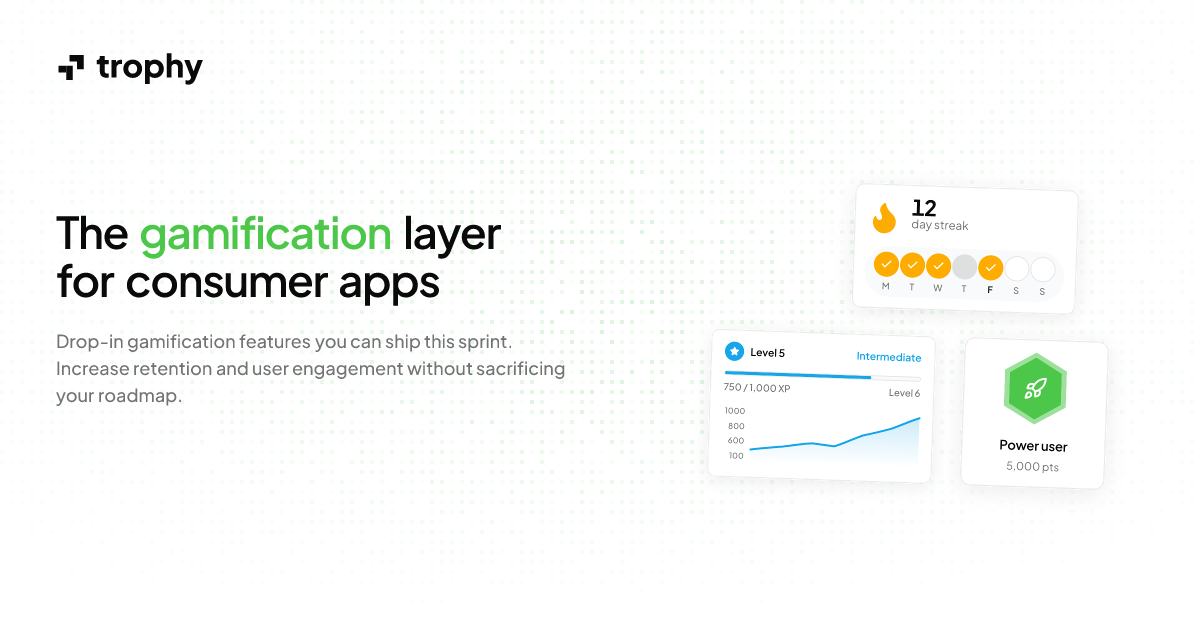
Trophy is gamification infrastructure for web and mobile consumer applications. It provides pre-built systems for achievements, streaks, points, leaderboards, and related user communications, allowing product teams to add engagement mechanics without building the underlying gamification infrastructure themselves.
Teams send product events to Trophy through REST APIs or SDKs, configure rules and campaigns, and retrieve the resulting user state for their application. They can present the experience through open-source UI components, Trophy-hosted drop-in pages, lifecycle emails, push notifications, or a custom interface, depending on their development resources and product roadmap.
Track user interactions through the Metrics API, then use event data to power gamification logic and inspect retention stages and behavior patterns.
Configure milestone, one-off, and streak achievements with API-driven rules. Trophy also handles streak timing details such as time zones, daylight-saving boundaries, and streak freezes.
Create point economies with earning rules, levels, multipliers, and limited-time boosts, then expose progress and balances to users.
Build daily, weekly, or all-time rankings and segment leaderboards into smaller groups using user attributes.
Deliver personalized lifecycle emails and push notifications triggered by user activity. Push delivery supports FCM, APNs, and Expo, while email campaigns use a block-based editor and can be sent from a company domain.
Use REST APIs and type-safe SDKs, open-source UI components, drop-in pages, or custom integrations. Webhooks send signed HTTP POST events to external systems, and separate environments support development, staging, and production.
Turn repeated actions such as lessons, workouts, or content creation into milestones, streaks, points, and levels. This gives users visible progress and can support recurring habits without a custom rules engine.
Add rankings for daily, weekly, or all-time activity and narrow them by user attributes. This suits apps that want competition or cohort comparison while controlling how users are grouped.
Use event-triggered email, push, or in-product pages to acknowledge completed goals, extended streaks, or newly earned badges. Teams can choose packaged communications or build their own interface.
Send signed Trophy events to internal services, data warehouses, notification systems, or third-party tools. This allows gamification state to trigger workflows outside the application UI.
Use the Metrics API and lifecycle analytics to examine activity patterns and retention stages, then adjust achievement, points, or communication rules around observed behavior.
Trophy provides type-safe SDKs for Node.js, Python, Go, Java, PHP, Ruby, and .NET, along with REST APIs. A documented quick start installs an SDK, initializes a client with an API key, sends a user event, retrieves gamification data, and displays UI with open-source components.
Trophy supports achievements, streaks, points, leaderboards, lifecycle emails, push notifications, drop-in pages, custom integrations, analytics, and webhooks. Availability varies by plan; for example, webhooks and integration guidance are listed on the Pro plan.
Yes. Trophy offers lifecycle emails, drop-in pages, APIs, SDKs, an open-source UI kit, and webhooks. Webhooks deliver HTTP POST events such as achievement.completed, streak.lost, and leaderboard.finished, with an X-Trophy-Signature header for verification.
The free plan supports up to 1,000 monthly active users and does not require a credit card. Paid plans start at $25 per month, while higher-volume or bespoke security and support requirements are handled through Enterprise sales.
Trophy is designed for web and mobile consumer applications. The documented APIs and SDKs let teams track product events and retrieve gamification state, while delivery can be handled through hosted pages, lifecycle communications, or a custom interface.

GameGrad turns PDF study material into quiz questions that appear inside arcade games, so users can practice active recall while they play. It offers a free tier with one PDF and a Pro plan with more uploads, more questions, and answer explanations.

DailyPlay.ai is a behavioral growth platform that uses AI site scanning and micro-games to help brands improve engagement and conversion. It supports web, mobile, and other digital touchpoints, with a one-line script setup and a free engagement scan.

ChessWoodie is a chess tactics training app based on the Woodpecker Method. It helps players build pattern recognition through repeated puzzle cycles, track speed and accuracy, and review missed tactics from their own games.

PixelForge turns a single photo into a game-ready 2D character sprite pack, including a 4×4 sheet, transparent frames, direction strips, and looping walk GIFs. It is designed for engine-ready use in Godot, Unity, Phaser, GameMaker, and web games.

Loniva is a mobile puzzle app that offers a calm daily mix of games across memory, attention, language, speed, logic, and focus. It runs on iPhone, iPad, and Android, with a free 7-day trial and a free daily workout after the trial.

Mixels.ai is a browser-based AI pixel art generator for creating 8-bit characters, sprites, avatars, and photo-to-pixel conversions. It is designed for users who want grid-aligned retro artwork without installing software.