
Two-record work ledger
Maintains an append-only local ledger containing the agent's claims and observed activity, including sessions, tool calls, edits, and results.

Yoetz is a local-first, open-source work ledger for AI coding agents that compares agent claims with host-observed activity. It issues receipts showing what was verified, the coverage reached, and what remains open, with first-party support for Codex, Claude Code, and Cursor.
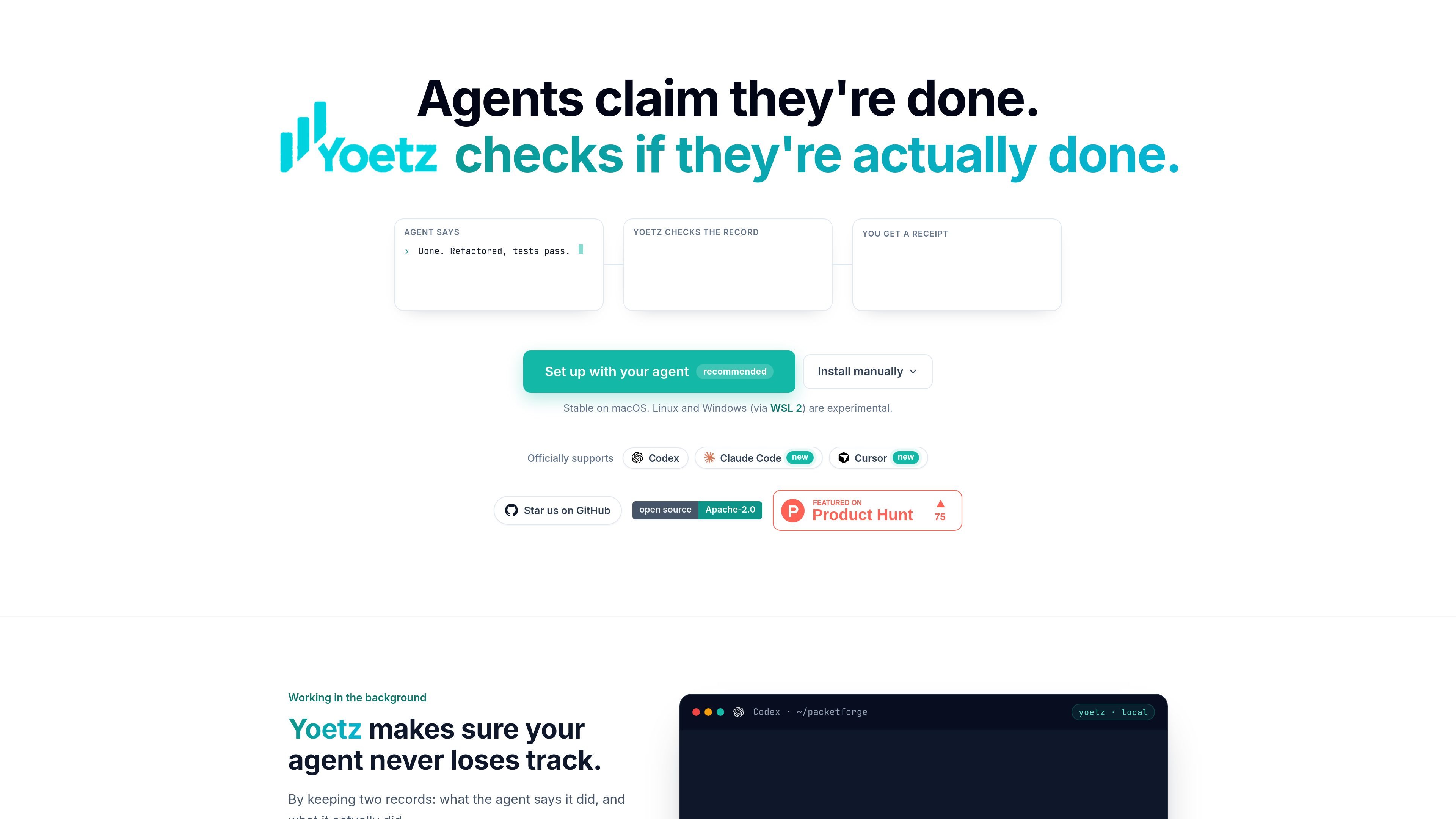
Yoetz is a local-first, open-source work ledger for AI coding agents. It records what an agent says it did alongside what the host actually observed, then checks the two records for disagreements before producing a receipt.
The receipt is deliberately bounded: it identifies what was verified, the coverage reached, and what remains open. This gives developers a more precise completion signal than an unqualified “done” claim, while keeping the service and ledger on the local machine.
Maintains an append-only local ledger containing the agent's claims and observed activity, including sessions, tool calls, edits, and results.
Compares published claims with recorded activity using local rules, then identifies disagreements such as evidence from a test run that predates a later edit.
Creates a receipt that records verified items, coverage, findings, and unresolved work instead of treating every completion claim as fully proven.
Uses MCP for agent-published information and hooks for host-observed activity, with one local service coordinating the records.
Supports task delegation and lineage in the terminal, including child task handles, child receipts, and one-level rollups that carry findings to the parent.
Groups multiple live tasks in one repository and, with consent from both sides, informs tasks when they have declared overlapping paths.
After an agent reports a refactor complete, Yoetz can compare the claim with edits and test evidence, flag stale runs or unverified obligations, and preserve those findings in the receipt.
A parent task can delegate work through an expiring child handle. The child publishes and checks its work, while the parent receipt rolls up child findings without treating a clean child receipt as proof of integration.
When two live tasks in one repository declare overlapping paths, Yoetz can group them and, with consent from both tasks, tell each task about the other's declared overlap.
Developers can use the local ledger and receipts to inspect what an agent claimed, what the host observed, and which checks remain open before accepting a change.
Yoetz runs as one local service on the user's machine. An agent connects over MCP, while hooks report host activity. The site describes a recommended setup flow that copies a prompt into the agent; manual installation is also available through PyPI or npm.
The agent publishes its plan, work, claims, and evidence through six MCP tools. The receipt is returned to the conversation and states what was verified, the coverage reached, and what remains open.
Yoetz is intended for AI coding agents and officially supports Codex, Claude Code, and Cursor. The site also states that any MCP host can connect to the service.
The service is local-first and the site says that nothing leaves the user's machine. A reviewer model is optional and can use the user's API key or ChatGPT plan; those runs are described as occurring from the user's environment rather than through Yoetz.
The site describes Yoetz as alpha software, version 0.2.2, and says macOS is stable while Linux and Windows through WSL 2 are experimental. It also cautions that the product is new and may have rough edges.

ByteAsk is a terminal-first AI coding agent for C and C++ that edits repositories and verifies changes with the real compiler, debugger, sanitizers, and tests before showing a diff. It offers a free tier plus paid plans, with editor connectors and zero-retention handling described in the source.

Manta AI is an autonomous web app testing tool for teams that want to map application behavior, catch regressions, and generate tests without writing scripts or maintaining selectors. It works from a URL and supports plain-English test flows, run results with screenshots, and scheduled or deployment-triggered checks.

CreateOS Sandbox is an isolated compute environment for running code and agent workloads inside Firecracker micro-VMs. It is designed for workflows that need machine-level isolation, private networking between sandboxes, and programmatic control through SDK, CLI, or MCP.

GitBot is a local browser-based workspace for creating reusable coding bots powered by Claude Code, Codex, or OpenCode. It helps developers run those agents across repository folders with persistent threads and configurable permissions.

hob is an independent workspace for coding agents that keeps agent sessions, terminals, history, and follow-up work organized around the tools and providers you already use. It is aimed at developers who want local control over routing, history, and workspace structure rather than a bundled model stack.

Ably Chat is a chat API platform for building custom realtime chat applications. It supports room-based messaging, typing indicators, presence, reactions, and message updates, with usage-based pricing options for different deployment stages.