

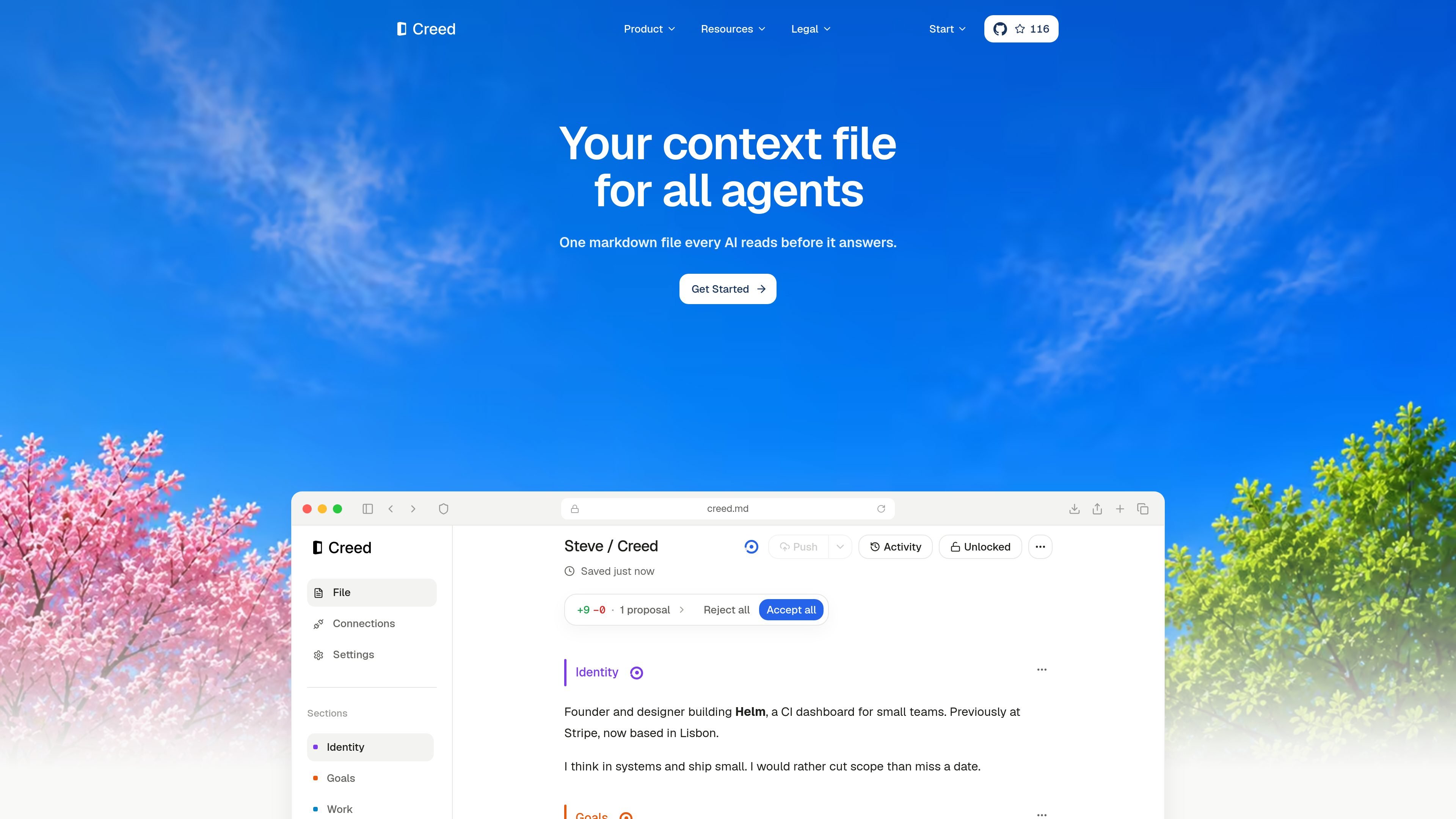
Personal context profile
Creed stores your context as a single Markdown profile that AI agents read before they answer. The file is meant to hold durable information such as values, goals, preferences, routines, and constraints.
Creed is a personal context profile for AI agents. It keeps one shared, up-to-date Markdown file with the durable details that help tools answer consistently: who you are, what you are working toward, how you prefer AI to respond, and the boundaries or routines that matter.
The product is built around a simple workflow: agents read your Creed before responding, propose precise updates when they learn something lasting, and either wait for your approval or write directly if you trust them. Creed can be self-hosted for free, or used as a hosted service with sync, backups, and managed storage.
Creed stores your context as a single Markdown profile that AI agents read before they answer. The file is meant to hold durable information such as values, goals, preferences, routines, and constraints.
Agents can read your Creed over MCP, so the same profile can travel across connected tools instead of living inside one chat app.
When an agent learns something durable, it can propose a precise edit as an inline diff. You can review the change before it lands in the profile.
Creed scores sections for signal, specificity, and weak spots so the profile stays concise and easier for agents to use.
Hosted plans add cross-device sync, backups, and managed backend, auth, and storage.
Hosted plans include monthly usage credits for AI analysis and agent work, with BYOK support if you want model spend on your own key.
Keep one stable profile that tools such as Claude Code, Codex, Cursor, and ChatGPT can read before they respond, so your preferences and constraints follow you across conversations.
Store working style, routines, boundaries, and preferences in one file so a new agent can start with your actual defaults instead of a generic prompt.
Let agents propose diffs when they learn something durable, then approve or reject updates so the profile evolves without becoming a chat transcript.
Use the Company plan when a team needs a shared Company Creed, member roles, and an activity view instead of separate personal profiles.
Creed is a personal context profile made of plain Markdown. You can export it at any time, and the site says there is no lock-in.
Creed connects to agents like Claude Code, Codex, Cursor, and ChatGPT over MCP. The site also says GitHub integration is available for version control, with Notion and Obsidian support on the way for editing and storage.
You can keep proposed edits reviewable, or let trusted agents write directly. Creed is designed so agents propose durable changes and you decide how much approval you want in the loop.
Yes. The pricing page says Creed is open source and free to self-host, while hosted plans start at $12 per month for Personal and $129 per month for Company.
Creed starts as a personal profile. The Company plan adds a shared Company Creed, member roles, an activity view across the team, and admin controls.

Goldfish is an AI memory app for macOS that helps you reply, write, summarize, and continue using the context already on your Mac. It stores memory locally and writes in your tone.

Dcyde is a decision log for product teams that captures what was decided, the reasoning behind it, and the source in one shared place. It supports pinning decisions from Slack, Figma, or inside Dcyde and keeps the record searchable over time.

Lasso is an ecommerce product data platform for enriching catalog records, processing supplier files, generating product content, and monitoring competitors. It combines a web app with a REST API, SDK, and MCP server for teams and developers.

Biji는 혁신적인 도구와 기능을 통해 생산성을 향상시키기 위해 설계된 다목적 플랫폼입니다.

Struere is an AI-native platform for turning spreadsheet data into structured operational software with dashboards, alerts, and automations. It is aimed at teams that want to replace manual spreadsheet workflows without building custom tools from scratch.

garden-md is an open-source Node.js CLI that turns meeting transcripts into a local company wiki. It links entities across transcripts, keeps the original text intact, and renders the result as a browsable wiki.