

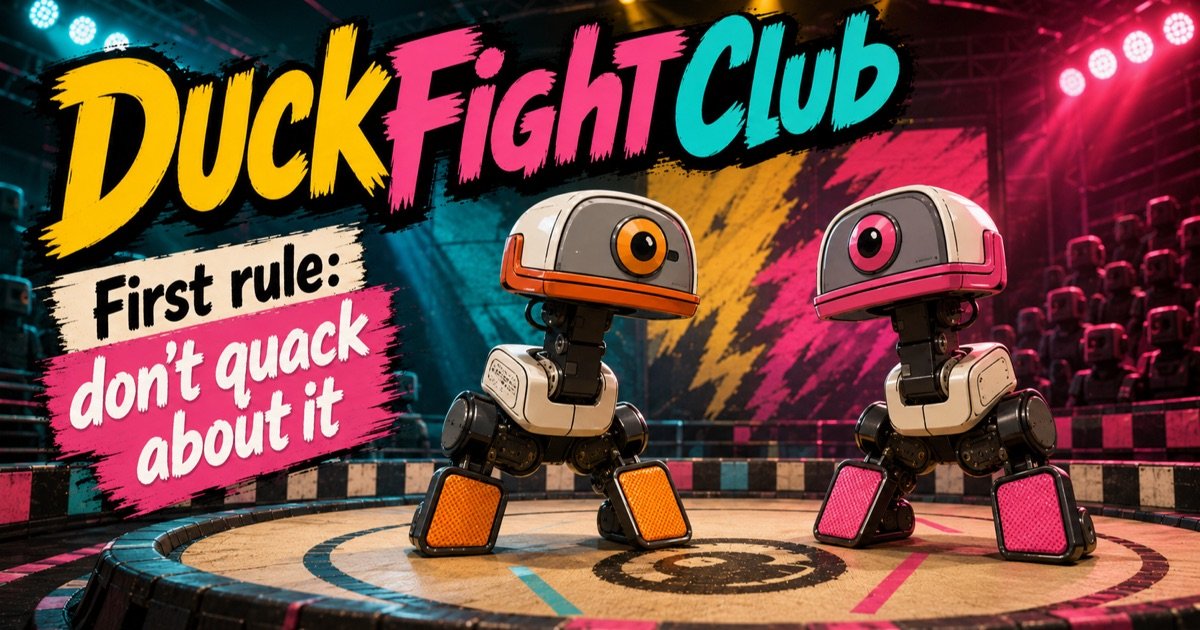
Simulator-based matches
All bouts run in the MicroDuck simulator instead of using physical robot hardware, allowing policies to compete in a controlled virtual environment.
DuckFightClub is a livestreamed simulator-sumo event for reinforcement-learning teams. Participants submit MicroDuck control policies, then compete in a fixed virtual ring for the Golden Beak Belt rather than operating physical robots.
The event is structured as an eight-team, single-elimination tournament. Teams train movement, pushing, dodging, ring awareness, and recovery in simulation, lock their final policies before the broadcast, and advance through best-of-three bouts based on whether their policy can keep its duck inside the circle while forcing its opponent out.
All bouts run in the MicroDuck simulator instead of using physical robot hardware, allowing policies to compete in a controlled virtual environment.
Teams create controllers for movement, balance, pushing, feints, and recovery, with reinforcement learning supported for training behaviors in simulation.
The event uses a fixed circular ring with the same spawn spots and physics for every match, supporting consistent match setup.
A round is won when one policy drives, trips, or pushes the opposing policy outside the circle. Bouts are best of three rounds.
Eight teams enter a single-elimination bracket with four quarterfinals, two semifinals, and one final; there are no first-round byes.
Final policies are submitted before the event and must run at the event settings through the approved control interface.
RL teams can develop and compare controllers for balance, edge awareness, pushing, dodging, and recovery under a shared event configuration.
Teams can use public simulator scrimmages scheduled before the event to test movement and ring behavior before the final policy submission.
The broadcast format gives technical communities a way to present policy behavior through bracket matches, replays, and on-screen match graphics.
Sponsors can purchase placements on the apron boards, mat center, or back-wall marquee, with additional naming, bout, and stream partnership options described by the site.
Cities, conferences, and labs can propose local DuckFightClub showdowns using the format for their own events.
DuckFightClub is a livestreamed simulator competition in which MicroDuck control policies compete in a robot-sumo-style bracket for the Golden Beak Belt.
No. The bouts run in the MicroDuck simulator rather than with physical robots. The source site says MicroDuck hardware is not yet released.
Teams write control policies for movement, balance, pushing, feints, and recovery, and may use reinforcement learning to train behaviors such as ring control, dodging, and edge recovery in simulation.
Eight teams compete in a single-elimination bracket. There are four quarterfinals, two semifinals, and a final, with no byes. Each bout is best of three rounds, and the first policy to win two rounds advances.
Yes. The event is scheduled to stream live on YouTube, although the channel is listed as to be announced. The broadcast is described as including match cards, replays, overlays, and sponsor placements.

GameGrad turns PDF study material into quiz questions that appear inside arcade games, so users can practice active recall while they play. It offers a free tier with one PDF and a Pro plan with more uploads, more questions, and answer explanations.

DailyPlay.ai is a behavioral growth platform that uses AI site scanning and micro-games to help brands improve engagement and conversion. It supports web, mobile, and other digital touchpoints, with a one-line script setup and a free engagement scan.

ChessWoodie is a chess tactics training app based on the Woodpecker Method. It helps players build pattern recognition through repeated puzzle cycles, track speed and accuracy, and review missed tactics from their own games.

PixelForge turns a single photo into a game-ready 2D character sprite pack, including a 4×4 sheet, transparent frames, direction strips, and looping walk GIFs. It is designed for engine-ready use in Godot, Unity, Phaser, GameMaker, and web games.

Loniva is a mobile puzzle app that offers a calm daily mix of games across memory, attention, language, speed, logic, and focus. It runs on iPhone, iPad, and Android, with a free 7-day trial and a free daily workout after the trial.

Mixels.ai is a browser-based AI pixel art generator for creating 8-bit characters, sprites, avatars, and photo-to-pixel conversions. It is designed for users who want grid-aligned retro artwork without installing software.