

Pseudonymization before the LLM call
Mask sits between your application and an LLM provider as a reverse proxy. It detects personal data in the prompt, replaces it with placeholders, and restores the original values in the answer.
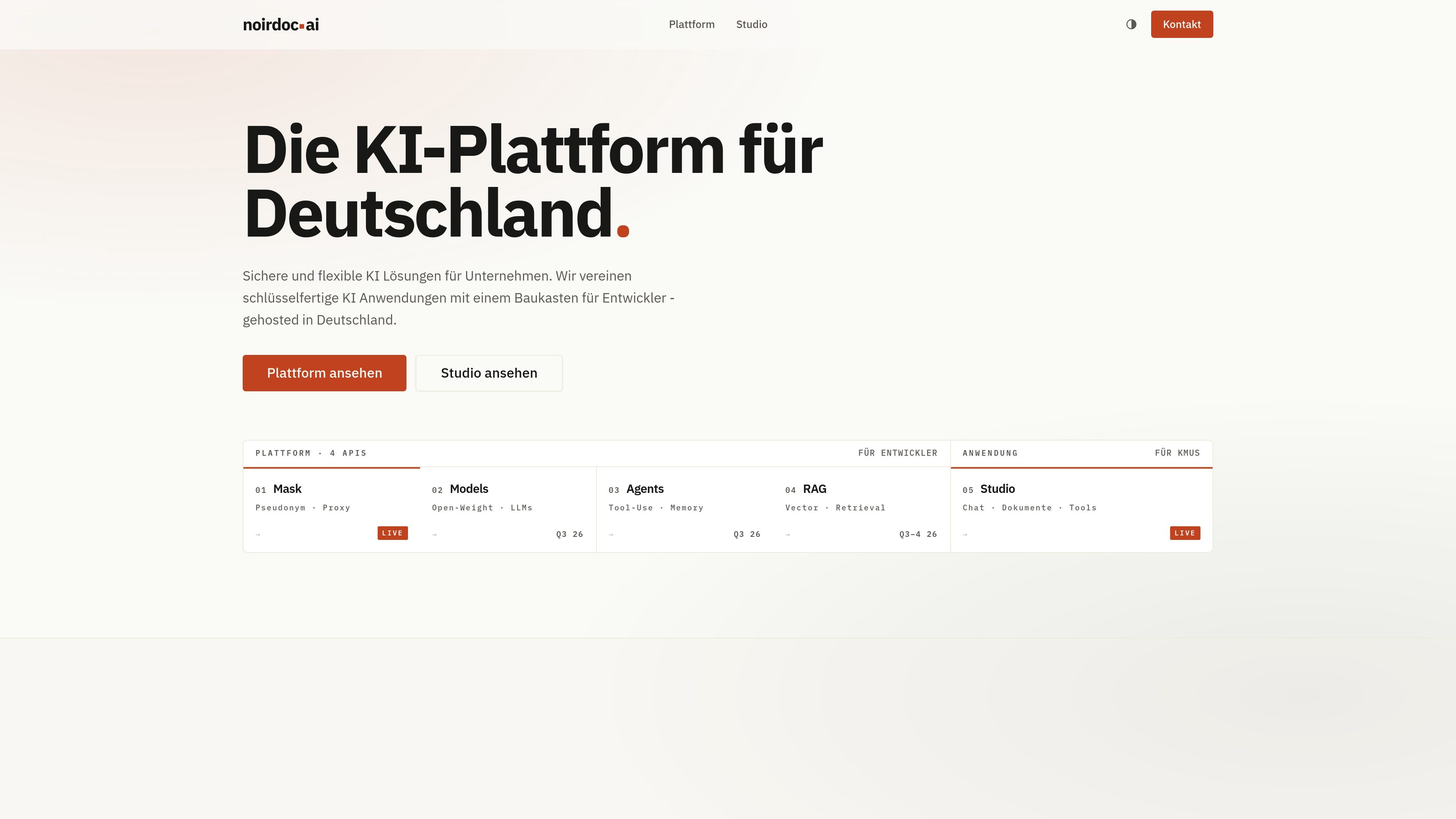
Noirdoc AI is a German-hosted AI platform that combines a developer-facing API layer with a ready-made application for companies. The site positions it as a way to use LLM workflows while keeping deployment and data residency in Germany.
The current public offering centers on Mask, an OpenAI-compatible reverse proxy that pseudonymizes personal data before requests reach an external model provider, and Studio, a turnkey application for chat, document search and tools. The roadmap also includes managed Models, Agents and RAG services.
Mask sits between your application and an LLM provider as a reverse proxy. It detects personal data in the prompt, replaces it with placeholders, and restores the original values in the answer.
The docs describe a standard OpenAI-compatible endpoint at `https://api.noirdoc.de/v1`, so existing clients can be repointed by changing the base URL and API key instead of rewriting integration code.
Models is presented as a managed model layer on Noirdoc's platform. The launch page says it will provide open-weight LLMs on German GPU infrastructure and can be addressed through the same schema used for Mask.
Agents is described as an orchestrated tool-use layer with memory, audit trail and tenant-level rate limits. The page says users define tools and policies while Noirdoc runs the loops.
RAG is presented as a hosted retrieval service. The source mentions document upload, embeddings, vector index, retrieval and answers with citations.
Studio combines chat, document search and tools in one interface. The site says it can run on customer-owned servers or be managed in a German data center.
Use Mask when you want to keep an existing LLM integration and reduce exposure of personal data. The docs show that names, emails, phone numbers, IBANs, dates and similar entities can be replaced before the request reaches the provider.
Use Studio when a team wants a single interface for chat, document search and tools without building a custom frontend. The site presents it as a ready-made application for companies and KMUs.
Use the current Mask endpoint if you already rely on OpenAI-compatible libraries or curl. The docs explicitly mention OpenAI, LangChain, LlamaIndex, Node.js clients and other tools that support a custom base URL.
Use the platform roadmap features if you need managed model access, agent orchestration or retrieval-backed answers but prefer a hosted service in German infrastructure. These capabilities are described on the launch page as upcoming services.
Noirdoc exposes an OpenAI-compatible endpoint. The docs say you typically only replace the base URL with `https://api.noirdoc.de/v1` and use a Noirdoc proxy API key that starts with `px-`.
The source describes Noirdoc as a platform for LLM requests with two products: Mask for pseudonymizing requests before they reach a model, and Models for managed models on the platform. Studio is presented separately as a ready-made application for KMUs.
Mask is designed to pseudonymize personal data such as names, email addresses, phone numbers and more before the request reaches the language model, then restore the original values in the response. The docs also say it works with OpenAI-compatible libraries and tools.
The site presents Studio as a managed or on-premise application with chat, document search and tools. It is described as suitable for companies that want a ready-made interface rather than building everything themselves.
The source does not list public pricing, plan limits or package details in the captured pages. The pricing page confirms the product exists, but no concrete pricing information is shown in the evidence provided.

ArtDeck is a visual reference board app for iPhone, iPad, and Mac that lets artists collect mixed reference material on one canvas and study it with ToolBox lenses. It works offline, supports optional iCloud sync, and is sold as a one-time purchase with no account required.
Gerty is a local AI assistant for Apple silicon Macs that handles chat, writing, documents, voice and selected Mac app tasks without sending data to the cloud. It works offline after model downloads and is designed for users who want private everyday AI without an account or subscription.

Codex Plugins bundle reusable skills, app integrations, and MCP servers into workflows you can install in the Codex app or use from Codex CLI. They help extend Codex with connected-service tasks, reusable instructions, and shared team workflows.

Grok 4.7 is an xAI model for software development and knowledge work, including extended coding tasks and professional analysis. It is available through Grok Build, Cursor, the Grok API, and other developer platforms, with token pricing starting at $2 per million input tokens and $6 per million output tokens.
AakarDev AI helps teams manage AI provider access, project-level setups, logs, and analytics from one dashboard. It supports BYOK workflows and lists providers including OpenAI, Google Gemini, Anthropic, Groq, Mistral AI, and Perplexity AI.

Snapmark is a VS Code extension that lets you annotate clipboard screenshots before pasting them into AI chats. It supports blur redaction, numbered callouts, and automatic resizing for large images.