

No-op preservation
Preserves text that is already correct. The model card explicitly says that if nothing needs fixing, the output should match the input character for character.
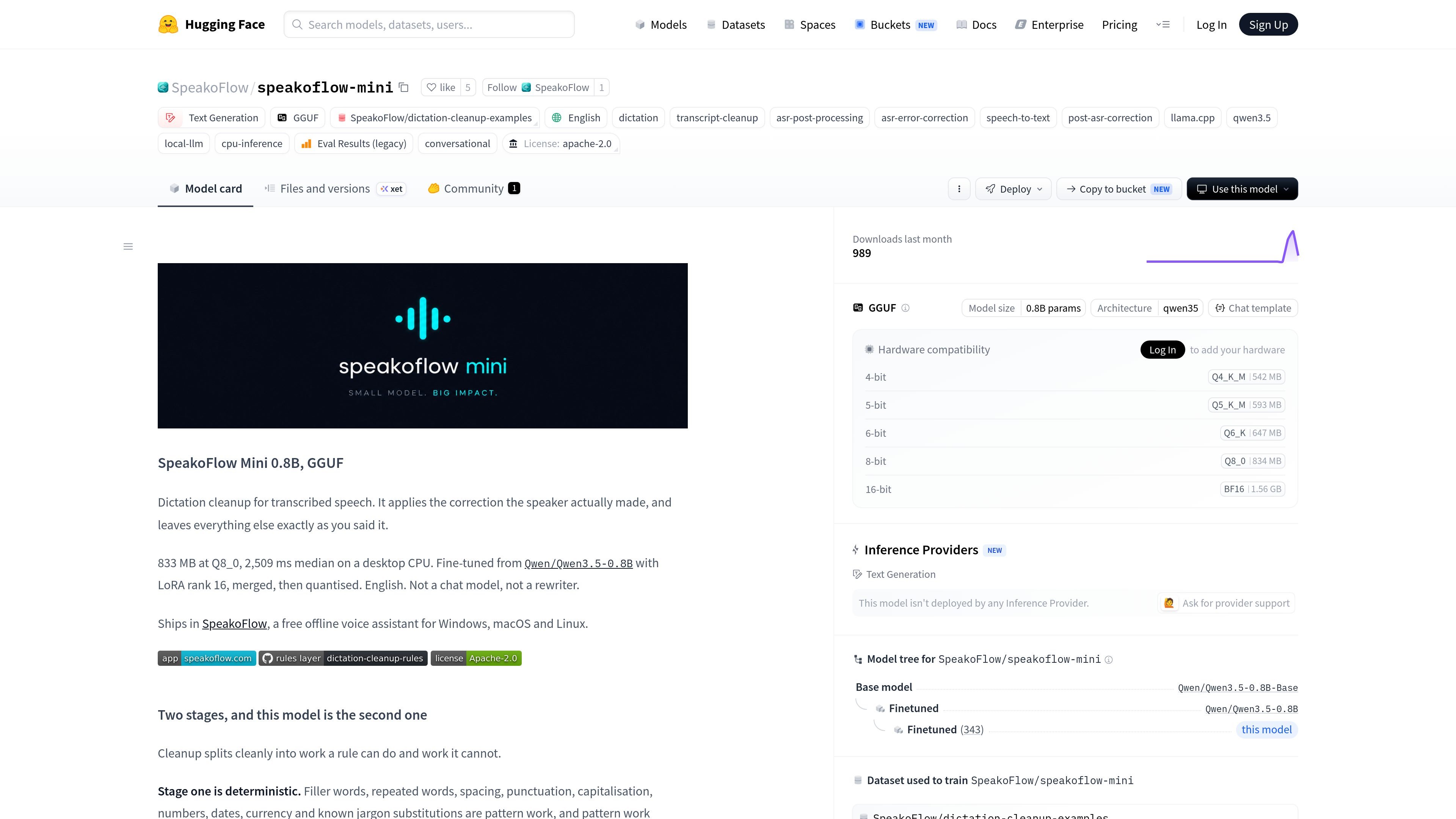
SpeakoFlow Mini is a 0.8B GGUF model for dictation cleanup. It is designed to take already-transcribed speech and return a cleaned transcript, while leaving unchanged text untouched when no correction is needed.
The model card describes it as the second stage in SpeakoFlow's cleanup pipeline. A separate rule-based layer handles deterministic edits such as filler words, repeated words, punctuation, capitalization, numbers, dates, currency, and known jargon substitutions; SpeakoFlow Mini handles the cases that depend on judgment about what the speaker meant.
The repository says the model was fine-tuned from Qwen/Qwen3.5-0.8B with LoRA rank 16, then merged and quantized. It is described as English-only, not a chat model, and not a rewriter. The card also notes a 833 MB Q8_0 file size and a 2,509 ms median on a desktop CPU.
The model is distributed through the SpeakoFlow project and can be run locally with llama.cpp, llama-server, Ollama, or LM Studio according to the examples shown on the card.
Preserves text that is already correct. The model card explicitly says that if nothing needs fixing, the output should match the input character for character.
Handles self-corrections and retractions, such as replacing an earlier phrase with the later correction when the speaker changes their mind mid-sentence.
Applies spoken editing commands like new paragraph and scratch that, turning them into formatting changes instead of leaving the command words in the transcript.
Recognizes spoken symbols and formatting intent, including email addresses, slash-separated paths, bullets, and paragraph breaks.
Uses a two-stage design: deterministic rules first, then this model for the cases that require judgment about intended meaning. The rules layer is published separately and can be used with or without the model.
Runs locally as a small GGUF model and is shipped in SpeakoFlow, a free offline voice assistant for Windows, macOS, and Linux.
Use this model when a transcript includes a speaker correction, such as changing a date, time, name, or number mid-sentence, and the later correction should replace the earlier text.
Use it for dictation commands that should become formatting changes, such as inserting a paragraph break or removing a statement after a scratch-that instruction.
Use it after transcription when common spoken symbols need to be normalized, such as email addresses, slash-delimited paths, or other dictated punctuation.
Use it in workflows where the transcript is already mostly correct and you want conservative edits that avoid rewriting the speaker's wording or meaning.
Use it in an offline voice-assistant setup on a desktop machine when you want a local model that can clean dictation without a hosted API.
SpeakoFlow Mini is a dictation cleanup model. It takes transcribed speech and returns a cleaned transcript, preserving text that is already correct and applying only changes that can be inferred from the spoken content.
The model is meant to be used as the second stage in SpeakoFlow's two-stage cleanup workflow. The first stage handles deterministic rules such as filler words, punctuation, spacing, numbers, dates, and known jargon substitutions; this model handles cases that require judgment about what the speaker meant.
The card says the model is not a chat model and not a rewriter. It should receive the transcript as the user message, with no extra instructions, delimiters, or examples.
The published examples and model card show English dictation cleanup. The card also says to keep the language of the text and never translate it.
The repository publishes a shorter examples.jsonl file for trying the model and a separate dictation-cleanup-examples set for demonstration. The evaluation set itself is private, so published examples are not meant to be quoted as benchmark scores.

Tactiq is an AI note taker for Google Meet, Zoom, and Microsoft Teams that transcribes meetings live and turns them into summaries, action items, and follow-up outputs. It is built around a Chrome extension and supports team workflows through sharing and integrations.

ProWritingAid is a writing assistant for storytellers that offers grammar checking, style editing, paraphrasing, and story analysis inside popular writing apps. It includes a free plan, paid tiers, and tools for chapter critique, manuscript review, and collaborative editing.

SpeakoFlow is a free, open-source desktop voice-to-text app for Windows, macOS, and Linux. It supports dictation into any app, voice-driven writing with Flow, cleanup, translation, and a screen-aware assistant.

Dictro is a private AI dictation app for Mac that turns speech into polished text in any editable app. It works on Apple Silicon Macs, processes locally by default, and can also run in an optional cloud Fast Mode.

Notewarp is an AI note-taking tool that turns voice notes, uploads, or pasted text into cleaner notes, transcripts, summaries, and action items. It helps people capture rough ideas quickly and then edit, export, or share the result.

Scripta is a privacy-first AI notetaker that records, transcribes, and summarizes meetings directly on your device. The public site currently shows a Mac beta download and a Windows waitlist.