
Grounded repository chat
Ask questions against indexed repository content and get answers that cite file and module references.
RepoLens is a developer tool for analyzing repositories, mapping structure and dependencies, and asking grounded questions with file- and module-level references.
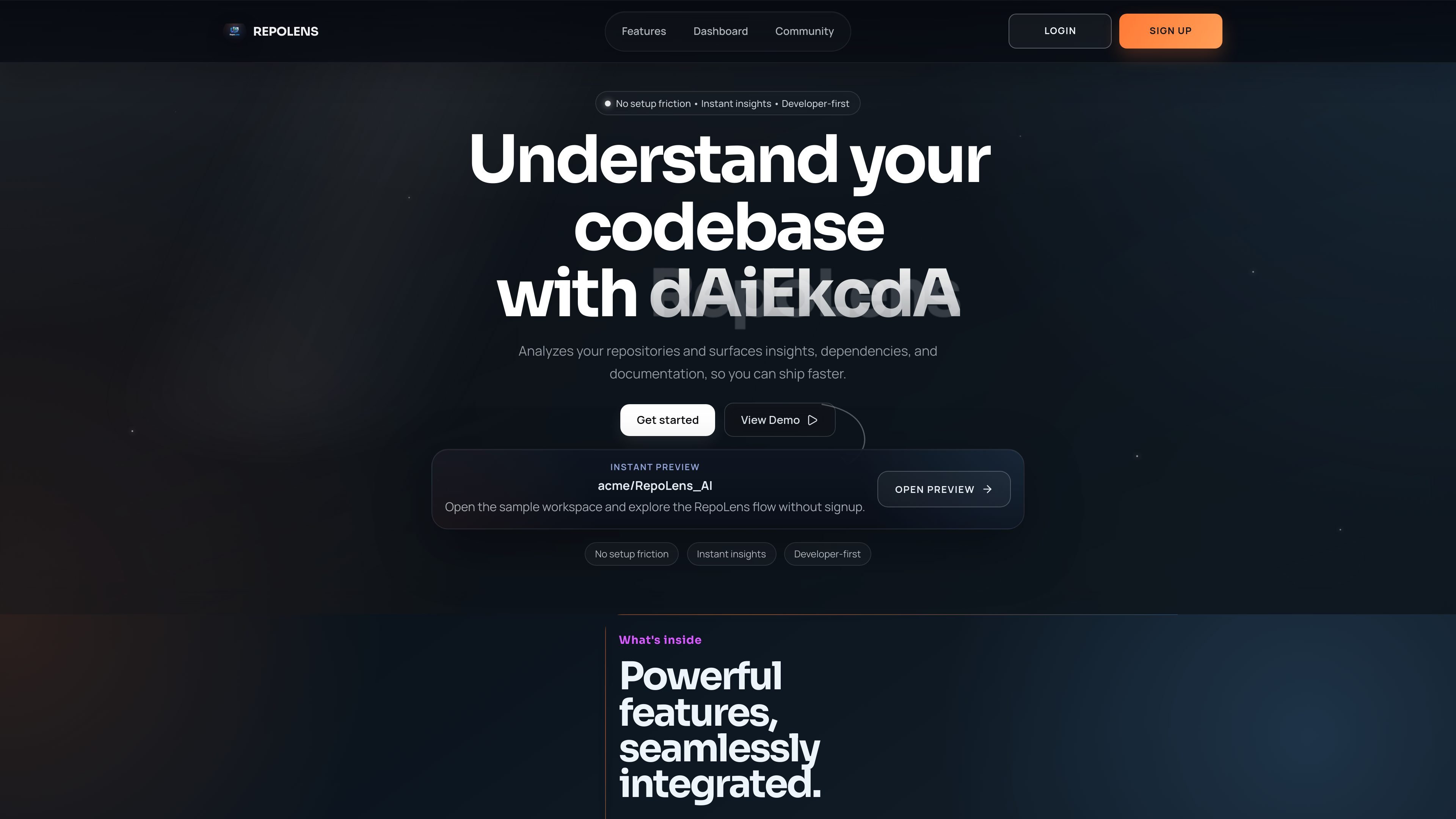
RepoLens is a developer tool for understanding codebases faster. It analyzes repositories, surfaces structure and dependency information, and lets you ask grounded questions against indexed code content with file and module references.
The product centers on a workspace view that brings together repository maps, architecture details, API and documentation extraction, and shareable summaries. It is presented for both public and private GitHub repositories, with a sign-in flow for accessing workspaces, exports, and analysis history.
Ask questions against indexed repository content and get answers that cite file and module references.
Connect GitHub to analyze private repositories, with branch snapshots and workspace controls shown on the pricing page.
Browse modules, dependencies, routes, and generated docs together in one interface to understand structure faster.
Start from a readable repository map instead of opening files one by one, which helps when you first enter a codebase.
Review analysis outputs that can be turned into summaries, handoff notes, and shareable reports.
Switch between architecture, impact, and review views to move from questions to decisions without manual diff-hopping.
Use RepoLens to get a concise, readable overview of a new repository before you start opening files or tracing code paths by hand.
Use grounded chat and module references to answer architecture questions without losing the connection to the underlying source files.
Use the architecture and impact views to review how a proposed change may affect routes, modules, and shared dependencies.
Use generated summaries and exportable reports to prepare handoffs, planning notes, or team updates around a repository.
Use private GitHub connectivity and workspace controls when you need to analyze code that is not public.
RepoLens connects to GitHub or accepts a repository link, then indexes the codebase so you can ask questions and inspect architecture context.
The source shows RepoLens working with public and private repositories through GitHub connection, with private repository access and workspace controls.
RepoLens is presented as a workspace for repository chat, architecture visibility, module maps, dependency inspection, API extraction, and generated documentation.
The pricing page shows a sign-in flow and account creation path, but the rendered source does not expose plan prices or limits.

ByteAsk is a terminal-first AI coding agent for C and C++ that edits repos and verifies changes with compilers, debuggers, sanitizers, and tests.

hob is an independent workspace for coding agents, with local control over sessions, terminals, history, routing, and follow-up work.

Ably Chat is a chat API platform for custom realtime chat apps, with rooms, typing indicators, presence, reactions, message updates and usage-based pricing.

Manta AI is an autonomous web app testing tool that maps app behavior, catches regressions, and generates tests from a URL, no scripts or selectors needed.

SonOf connects to your repo and PM tool, audits your codebase, and turns approved work into shipped tickets with senior engineering review.

Ghost is a terminal-based AI assistant for chatting, code generation, and CLI tasks. Includes free models, supports Linux, macOS, Windows, and is open source.