
Multi-input asset creation
Upload raw 3D models, 2D images, or describe the asset in text. The site says no pre-processing or manual format conversion is required before upload.

Rigyd generates physically accurate SimReady 3D assets and worlds for robotics simulation from 3D models, images, or text. Exports OpenUSD and MJCF for Isaac Sim and MuJoCo.
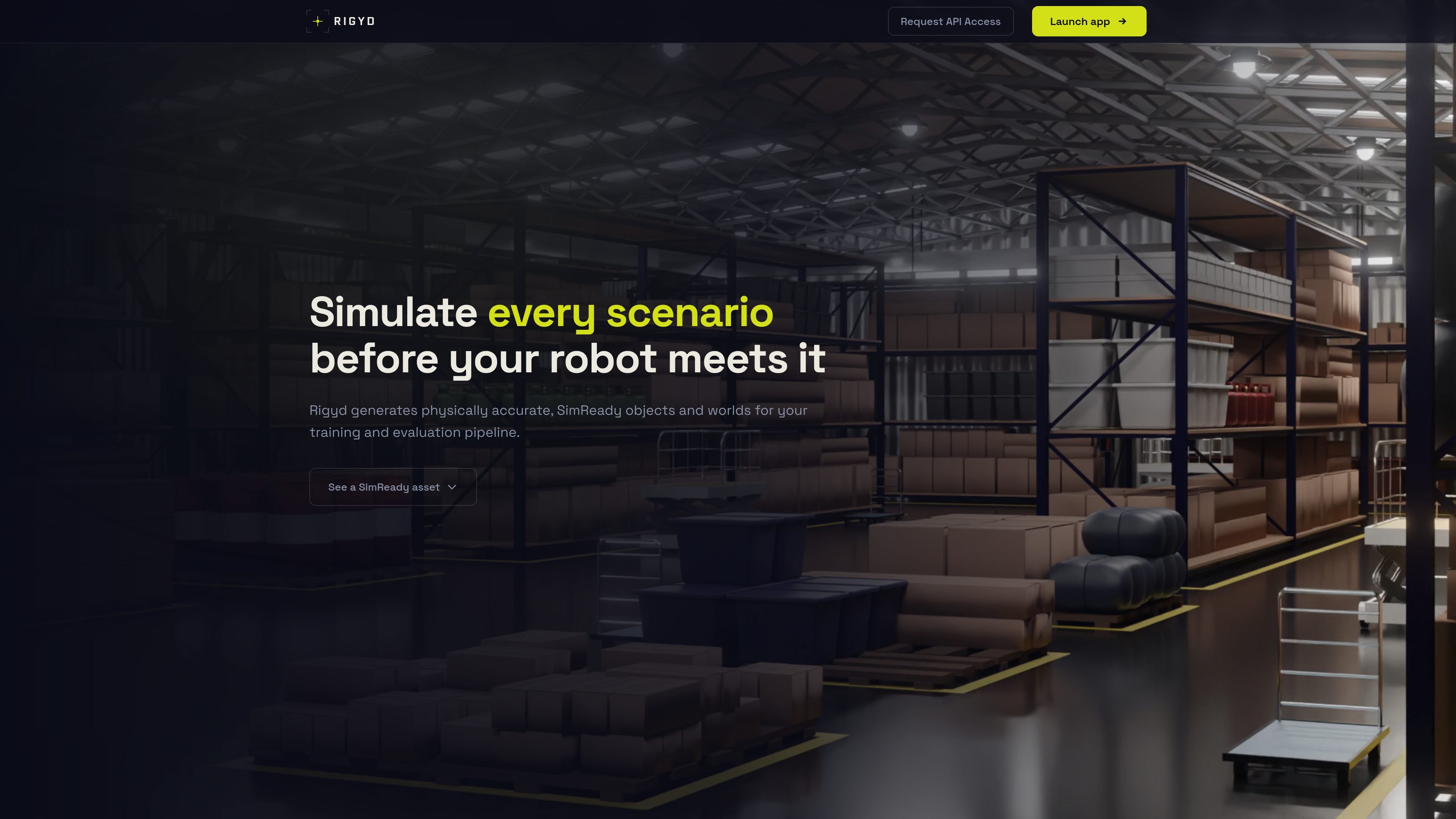
Rigyd generates SimReady 3D assets and worlds for robotics simulation. It takes raw 3D models, images, or text descriptions and produces physically accurate output that can be used in simulation workflows instead of geometry-only files.
The published pages emphasize automatic enrichment for simulation: physics properties, collision geometry, semantic labeling, and simulator-friendly packaging in OpenUSD and MJCF. Rigyd positions this workflow for teams working in NVIDIA Isaac Sim, MuJoCo, Genesis, and related robotics environments.
Upload raw 3D models, 2D images, or describe the asset in text. The site says no pre-processing or manual format conversion is required before upload.
Rigyd estimates density, friction, restitution, mass, center of mass, and inertia from the source content, using mesh volume, geometry, and a calibrated materials database.
The pipeline generates collision geometry automatically with convex decomposition/V-HACD, which the site presents as optimized for simulation runtimes like PhysX.
Export SimReady assets in OpenUSD with USDPhysics schemas and in MJCF for MuJoCo. The homepage also says assets are Z-up, metric, and single rigid bodies, with URDF coming soon.
A 106-check validator and Omniverse asset validation report are part of the output flow, helping confirm structure before the asset is used in simulation.
The product is built to produce large volumes of distinct assets and scenes, including domain-randomization-friendly variations for robotics training pipelines.
Convert existing CAD or mesh libraries into physically accurate simulation assets when you need more than just rendered geometry.
Generate large collections of distinct objects and scene variations for domain randomization and robot policy training.
Prepare Isaac Sim-compatible OpenUSD with physics schemas, collision geometry, and validation for robotics teams using NVIDIA’s stack.
Create MuJoCo-ready MJCF assets when you need physics-aware objects for robot learning, testing, or evaluation.
Support enterprise simulation programs that need API-driven batch creation of many assets and scenes across a catalog or warehouse-like environment.
Rigyd accepts 3D models such as .glb, .fbx, and .obj, plus 2D images and text descriptions. The source pages say no pre-processing is needed before upload; the system handles geometry cleanup, physics estimation, collision mesh generation, and semantic labeling automatically.
Rigyd outputs OpenUSD assets with USDPhysics schemas and MJCF exports. The Isaac Sim page says the OpenUSD output includes PhysicsRigidBodyAPI, PhysicsMassAPI, and PhysicsCollisionAPI, and the homepage says URDF is coming soon.
The source pages describe a fully automated pipeline. You upload a model, image, or text prompt; Rigyd renders views, estimates physics properties from geometry and materials, generates collision hulls, and then validates the result before download.
Rigyd is positioned for robotics simulation, embodied AI, and robot learning/evaluation workflows that need physically accurate assets and worlds. The site specifically mentions Isaac Sim, MuJoCo, Genesis, and Gazebo as supported simulator targets or related pages.
The pricing page on the site is unavailable, but the homepage and Isaac Sim page indicate API access and an Enterprise plan for batch processing. The site also says to request API access for higher-volume use.

DeepMotion is a web-based AI motion capture and 3D animation platform with Animate 3D for video-to-animation and SayMotion for text-to-animation.
Atlasly is an AI site analysis and feasibility tool for architects, developers, and planners, assessing constraints, walkability, and urban context in web app or MCP-connected AI assistants.

anyCreature turns a short text order into a game-ready 3D creature, compiled from one JSON spec with animation, vertex colour, AO baking and an offline viewer.

模袋云 is an accessible online villa modeling software.

Vizcom is an AI design platform for product designers and teams that turns sketches into photorealistic 3D renders, with iteration and team workflows.

Amara is an AI-powered 3D creation tool for mesh generation and plugin-based actions, with a free entry point and tiered plans for individuals and teams.