
U.S. Address Sample Generation
Generates fictional address samples in common U.S. order, including street number, street, city, state abbreviation, and ZIP code, making it easy to check field arrangement and line breaks.

美国地址生成器提供符合美国书写格式的虚构地址、州缩写、邮编和多类测试资料,适合格式学习、软件测试和表单验证。页面还按州与按城市提供专页,并明确标注样本不能用于真实业务提交。
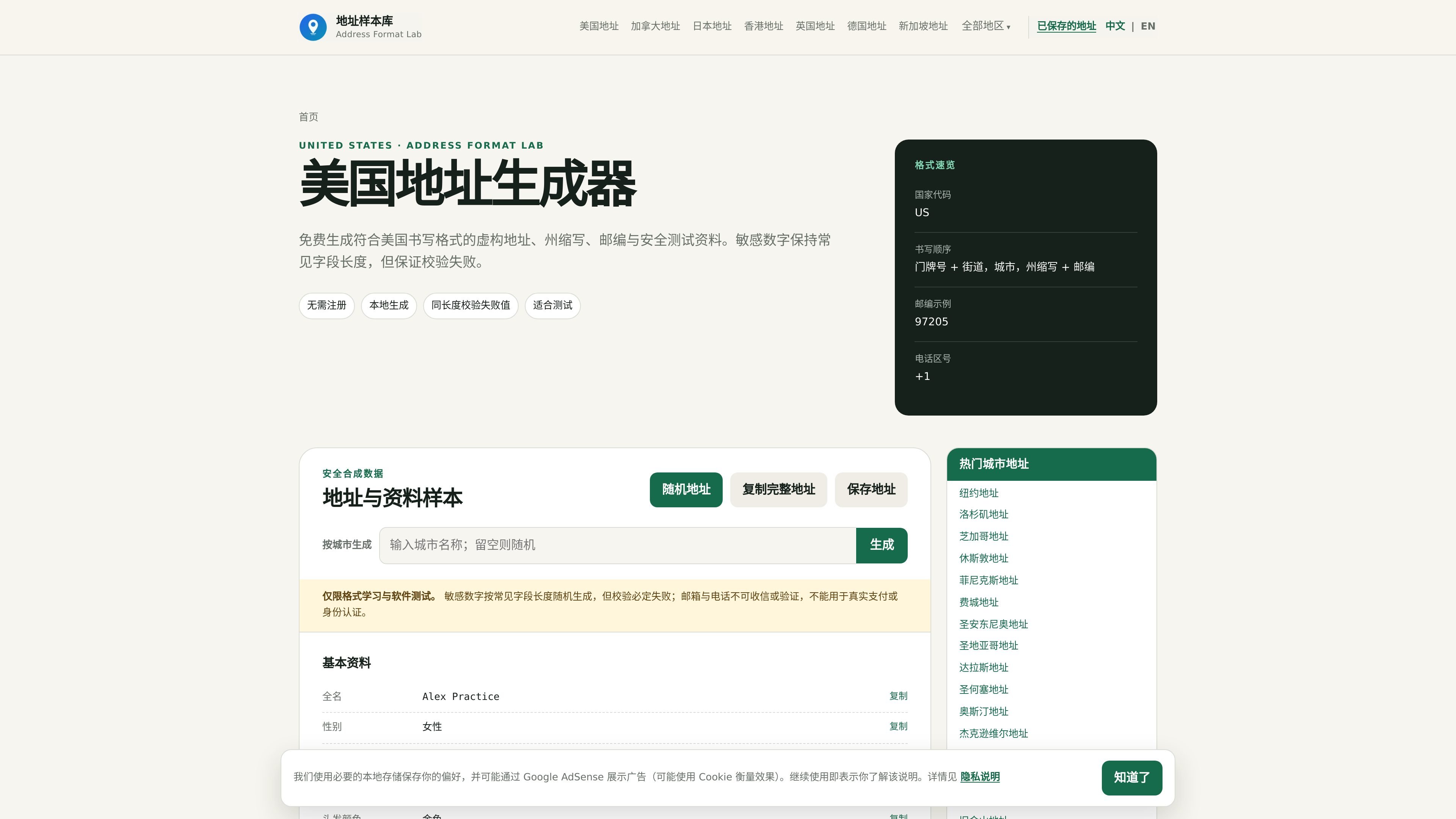
美国地址生成器 is a website for generating fictional U.S. addresses and related test data. Based on common U.S. writing conventions, it provides sample fields such as street number, street name, city, state abbreviation, and ZIP code, helping users check form layouts, field length, and address line wrapping.
The site also offers separate pages by state and by city, such as California, Ohio, and New York City, to help users compare address formatting across regions. Sensitive numbers on the page keep common field lengths, but validation will always fail, and email addresses and phone numbers cannot be used for real message delivery or verification.
In addition to addresses, the page also displays names, birthdays, contact details, employment information, IDs, bank cards, account numbers, and other demo fields, making it suitable for interface validation in development and testing environments. The site repeatedly emphasizes that these samples are for format learning and software testing only, and should not be used for real payments, identity verification, logistics, or compliance workflows.
Generates fictional address samples in common U.S. order, including street number, street, city, state abbreviation, and ZIP code, making it easy to check field arrangement and line breaks.
Provides a quick reference for format details such as country codes, state abbreviations, ZIP code examples, and area codes, helping users understand the basic structure of U.S. address fields.
Offers separate pages by state and by city, such as California, Ohio, and New York City, so users can review fixed samples and notes for different regions.
Includes copy buttons and complete profile samples, supporting the use of addresses, contact details, and test fields for interface validation.
Shows multiple types of test data at the same time, including names, birthdays, contact details, employment, IDs, and account information, which is suitable for checking how forms handle multi-field input.
Clearly marks the content as intended only for format learning and software testing, and warns against using it for real payments, identity verification, or business submissions.
Check in a development environment whether a U.S. address form correctly handles the arrangement of street number, street name, city, state abbreviation, ZIP code, and secondary address fields.
Test field validation on payment, identity verification, logistics, or other pages that require addresses, with a focus on confirming length, line breaks, state fields, and ZIP code format.
Learn the standard way U.S. addresses are written, or compare the address format notes on different state and city pages.
Test copy buttons, long-text display, responsive layouts, and multi-field sample presentation in a front-end interface.
The page explicitly states that the samples are fictional data assembled from publicly available address formats. They are not guaranteed to correspond to deliverable locations, and they do not match real individuals.
No. Card numbers, IDs, and SSNs only keep common display lengths, but validation will fail; email addresses and phone numbers cannot be used for receiving messages or verification.
The standard format is “street number + street, city, state abbreviation + ZIP code.” The page also explains that apartment, suite, or unit information can be used as a second line, with common forms including Apt, Ste, and Unit.
Yes. The page provides separate sample pages by state and by city, such as California, Ohio, and New York City, making it easy to review state abbreviations and format differences across regions.
The page is positioned for format learning and software testing. For payment, identity verification, logistics, or compliance workflows, it recommends using the provider’s official sandbox data rather than submitting to real business systems.

ByteAsk is a terminal-first AI coding agent for C and C++ that edits repositories and verifies changes with the real compiler, debugger, sanitizers, and tests before showing a diff. It offers a free tier plus paid plans, with editor connectors and zero-retention handling described in the source.

MacSpoof é um alterador de MAC no macOS que permite trocar ou randomizar o endereço Wi‑Fi para reconectar e reduzir o registro da identidade.

Manta AI is an autonomous web app testing tool for teams that want to map application behavior, catch regressions, and generate tests without writing scripts or maintaining selectors. It works from a URL and supports plain-English test flows, run results with screenshots, and scheduled or deployment-triggered checks.

NomNak é um app gratuito para iPhone que ajuda a descobrir restaurantes com recomendações de amigos, spots salvos, passaporte gastronómico e busca por cidade.

Ctrl+Shift+3 is a calm, text-first community platform with a chronological feed, profiles, RSS, and private groups called Clicks. It is built for reading, posting, and joining smaller communities without algorithmic ranking or vanity counts.

TyeGit é um cliente Git nativo em Rust e Tauri para controle rápido e preciso de staging, commits, branches e remotes no Windows, macOS e Linux.