
Reproducible analysis traces
Claude Science runs analyses, searches databases, and keeps a trace of each step from data wrangling through publication so results can be reviewed later.

Claude Science is Anthropic’s AI workbench for scientific research. It helps researchers run analyses, inspect scientific data natively, and trace work from raw data through publication.
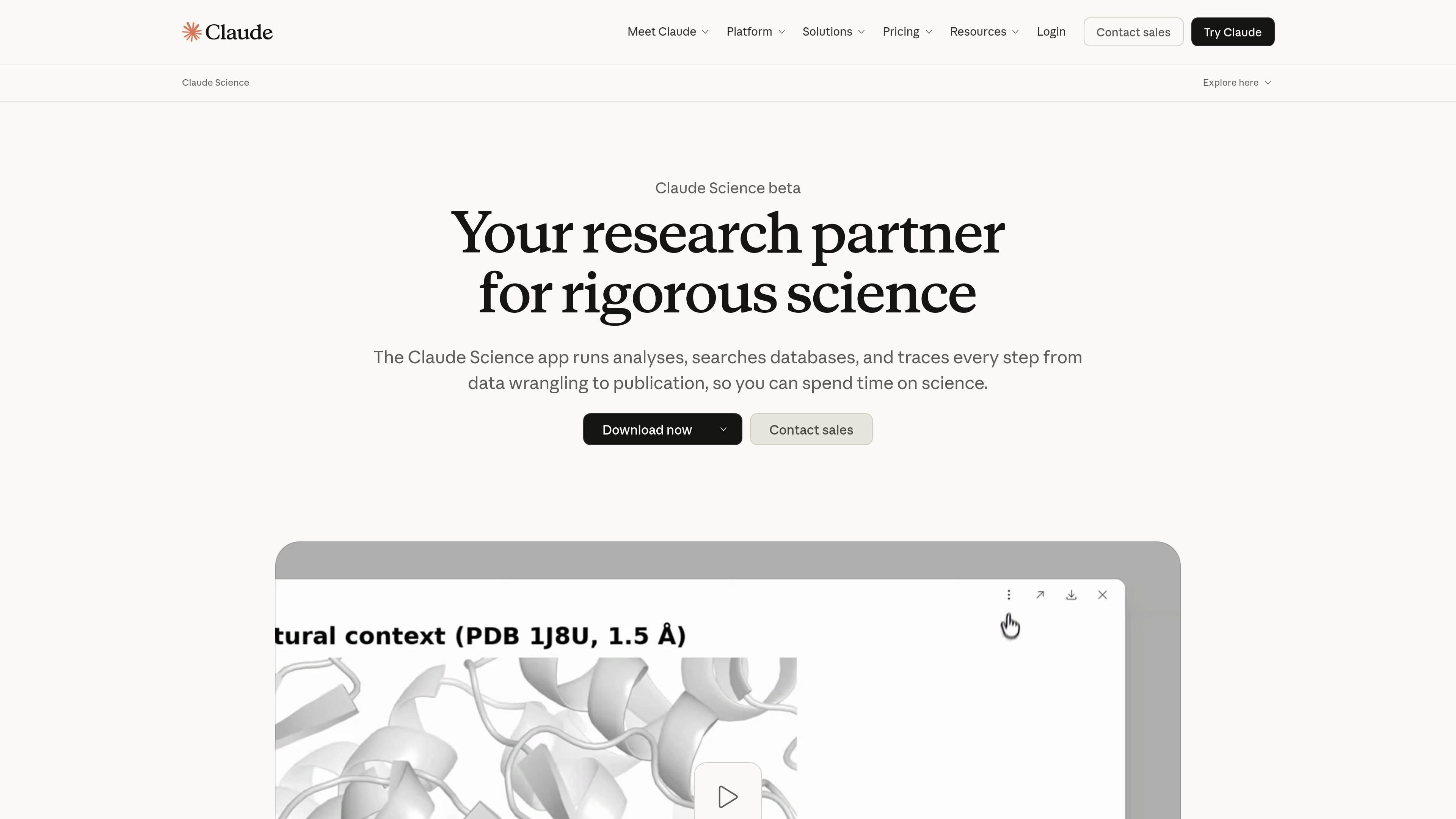
Claude Science is Anthropic’s AI workbench for scientific research. The page positions it as a research partner that can run analyses, search databases, and trace each step of the work so scientists can move from raw data to publication in one environment.
The product is aimed at scientific and life-science workflows. It supports reproducible artifacts, native scientific renderers, compute management across local and remote machines, and domain-specific work such as genomics, single-cell analysis, proteomics, structural biology, and cheminformatics.
Claude Science runs analyses, searches databases, and keeps a trace of each step from data wrangling through publication so results can be reviewed later.
The app renders proteins, structures, molecules, alignments, genomic tracks, chemical structures, figures, tables, notebooks, and PDFs in native form without extra setup.
Figures, tables, and notebooks include the exact code, environment, and conversation that produced them, which makes outputs easier to reproduce or defend.
A background reviewer flags incorrect citations, untraceable numbers, and figures that do not match their underlying code.
Claude manages environments and compute on a laptop, Linux box, cluster, GPU machine, or through SSH and Modal, including batch jobs on HPC systems.
It supports persistent Python and R kernels, database connections, reusable skills, and connectors so labs can extend workflows over time.
Analyze large single-cell datasets, cluster and annotate cells, and keep each figure tied back to the code that generated it.
Align orthologs, infer maximum-likelihood trees, and map functional residues onto a phylogeny within a reproducible session.
Inspect predicted protein structures, add domains and clinical variants, and work with the model in 3D.
Search bioactivity data, compute properties and similarities, and refine structures in a live 2D sketcher.
Draft results, figures, and manuscript text alongside the underlying analysis, using Markdown and LaTeX previews in one workspace.
The source says Claude Science is available now for macOS and Linux.
It is described as a research environment for scientific work that connects to scientific databases, research tools, ELNs, protein and structure models, HPC systems, and more.
The page says Claude Science can run analyses, search databases, trace every step, and let you inspect proteins, alignments, genomic tracks, chemical structures, and PDFs in native renderers.
The pricing page shows Claude has Free, Pro, Max, Team, and Enterprise plans, and the Claude Science page includes a 'Contact sales' path as well as a download option.

ByteAsk is a terminal-first AI coding agent for C and C++ that edits repositories and verifies changes with the real compiler, debugger, sanitizers, and tests before showing a diff. It offers a free tier plus paid plans, with editor connectors and zero-retention handling described in the source.

Hype is a web tool for finding trending YouTube topics by category, time range, and scoring mode. It helps creators spot emerging ideas, inspect source videos, and decide what to cover next.

hob is an independent workspace for coding agents that keeps agent sessions, terminals, history, and follow-up work organized around the tools and providers you already use. It is aimed at developers who want local control over routing, history, and workspace structure rather than a bundled model stack.

Ably Chat is a chat API platform for building custom realtime chat applications. It supports room-based messaging, typing indicators, presence, reactions, and message updates, with usage-based pricing options for different deployment stages.

Manta AI is an autonomous web app testing tool for teams that want to map application behavior, catch regressions, and generate tests without writing scripts or maintaining selectors. It works from a URL and supports plain-English test flows, run results with screenshots, and scheduled or deployment-triggered checks.

SonOf connects to your repo and PM tool, audits the codebase and surrounding product context, and turns approved work into shipped tickets with senior engineering review. It is aimed at founders and engineering leaders who need backlog help without hiring a full team immediately.