
Chromium-based source rendering
Renders the uploaded source in Chromium first, then reconstructs it as a structured Figma design instead of a flat screenshot.

Source → Design is a Figma Community plugin that converts HTML and frontend project ZIPs into editable Figma layers. It helps designers and developers bring rendered web layouts into Figma for editing, review, and handoff.
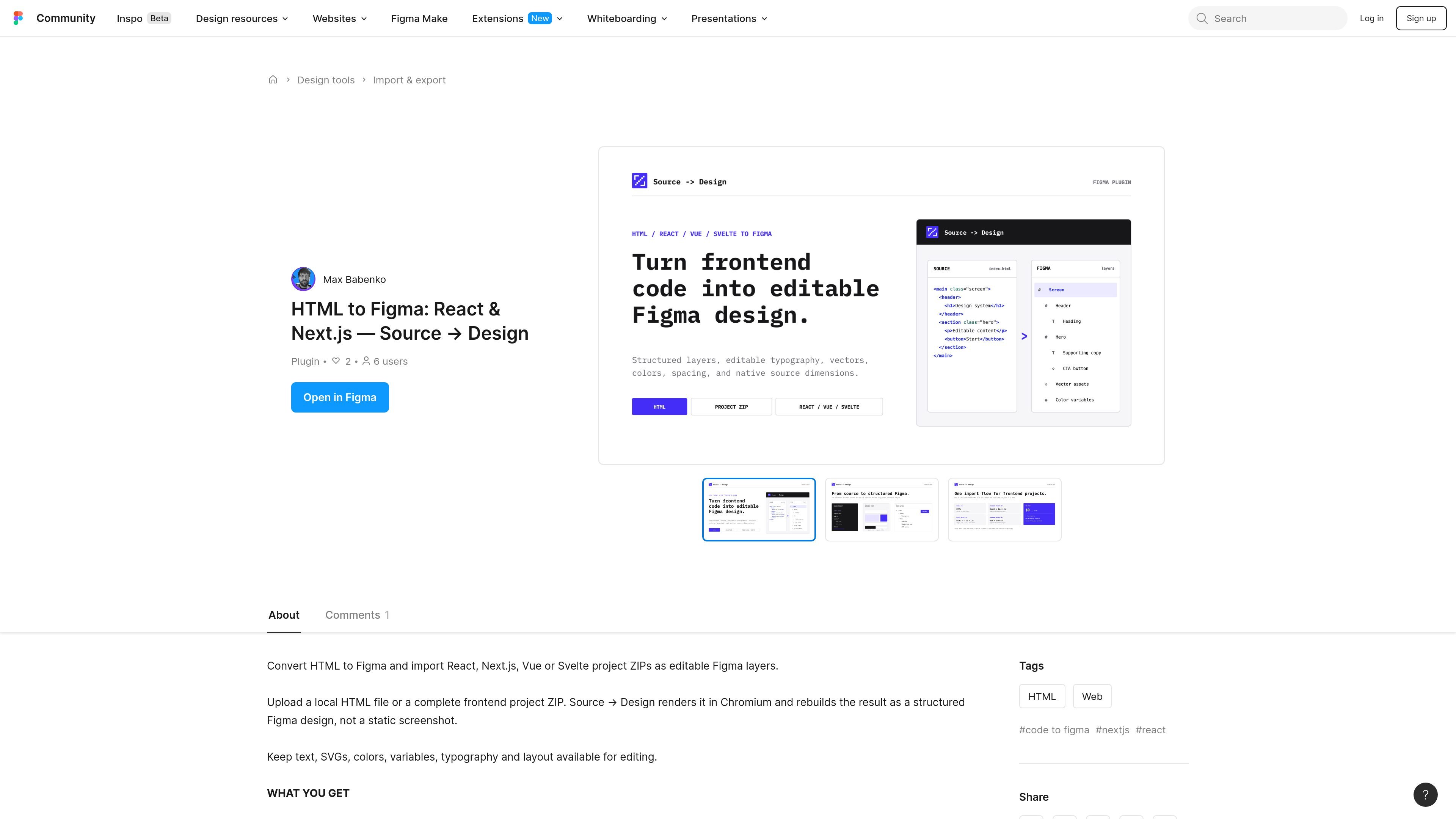
HTML to Figma: React & Next.js — Source → Design is a Figma Community plugin for converting front-end source files into editable Figma layers. It is designed for HTML files and project ZIPs, including React, Next.js, Vue, and Svelte projects.
Instead of capturing a screenshot, the plugin renders the source in Chromium and rebuilds the result as a structured design. That makes the output more useful for editing and design iteration because text, vectors, layout, and selected styling details remain separate Figma elements when the source is supported.
Renders the uploaded source in Chromium first, then reconstructs it as a structured Figma design instead of a flat screenshot.
Keeps text editable with detected font family, weight, style, size, line height, letter spacing, alignment, and measured line breaks.
Imports vector SVG assets and supported icons so graphical elements remain usable in Figma.
Rebuilds frames, fills, borders, corner radii, shadows, gradients, opacity, clipping, and transforms as editable design layers.
Extracts colors and reusable variables from the rendered interface to preserve design tokens where possible.
Supports native source dimensions or a selected mobile, tablet, or desktop viewport for output sizing.
Bring a static HTML page or a frontend project ZIP into Figma so the layout can be adjusted without rebuilding the design from scratch.
Convert a React, Next.js, Vue, or Svelte project ZIP into layered Figma content for design review and iteration.
Preserve editable typography, vectors, and layout when a team wants to compare rendered UI against a design file.
Choose a mobile, tablet, or desktop viewport when the same source needs to be imported at a specific frame size for presentation or handoff.
It runs inside a Figma Design file. You start the plugin, drop in a self-contained HTML file or a supported project ZIP, confirm the detected project and output size, and then start the import while the plugin remains open.
The source text lists self-contained .html files, static project ZIPs, and project ZIPs for React, Next.js, Vue, and Svelte.
The plugin rebuilds rendered output as editable Figma layers, including text, SVG assets, layout, colors, variables, typography, and common visual properties such as fills, borders, shadows, and gradients.
Browser-only output such as canvas, WebGL, active video, and some complex filters does not have a direct editable Figma equivalent. Those areas may fall back to local raster output.
The page says three successful imports are free. After that, Source → Design Pro is listed at $9/month for unlimited code-to-design imports.

imgcook is a design-to-code tool that converts design drafts into front-end code. It supports plugin-based and developer workflows for Sketch, Photoshop, VS Code, and CLI usage.

ByteAsk is a terminal-first AI coding agent for C and C++ that edits repositories and verifies changes with the real compiler, debugger, sanitizers, and tests before showing a diff. It offers a free tier plus paid plans, with editor connectors and zero-retention handling described in the source.

CreateOS Sandbox is an isolated compute environment for running code and agent workloads inside Firecracker micro-VMs. It is designed for workflows that need machine-level isolation, private networking between sandboxes, and programmatic control through SDK, CLI, or MCP.

hob is an independent workspace for coding agents that keeps agent sessions, terminals, history, and follow-up work organized around the tools and providers you already use. It is aimed at developers who want local control over routing, history, and workspace structure rather than a bundled model stack.

Ably Chat is a chat API platform for building custom realtime chat applications. It supports room-based messaging, typing indicators, presence, reactions, and message updates, with usage-based pricing options for different deployment stages.

Manta AI is an autonomous web app testing tool for teams that want to map application behavior, catch regressions, and generate tests without writing scripts or maintaining selectors. It works from a URL and supports plain-English test flows, run results with screenshots, and scheduled or deployment-triggered checks.