
TypeScript application scaffold
Generate a working TypeScript application with a model, agents, retrieval, and runtime already included, then modify the scaffold.

lloyal.ai is a TypeScript platform for building and deploying AI applications with programmable agent harnesses, inference-native Abilities, and multiple deployment modes. It is aimed at developers who need to coordinate model-driven workflows across local devices, private infrastructure, or hosted frontier compute.
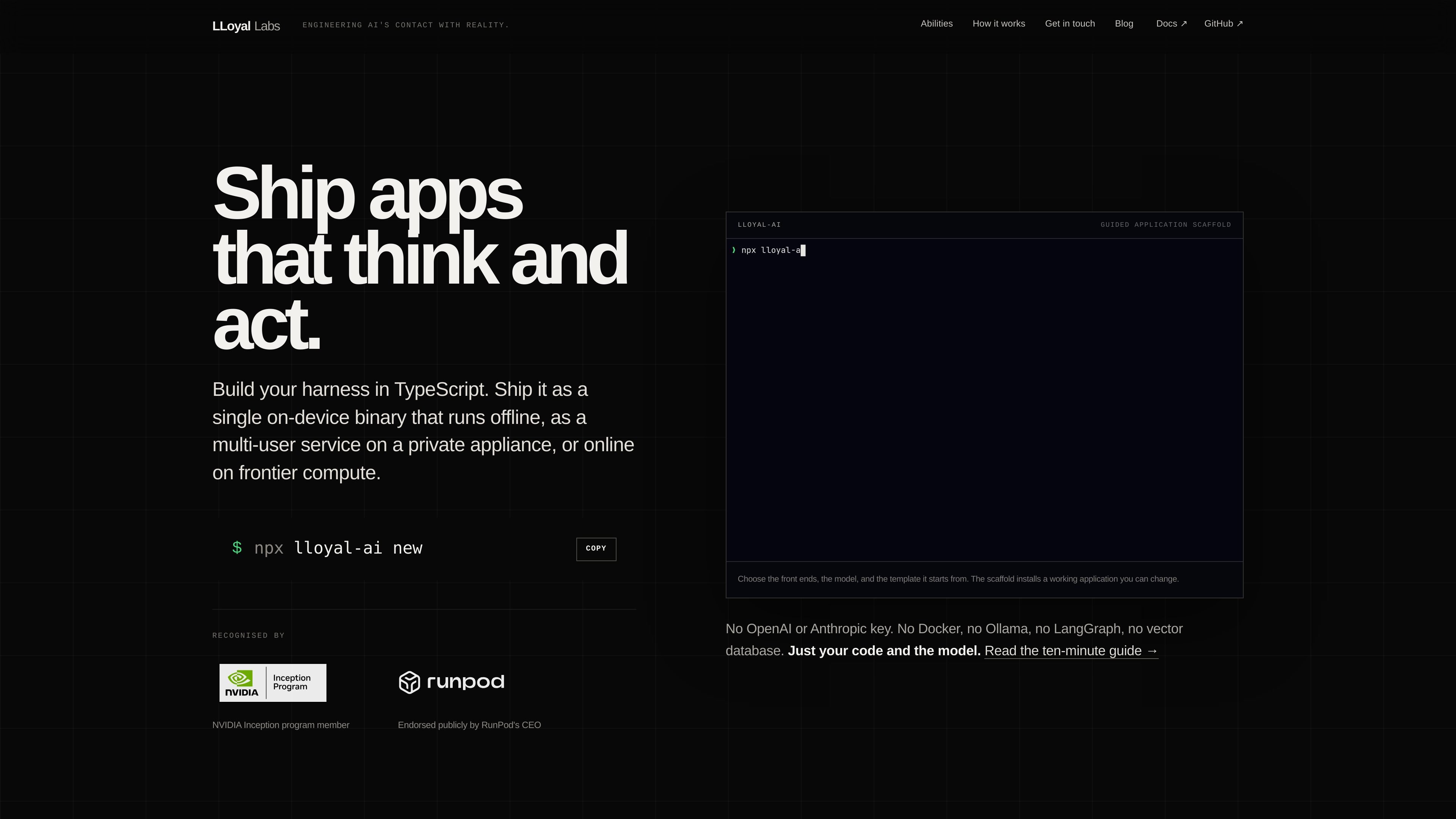
lloyal.ai is a TypeScript platform for building applications whose language models can reason, use tools, coordinate with other agents, and continue work under program control. Its central artifact is a harness: ordinary application code that defines policy, capabilities, control flow, recovery, and how live inference is used.
The platform starts with a command-line scaffold and is designed to keep the same program behavior across different product surfaces and compute environments. The site describes deployment options ranging from an offline binary on a device to a private multi-user appliance or hosted frontier compute, while its public materials emphasize a model runtime and agent system integrated into the application.
Generate a working TypeScript application with a model, agents, retrieval, and runtime already included, then modify the scaffold.
Use a single application design across local execution and hosted frontier compute, with the harness controlling policy, capabilities, orchestration, recovery, and continuation.
Extend agents with inference-native Abilities that can provide tools, schemas, live sources, situation-aware skills, and composed models.
Coordinate multiple agents through shared live inference state, including branching, agent pools, parallel work, and evidence reconciliation.
Deploy as an offline on-device binary, a multi-user service on a private appliance, or an online application running on frontier compute.
Support application surfaces including CLI, desktop, and web, with mobile described as coming soon on the site.
Create a local AI application that packages its model runtime into an on-device binary for offline operation, where the same harness can govern agent behavior without relying on a hosted service.
Build an internal multi-user service on a private appliance, using TypeScript policy and orchestration code to coordinate agents and operator decisions within a controlled deployment.
Implement research and investigation workflows in which agents run parallel tasks such as searching service history, inspecting telemetry, and reviewing technical manuals before reconciling evidence.
Develop applications that need explicit approval gates before an automated action is committed, such as the site's example flow for proposing remediation after evidence review.
Use hosted frontier compute for workloads that require multiple concurrent agents and shared inference state while retaining the same application-level harness.
Run `npx lloyal-ai new` to scaffold a working TypeScript application. The site says the scaffold includes the model, agents, retrieval, and runtime, and can be changed as needed.
The site describes deployment as a single on-device binary that can run offline, a multi-user service on a private appliance, or an online application using frontier compute.
No. The site explicitly presents the scaffold as requiring no OpenAI or Anthropic key, Docker, Ollama, LangGraph, or vector database.
Abilities are extensions that can provide tools and schemas, live sources, situation-aware skills, and composed models. They run within the model's execution and can access execution context described by the platform.
The public site links to a ten-minute guide, documentation, an HDK GitHub repository, and a browser-based contact form. The available material does not specify public pricing or plan limits.

CreateOS Sandbox is an isolated compute environment for running code and agent workloads inside Firecracker micro-VMs. It is designed for workflows that need machine-level isolation, private networking between sandboxes, and programmatic control through SDK, CLI, or MCP.

GitBot is a local browser-based workspace for creating reusable coding bots powered by Claude Code, Codex, or OpenCode. It helps developers run those agents across repository folders with persistent threads and configurable permissions.

AakarDev AI helps teams manage AI provider access, project-level setups, logs, and analytics from one dashboard. It supports BYOK workflows and lists providers including OpenAI, Google Gemini, Anthropic, Groq, Mistral AI, and Perplexity AI.

Trigger.dev chat agent is a durable AI chat backend for developers building stateful conversations that can survive refreshes, crashes, and long-running turns. It connects with the AI SDK `useChat` flow and runs on managed infrastructure with no timeout on a turn.

ByteAsk is a terminal-first AI coding agent for C and C++ that edits repositories and verifies changes with the real compiler, debugger, sanitizers, and tests before showing a diff. It offers a free tier plus paid plans, with editor connectors and zero-retention handling described in the source.

Codex Plugins bundle reusable skills, app integrations, and MCP servers into workflows you can install in the Codex app or use from Codex CLI. They help extend Codex with connected-service tasks, reusable instructions, and shared team workflows.