
Live topology graph
Visualize resources and their connections as a live topology graph, with grouping by namespace or label and updates pushed over SSE.

Radar is an open-source Kubernetes UI that runs as a single binary on a laptop or in-cluster, with views for topology, events, Helm, GitOps, audits, traffic, and cost data. Radar Cloud adds hosted multi-cluster, retention, alerts, and SSO features on top of the same engine.
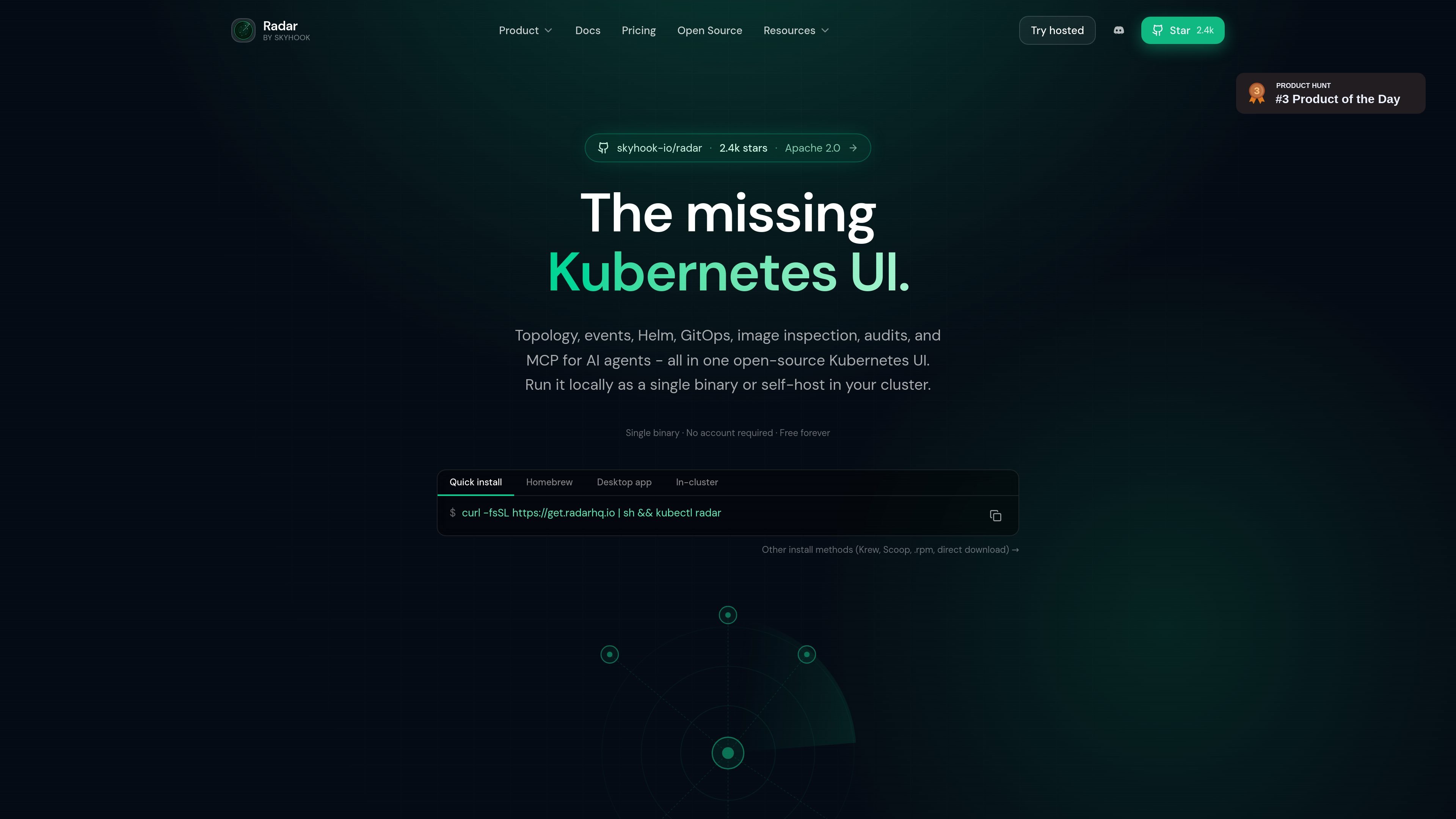
Radar is an open-source Kubernetes UI built around a single Go binary. It runs locally or inside a cluster and is designed to help operators understand workloads, events, topology, GitOps state, cost signals, and traffic without switching between several separate tools.
The open-source engine is Apache 2.0 and requires no account. Radar Cloud uses the same engine as a hosted layer for fleet-scale needs such as multi-cluster aggregation, persistent retention, alerts, and SSO.
Visualize resources and their connections as a live topology graph, with grouping by namespace or label and updates pushed over SSE.
Capture Kubernetes events and resource deltas as they happen so teams can review incidents after the API server’s built-in event TTL.
Inspect container image filesystems directly in the UI, including tree browsing, sizes, symlinks, search, and downloads.
Run a cluster audit with 31 best-practice checks covering security, reliability, and efficiency, using cached state for fast results.
Work with GitOps and package data in one place, including FluxCD and ArgoCD sync state, Helm releases, and revision history.
Add OpenCost cost views, traffic visualization, and MCP tools for AI agents when those integrations are present in the cluster.
Use Radar when a pod is failing and you need to search across clusters, inspect logs, and rewind the event timeline from one interface instead of hopping between kubectl commands.
Use the fleet view to compare workloads, search resources across every connected cluster, and keep track of drift or failures in a single signed-in workspace.
Use the GitOps views to inspect FluxCD or ArgoCD sync state alongside the resources they produced, especially when you want to understand reconciliation status quickly.
Use the Helm manager to review releases, diff revisions, inspect values files, and roll back changes without leaving the UI.
Use the image filesystem viewer and cluster audit to inspect what is running in a workload and check it against best-practice rules before or after a change.
Radar OSS runs as a single Go binary you can install with Helm and run in your own cluster, or use locally from your laptop. Radar Cloud layers on hosted fleet features such as multi-cluster view, longer retention, alerts, and SSO.
Yes. The source describes Radar OSS as the open-source engine and Radar Cloud as an optional layer on top. The pages do not describe a combined deployment in detail, so the safest reading is that they are separate ways to use the same engine.
Pricing is per cluster rather than per seat. The site says this is intended to let teams add viewers without paying more per person.
The pricing page states that self-hosted Radar is free forever, while paid hosted plans include a 14-day free trial with no credit card.
The site says cluster data stays in your cluster for the self-hosted engine, while Radar Cloud adds hosted features such as retention and alerts. The public pages do not provide a deeper data-handling policy beyond that.

Revinho is a revenue-intelligence platform for SaaS founders and lean teams. It connects GA4, Stripe, and optional Search Console data to compare traffic, conversion, revenue, and organic growth, with evidence-backed reports and read-only MCP and REST access.

Jarvey is a Google Meet meeting assistant that answers questions aloud, recalls decisions from earlier calls, and creates missing task-board cards with owners and deadlines. It helps teams keep meeting context and follow-up work in one workflow.

SaaS Rank is a public leaderboard where SaaS builders submit a product URL and compete for positions through paid bids. It also includes public traffic metrics, bid activity, and a separate 72-hour Launch Arena for structured feedback from other builders.

WriteCV's ATS Resume Checker is a web-based tool for job seekers that assesses resume structure, keywords, content quality, and measurable impact for common Applicant Tracking System requirements. It returns a 0–100 baseline score with targeted feedback and bullet-level improvement suggestions.

Growth Brain is an AI growth-operations platform that connects a team’s existing data, marketing, and customer tools to identify audiences, activate approved workflows, and measure results. It is designed for growth and go-to-market teams that want an always-on decision loop without replacing their current stack.
Theta PM is a project management and team collaboration workspace for organizing projects, tasks, documents, schedules, and team conversations in one place. It supports startups, agencies, product teams, distributed teams, and larger organizations with boards, timelines, dashboards, permissions, and automation.