What YC Is Really Betting On icon

What YC Is Really Betting On

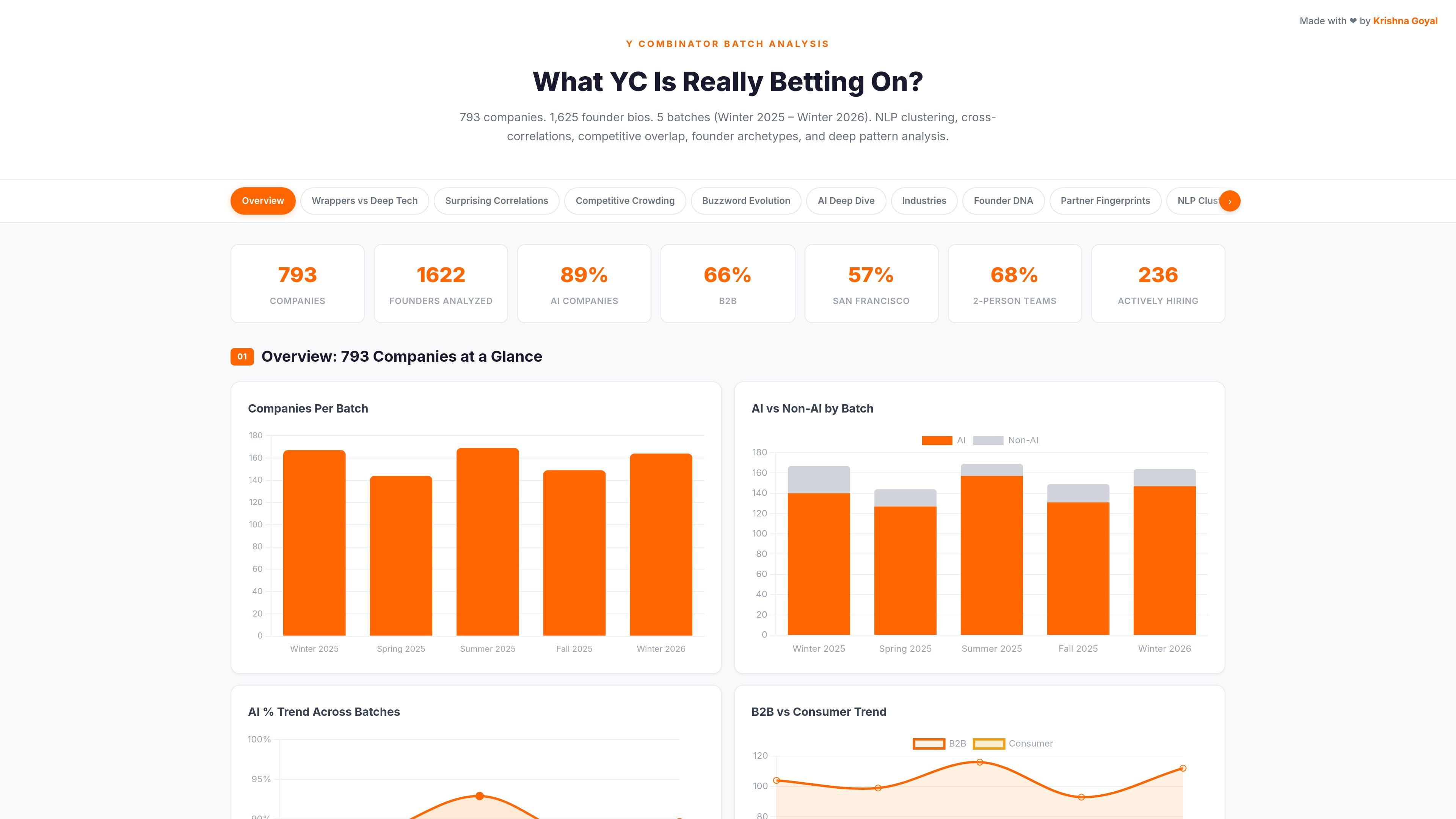
A data analysis product that examines 793 Y Combinator companies and 1,625 founder bios across five batches to surface patterns in AI depth, founder backgrounds, crowding, and batch composition. It is aimed at readers who want a structured view of YC funding trends rather than a company directory.

What YC Is Really Betting On

Overview

What YC Is Really Betting On is a data analysis product that examines 793 Y Combinator companies and 1,625 founder bios across five batches, covering Winter 2025 through Winter 2026. It organizes the cohort into views such as AI vs. non-AI, founder archetypes, competitive overlap, hiring signals, naming patterns, and partner preferences.

The homepage frames the product as a structured trend analysis rather than a directory or marketplace. Its purpose is to help readers understand what kinds of startups YC is funding, how those companies cluster, and which patterns stand out across the batches.

What the analysis surfaces

Batch-level trend analysis

Breaks down 793 YC companies across five batches and summarizes the main shifts over time, including AI share, B2B share, team size, and hiring activity.

AI depth breakdown

Classifies AI companies into wrappers, applied AI, AI infrastructure, and deep tech so readers can see how much of the batch is technical depth versus thin application layers.

Founder and team profiling

Maps founder background signals such as ex-FAANG and PhD experience, plus team composition and location patterns like San Francisco concentration.

Correlation analysis

Identifies statistical relationships such as sector correlations, hiring patterns, and naming trends to highlight non-obvious patterns in the dataset.

Competitive overlap scoring

Measures competitive crowding by vertical and flags especially crowded or unusually unique companies within the batches.

Text clustering and archetypes

Groups companies into NLP clusters and pattern-based archetypes, including partner fingerprints and thematic segments like founder DNA and the archetype view.

Where it is useful

  • Tracking YC batch trends

    Useful for people who want a compact read on what YC is funding across recent batches, especially when comparing AI, B2B, and deep-tech concentration over time.

  • Studying startup positioning

    Helpful for founders or operators who want to see how YC companies are grouped by archetype, naming patterns, and competitive crowding before positioning a startup.

  • Researching cohort patterns

    Relevant for investors, analysts, or journalists looking for quantitative evidence about founder backgrounds, company mix, and cluster-level patterns in YC cohorts.

  • Finding reference companies

    Useful when you want examples of companies in crowded or unusual categories, since the analysis includes representative companies for wrappers, applied AI, infrastructure, and deep tech.

Pros and Cons

Pros

  • Covers a clearly defined corpus: 793 companies and 1,625 founder bios across five batches.
  • Breaks the analysis into multiple lenses, including AI depth, founder background, crowding, and naming.
  • Highlights specific quantified findings, such as the share of AI companies and the decline in wrapper-style companies across batches.
  • Surfaces both broad trends and example companies, which makes the analysis easier to interpret.

Cons

  • The public pages do not show pricing, trial terms, or plan details.
  • The pricing URL returns a 404, so there is no visible plan page to review.
  • The site text does not describe integrations, exports, or a documented workflow for teams.

FAQ

What is this product for?

The site presents an analysis of 793 Y Combinator companies across five batches, from Winter 2025 through Winter 2026. The homepage does not describe a separate setup flow or login-based workflow.

What kinds of insights does it cover?

The published analysis focuses on company mix, AI depth, founder backgrounds, competitive overlap, naming patterns, hiring signals, and partner fingerprints. It is intended for readers who want a structured view of YC batch trends rather than a general company directory.

How much data is analyzed?

The homepage highlights analysis of 793 companies and 1,625 founder bios, along with NLP clustering, cross-correlations, and competitive overlap. It does not mention an export format or downloadable dataset on the page text provided.

Is pricing available?

The site text does not show pricing information, and the pricing page resolves to a 404. Based on the available evidence, pricing is not disclosed on the public pages provided.

Quick Facts

Category
Market research
Scope
793 YC companies across 5 batches
Founder bios analyzed
1,625
Primary focus
YC batch trend analysis and clustering
Source domain
yc-trends.vercel.app
Pricing
Not disclosed on the provided pages
