
Bring your own AI agent
Connect Macaly Cloud to Claude, ChatGPT, or Grok Bot and continue describing requirements in the agent conversation rather than switching to a separate builder interface.

Macaly Cloud gives Claude, ChatGPT, or Grok Bot hosting, databases, previews, authentication, and other infrastructure for building and publishing websites and web apps from a conversation. It is suited to users who want an AI agent to handle code while they use a managed platform for deployment and project services.
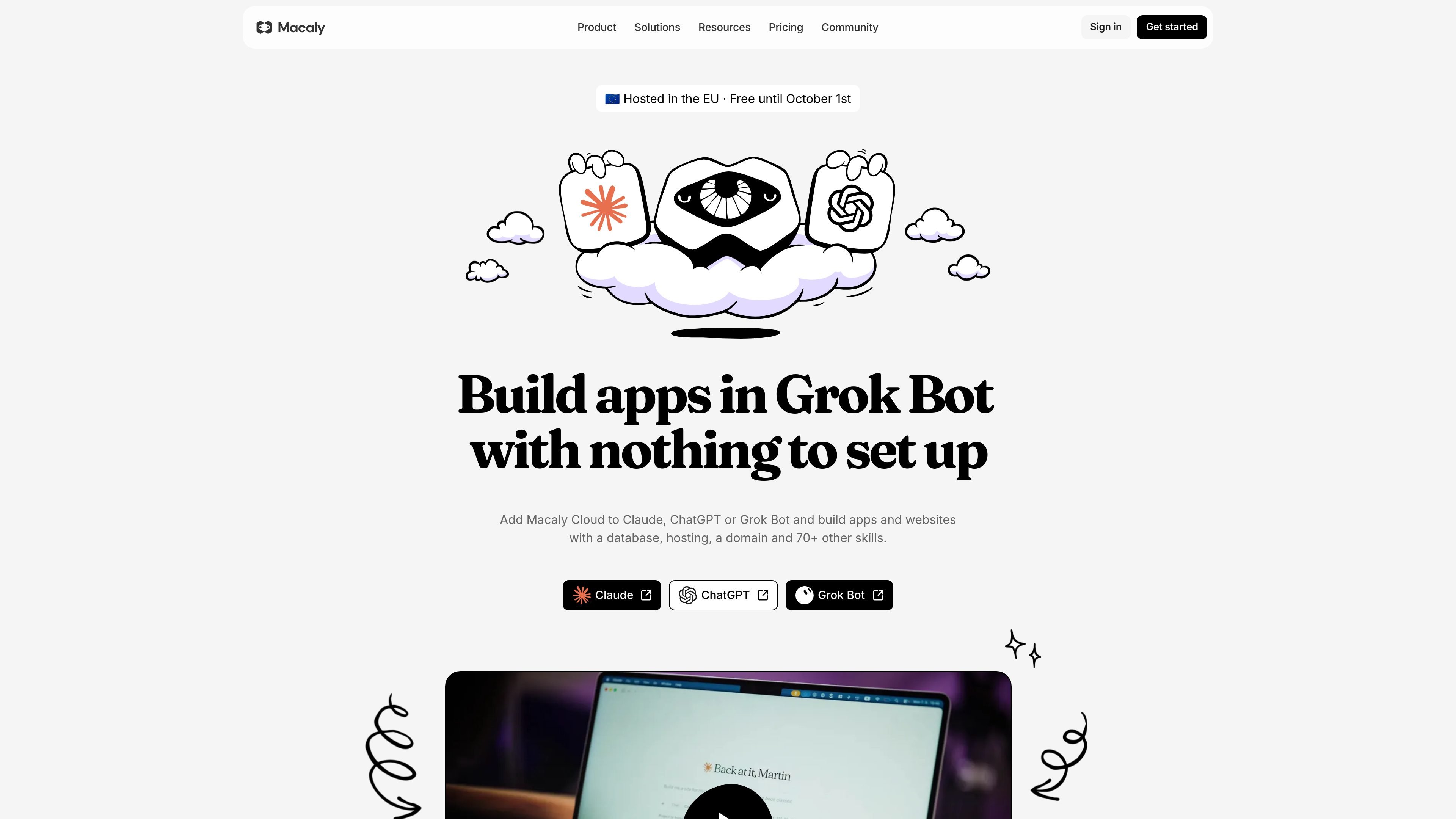
Macaly Cloud is a hosted development platform that gives Claude, ChatGPT, or Grok Bot infrastructure for creating and publishing web apps and websites. A user connects an agent, describes the desired project in chat, and the agent writes the code while Macaly Cloud supplies hosting, previews, a database, authentication options, and related skills.
The documented stack includes React and Next.js with a managed Postgres database. Projects can be published on a macaly.app address, while custom domains are supported through applicable paid options. Macaly states that projects and data are hosted in Frankfurt and Ireland, with source code and data available for export.
Connect Macaly Cloud to Claude, ChatGPT, or Grok Bot and continue describing requirements in the agent conversation rather than switching to a separate builder interface.
The agent can create and connect a managed Postgres database when the project needs persistent data, with database usage limits determined by the applicable plan.
Each change can produce a preview link, and a publish instruction puts the project online at a macaly.app address. Custom domains are available through paid plan options or domain connection.
Projects can include Google sign-in, email authentication, or one-time codes without requiring the builder to implement the authentication flow from scratch.
Macaly projects support metadata, server-side rendering, and favicons for indexable pages. Higher-tier pricing information also lists SEO optimization and analytics capabilities.
The platform lists more than 70 additional skills, including email, analytics, payments, voice, web search, image generation, AI-powered apps, and integrations such as WhatsApp and Telegram, with availability varying by plan.
Describe a landing page, campaign site, or small interactive web experience in an AI chat, then preview revisions and publish it without separately configuring a hosting service.
Specify the screens, data fields, and user flow for a lightweight web application. The agent can wire the project to a managed database and add authentication options where required.
Build an AI-enabled product that uses capabilities such as chat, summaries, image or video generation, or voice without setting up a separate API key for each listed capability.
Create a client project on the web stack and publish it to a macaly.app address or connected custom domain. Agencies needing separate workspaces, billing, or client permissions can use the higher-tier Agency offering listed on the pricing page.
Use the connected agent to extend an existing project with email, analytics, payments, search, or messaging integrations when the relevant skill and plan are available.
Macaly Cloud connects to Claude, ChatGPT, or Grok Bot. After signing in, you describe the app or website you want in the agent conversation, and the agent builds it, connects the database when needed, and can publish it online.
Macaly Cloud includes hosting, previews, a macaly.app address, a database allowance, SEO features, authentication options, and access to additional skills. Some skills may use Macaly AI credits. The standalone Macaly Cloud offer is described as free until October 1, after which it is listed at $10 per month.
Hosting is included for a live macaly.app address. A custom domain must be purchased through Macaly or connected from another registrar; Macaly handles the DNS records and certificate.
Projects and data run on European infrastructure in Frankfurt and Ireland. Macaly states that it is GDPR compliant, does not use customer content to train AI models, and allows source code and data to be exported.
The documented web stack uses React and Next.js with a managed Postgres database. Users do not need to install or configure these components themselves.

CreateOS Sandbox is an isolated compute environment for running code and agent workloads inside Firecracker micro-VMs. It is designed for workflows that need machine-level isolation, private networking between sandboxes, and programmatic control through SDK, CLI, or MCP.

GitBot is a local browser-based workspace for creating reusable coding bots powered by Claude Code, Codex, or OpenCode. It helps developers run those agents across repository folders with persistent threads and configurable permissions.

Codex Plugins bundle reusable skills, app integrations, and MCP servers into workflows you can install in the Codex app or use from Codex CLI. They help extend Codex with connected-service tasks, reusable instructions, and shared team workflows.

Wallie is an open-source AI streamer that watches your screen, hears chat, and generates live commentary in a configurable persona. It runs locally on your machine with your own keys and is aimed at faceless content, autonomous streams, and real-time reactions.

Prompty Town is a web product that turns a link into a building in a small internet city. It appears to let users buy a tile, add a prompt, and publish the result alongside other buildings.

Make Real is a Next.js app that turns hand-drawn wireframes into working HTML prototypes using the tldraw SDK and AI models. It helps users sketch on a canvas, generate code, and review the result in an embedded preview.