
Large pattern catalog
The homepage shows 303 patterns, giving readers a broad set of examples to browse by category, company, or tag.

Product Patterns is a curated library of real UX patterns, frameworks, and psychology principles drawn from live products. It helps designers, product teams, and researchers study how modern interfaces handle onboarding, trust, discovery, pricing, and other common product interactions.
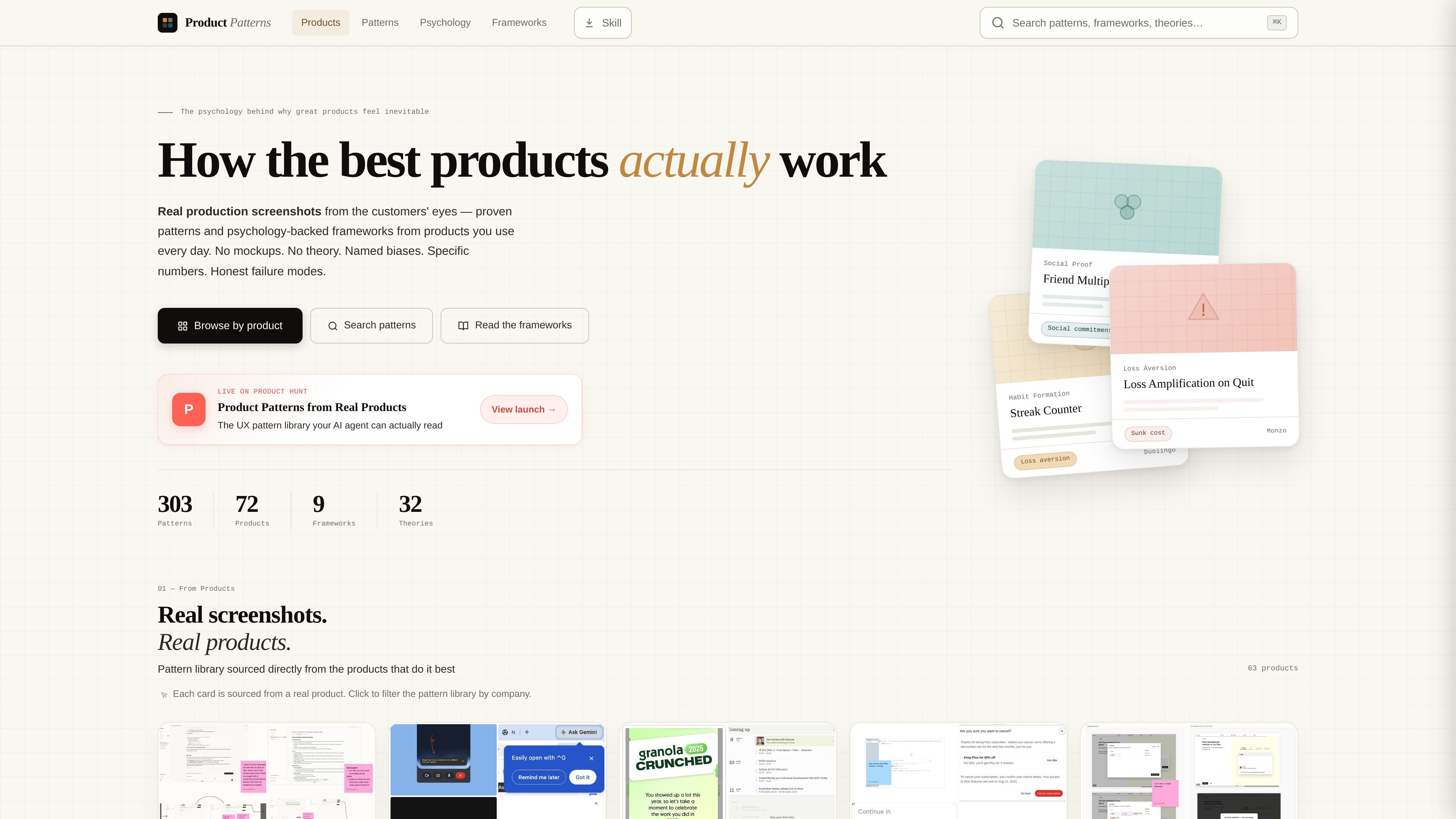
Product Patterns is a reference site for studying UX patterns from real products. It organizes examples from production interfaces into categories such as onboarding, cognitive load, trust, feature discovery, pricing psychology, and anti-patterns, with the goal of making behavioral and interaction patterns easier to browse and compare.
The site presents a large catalog of examples across products and tags, and it also includes tools for contributing screenshots, comparing patterns side by side, and exploring a compiled knowledge graph of patterns, frameworks, theories, and contradictions.
The homepage shows 303 patterns, giving readers a broad set of examples to browse by category, company, or tag.
Patterns can be organized through multiple lenses, including broad UX topics, named products, and specific interaction tags.
A submission page lets users share a real production screenshot so it can be added to the collection.
A diff page compares two approaches side by side and highlights mechanism, placement, success conditions, and failure modes.
A graph view links patterns, frameworks, psychology concepts, intents, and contradictions, and lets users traverse related nodes.
The interface emphasizes pattern search, making it easier to look up examples without manually scanning the catalog.
Designers can look up existing examples to compare interface choices against patterns already used in other products.
Researchers and instructors can use the catalog to illustrate concepts such as cognitive load, trust, onboarding, and progressive disclosure with concrete product examples.
Teams evaluating two interaction approaches can use the diff view to compare how each works and where each may fail.
Users who find a real-world interface worth documenting can submit a screenshot for inclusion in the collection.
People investigating a UX question can move through the knowledge graph to follow links between patterns, frameworks, theories, and contradictions.
It is a curated collection of UX patterns, frameworks, and psychology concepts drawn from real products.
The catalog includes topics such as onboarding, feature discovery, trust, cognitive load, conversion, pricing psychology, and anti-patterns.
Yes. The submission page invites users to share a real production screenshot for review.
Yes. The pattern diff page is designed to compare two approaches side by side across mechanism, placement, success conditions, and failure modes.
No pricing details were available from the fetched pages, and the pricing URL returned a 404.

MacSpoof ist ein MAC-Adressenwechsler für macOS: WLAN-MAC ändern oder randomisieren, um Verbindungen zu erneuern und die Protokollierung auf öffentlichem WLAN zu reduzieren.

NomNak ist eine kostenlose Restaurant-Discovery-App für iPhone, mit der du Orte über Empfehlungen von Freunden statt über anonyme Bewertungen findest.

TyeGit ist ein nativer Git-Client auf Basis von Rust und Tauri für schnelle, präzise Kontrolle über Staging, Commits, Branches und Remotes unter Windows, macOS und Linux.

Loomal is a payments layer for agentic commerce that lets developers add paywalls to APIs, MCP tools, or hosted files. It settles agent payments in USDC on Base and is aimed at services that want per-request payment from AI agents.

idmly converts self-contained HTML designs into editable Adobe InDesign (.idml) files. It is built for designers and teams that need browser-made or AI-generated layouts turned into InDesign without rebuilding them by hand.

Rokoko is a motion capture software and hardware ecosystem for body, finger, and face animation. Rokoko Studio processes capture data, lets creators clean and retarget it, and streams or exports it to 3D tools.