
Adoption-based scoring
The hackathon scores projects on actual human, technical, and financial adoption, with public reports showing a PoU score that cross-checks claims against publicly available data.

Proof of Usefulness is HackerNoon’s tech and AI hackathon for developers and startups that want to compete on real adoption rather than pitch quality. Participants submit a live project, generate a PoU report, and publish documentation on HackerNoon for monthly and grand prizes.
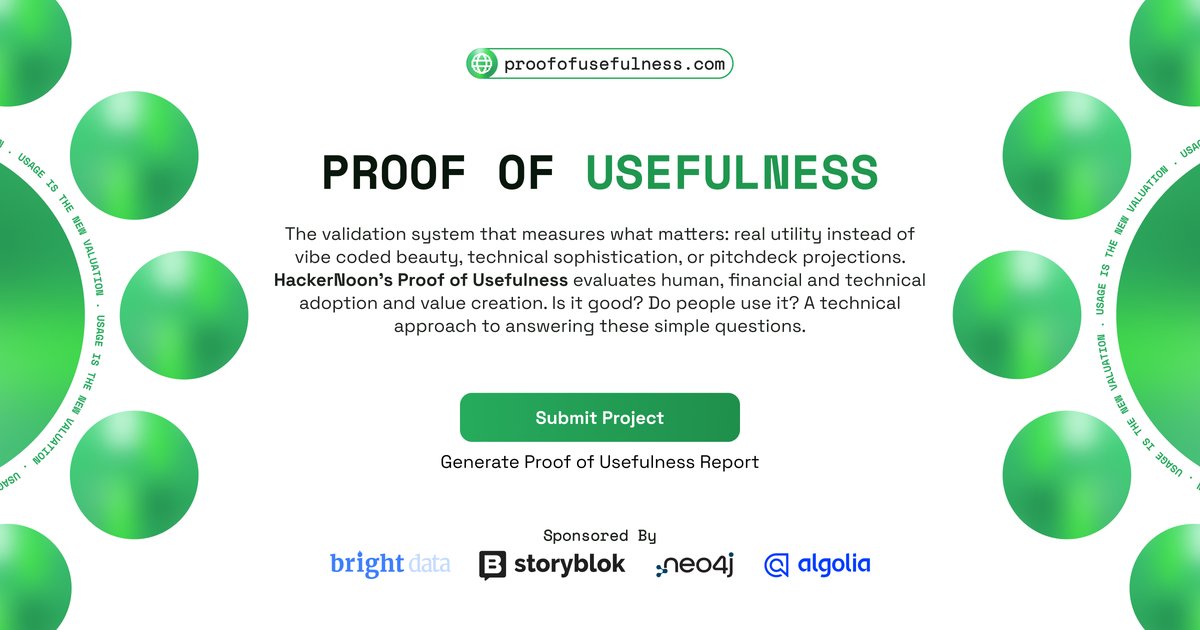
Proof of Usefulness is HackerNoon’s tech and AI hackathon built around a simple scoring idea: usefulness should matter more than presentation polish, speculative pitch decks, or technical showmanship. Projects are evaluated on real human, technical, and financial adoption, and the site frames the program as a way to measure whether a tool is actually being used.
The program is open to individual developers and budding startups, and it gives entrants a path that combines project submission, a Proof of Usefulness report, and HackerNoon publication. Rolling submissions run from January 5 to June 5, 2026, with monthly cash prizes and a final grand-prize pool for top-scoring projects.
The hackathon scores projects on actual human, technical, and financial adoption, with public reports showing a PoU score that cross-checks claims against publicly available data.
Entrants submit a live project URL, GitHub repo, and integrated tech stack to generate a Proof of Usefulness report; the site says this report is required for scoring.
Participants are asked to document the problem, solution, and implementation on HackerNoon, with code snippets and relevant tags, to complete the entry and reach judges.
The program runs on a rolling schedule from January 5 to June 5, 2026, with monthly judging and the ability to improve a project and resubmit updates over time.
The site offers sponsor credits and build inventory to help participants start or expand projects, including Bright Data credits, Storyblok access, Neo4j AuraDB Build, Algolia Build tier, and HackerNoon publishing credit.
Any technology is allowed, but the page notes that larger prizes are reserved for AI and ML projects using sponsor technologies, shaping how teams choose their stack.
A solo developer with a working product can submit the live URL, repo, and stack to get a PoU report and then publish a technical write-up on HackerNoon to finish the entry.
A startup team that already has users, API activity, or open-source traction can use the rolling window to improve the product, resubmit, and try to raise its score before monthly judging.
An AI or ML project using sponsor technologies can combine the hackathon’s free credits with the documentation step to qualify for the larger prize tracks tied to those sponsor categories.
A builder who needs infrastructure or discovery tools can claim sponsor resources such as Bright Data, Storyblok, Neo4j AuraDB, or Algolia Build access to support development before submission.
A technical founder looking for both feedback and exposure can publish a HackerNoon article about the problem, solution, and implementation while also competing for cash prizes and a public PoU score.
Projects begin by submitting a live project URL, GitHub repo, and integrated tech stack to generate a Proof of Usefulness report. That report is the official registration step and the page says a project will not be scored without it.
The submission flow asks for evidence of traction such as active users, API calls, or GitHub stars and forks. The site also says projects can be updated over time to improve their PoU score during the rolling judging period.
The site says all technologies are welcome, but bigger prizes are reserved for AI and ML projects that use sponsor technologies. The public report pages also show that the algorithm evaluates human, technical, and financial adoption rather than only design or pitch quality.
Yes. The entry flow is designed around a project submission plus a HackerNoon publication, and the hackathon pages say individual developers and budding startups are welcome to participate.
The published sources do not show a formal integration checklist beyond submitting the live project, repo, and stack, plus optionally using sponsor technologies such as Bright Data, Storyblok, Neo4j, or Algolia when relevant to the prize tracks.

MacSpoof ist ein MAC-Adressenwechsler für macOS: WLAN-MAC ändern oder randomisieren, um Verbindungen zu erneuern und die Protokollierung auf öffentlichem WLAN zu reduzieren.

NomNak ist eine kostenlose Restaurant-Discovery-App für iPhone, mit der du Orte über Empfehlungen von Freunden statt über anonyme Bewertungen findest.
TyeGit ist ein nativer Git-Client auf Basis von Rust und Tauri für schnelle, präzise Kontrolle über Staging, Commits, Branches und Remotes unter Windows, macOS und Linux.

Loomal is a payments layer for agentic commerce that lets developers add paywalls to APIs, MCP tools, or hosted files. It settles agent payments in USDC on Base and is aimed at services that want per-request payment from AI agents.

idmly converts self-contained HTML designs into editable Adobe InDesign (.idml) files. It is built for designers and teams that need browser-made or AI-generated layouts turned into InDesign without rebuilding them by hand.

Rokoko is a motion capture software and hardware ecosystem for body, finger, and face animation. Rokoko Studio processes capture data, lets creators clean and retarget it, and streams or exports it to 3D tools.