Clyro icon

Clyro

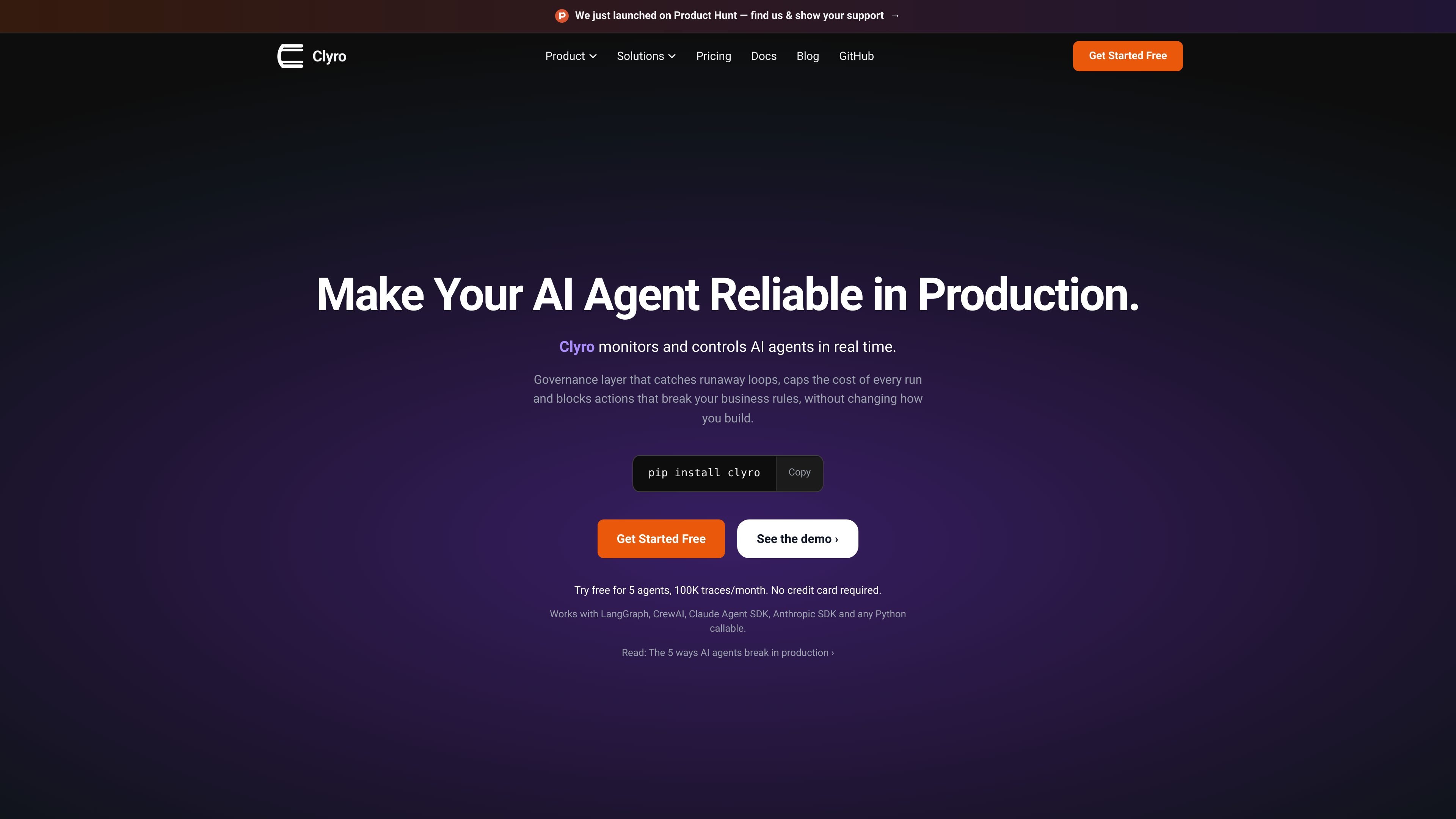
Clyro is a runtime governance layer for AI agents that monitors execution, enforces policies, and limits runaway behavior before failures escalate. It is aimed at teams building production agents with frameworks like LangGraph, CrewAI, Claude Agent SDK, Anthropic SDK, or custom Python callables.

Clyro

Runtime governance for AI agents

Clyro wraps AI agents with runtime controls that monitor execution, enforce policy rules, and limit cost or step growth before a run goes off track. It is designed for production agent systems where the main concern is not model quality alone, but what the agent does while it is acting.

The product supports Python-based agent workflows and works with frameworks including LangGraph, CrewAI, Claude Agent SDK, Anthropic SDK, and generic Python callables. Teams can use it to add governance without changing the basic way they build agents.

Core capabilities

Policy enforcement at tool-call time

Define rules for tool parameters with operators such as max value, equals, and allowlists. Policies can block violations instantly or log decisions for audit trails, and they can be managed in YAML or through the dashboard.

Audit logging with execution context

Every tool call is recorded with parameters, governance decisions, cost, and outcomes. Logs are stored in append-only JSONL format with sensitive field redaction and fail-open execution handling.

Loop detection and cost bounds

Clyro detects repeated tool-call patterns, such as identical calls in a sliding window, and stops runs before costs spiral. The CostTracker checks budgets before execution and tracks accumulated spend across the session.

Replay and trace comparison

The cloud plans include local replay, flame graphs, and trace comparison so teams can inspect how an agent reached a result and compare runs when behavior changes.

Drift detection and reliability scoring

Starter and Team plans add drift detection, while the product also exposes an Agent Reliability Index with trends and alerts so teams can watch for changes in agent behavior over time.

MCP governance wrapper

Clyro can sit between an agent and an MCP server to apply default-deny server allowlists, parameter rules, loop detection, and cost ceilings to every tool call.

Practical use cases

  • Production agent guardrails

    Teams shipping agents can wrap an existing agent and apply runtime controls such as step limits, cost ceilings, and policy checks before tool execution.

  • MCP tool governance

    For agents that use the Model Context Protocol, Clyro adds server-scoped allowlists and parameter rules so tool access and write actions can be constrained centrally.

  • Agent debugging and incident review

    Shared replays, flame graphs, trace comparison, and full audit logs help teams understand what happened in a run and compare it against expected behavior.

  • Monitoring behavioral drift

    Drift detection and ARI trends are aimed at teams that want to notice when agent behavior changes over time rather than discovering it after a visible incident.

  • Team policy management

    Cloud policy sync, shared dashboards, RBAC, and alerts support teams that want to define governance once and apply it across multiple agents or environments.

Pros and Cons

Pros

  • Covers prevention, not just post-run observability.
  • Works with several popular agent frameworks and generic Python callables.
  • Includes audit logs, replay, drift detection, and cost controls in one product.
  • Offers a free tier and cloud tiers for teams that need shared governance.
  • Supports enterprise deployment options such as SSO and self-hosted use.

Cons

  • The strongest feature detail comes from the pricing and MCP pages; the broader product documentation is less complete in the provided source.
  • Some advanced capabilities are tied to higher-priced cloud or enterprise plans rather than the free tier.
  • The source does not fully document every supported framework or workflow in one place.

FAQ

What does Clyro actually do at runtime?

It wraps an agent and evaluates tool calls before they execute, using controls such as policy checks, loop detection, cost limits, and step limits. It also logs execution context for review.

Which frameworks does Clyro support?

The source names LangGraph, CrewAI, Claude Agent SDK, Anthropic SDK, and a generic adapter for Python-based agents or callables.

Does Clyro only provide observability?

No. The product is positioned as a prevention layer, so it blocks or bounds risky behavior at runtime rather than only showing what failed afterward.

Is there a free tier?

Yes. The pricing page shows a free plan with usage limits, plus paid Starter, Team, and Enterprise options.

What does the MCP wrapper add?

It adds default-deny governance for MCP tool calls, plus server-scoped allowlists, parameter rules, audit logging, loop detection, and cost ceilings.

Quick Facts

Category
Developer Tool
Product type
Runtime governance layer for AI agents
Primary users
Teams building production AI agents
Framework support
LangGraph, CrewAI, Claude Agent SDK, Anthropic SDK, generic Python
Deployment
SDK plus cloud dashboard; enterprise self-hosted option available
Website
clyro.dev

Alternativas a Clyro

CreateOS Sandbox icon

CreateOS Sandbox

CreateOS Sandbox is an isolated compute environment for running code and agent workloads inside Firecracker micro-VMs. It is designed for workflows that need machine-level isolation, private networking between sandboxes, and programmatic control through SDK, CLI, or MCP.

ByteAsk icon

ByteAsk

ByteAsk is a terminal-first AI coding agent for C and C++ that edits repositories and verifies changes with the real compiler, debugger, sanitizers, and tests before showing a diff. It offers a free tier plus paid plans, with editor connectors and zero-retention handling described in the source.

hob icon

hob

hob is an independent workspace for coding agents that keeps agent sessions, terminals, history, and follow-up work organized around the tools and providers you already use. It is aimed at developers who want local control over routing, history, and workspace structure rather than a bundled model stack.

Manta AI icon

Manta AI

Manta AI is an autonomous web app testing tool for teams that want to map application behavior, catch regressions, and generate tests without writing scripts or maintaining selectors. It works from a URL and supports plain-English test flows, run results with screenshots, and scheduled or deployment-triggered checks.

SonOf icon

SonOf

SonOf connects to your repo and PM tool, audits the codebase and surrounding product context, and turns approved work into shipped tickets with senior engineering review. It is aimed at founders and engineering leaders who need backlog help without hiring a full team immediately.

Ghost icon

Ghost

Ghost es un asistente de IA para terminal para chatear, generar código y ejecutar tareas en la línea de comandos. Incluye modelos gratuitos, es compatible con Linux, macOS y Windows, y es de código abierto.