
Monitor event sources
Momentra monitors trusted organizations and their public event sources so publishers do not have to repeatedly check each site manually.

Momentra monitors public event sources, discovers and refreshes event records, and delivers structured data to calendars, guides, newsletters, apps, and AI workflows. It is built for independent publishers and event-discovery platforms that aggregate events from many community organizations.
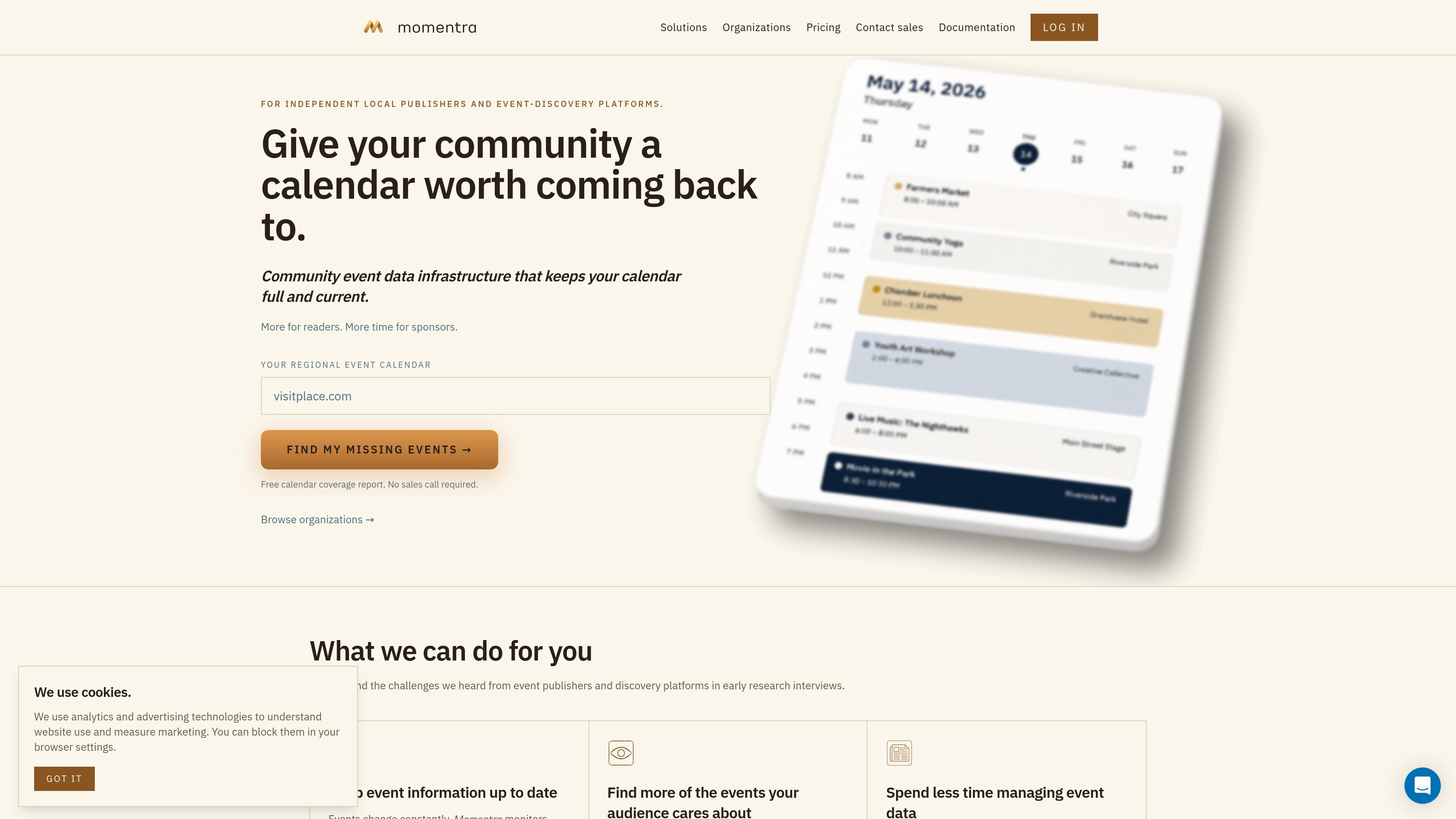
Momentra is community event data infrastructure for independent publishers and event-discovery platforms. It monitors public event sources from organizations such as libraries, venues, towns, publishers, chambers, businesses, and other community groups, then helps identify, refresh, and deliver event records for downstream products.
The service is intended for calendars and guides that need broader, more current coverage without relying on repeated manual searches or inconsistent submissions. Teams keep their existing website or app and retain editorial control over the records and their sources; available delivery options listed by Momentra include an Events API, ICS, RSS, and MCP.
Momentra monitors trusted organizations and their public event sources so publishers do not have to repeatedly check each site manually.
The service searches across scattered organization calendars and other listed sources to identify events that may be missing from an existing calendar or guide.
Event information is refreshed as source details change. Re-fetches and updates to an event already received are not charged as additional events.
Momentra delivers structured event information to existing calendars, guides, newsletters, apps, and AI agents, while each record retains its source for editorial review and control.
The site lists Events API, ICS, RSS, and MCP, and shows connections or examples involving tools and platforms such as Google Calendar, Microsoft 365, WordPress, Mailchimp, and Eventbrite.
Enterprise packages can include done-for-you calendar automation, custom feeds and integrations, webhooks, custom taxonomies, editorial controls, and higher throughput or rate limits.
A regional publisher can supplement its existing calendar by having Momentra identify public events from libraries, venues, towns, and other organizations that do not submit consistently.
A family activity guide or local lifestyle publication can receive structured event records for editorial review instead of manually finding, checking, formatting, and re-entering listings across many websites.
An event-discovery app can use refreshed records from multiple community sources while keeping its current website or application as the reader-facing product.
A newsletter team can use event data delivered to its existing workflow to assemble recurring local listings without repeatedly checking the same organization calendars.
A team building an AI-powered event experience can connect through MCP, while publishers and developers can also use the listed API, ICS, or RSS options for non-chat workflows.
Momentra is designed for calendars and discovery products that aggregate public events from many independent organizations. The site specifically lists independent regional publishers, family activity guides, local lifestyle and travel publications, and local event-discovery platforms. It is not designed for organizations publishing only their own events.
Momentra monitors organizations, discovers upcoming public events, refreshes event information, and delivers structured records to the calendar, guide, newsletter, app, or AI workflow you already use. The site lists Events API, ICS, RSS, and MCP as output or connection options.
No. An event is counted as one unique record, and re-fetches or updates to an event already received do not count again. Monthly subscription allowances reset at the end of each billing cycle, including annual plans, while additional credits can be purchased at 1¢ per event.
Momentra offers a free calendar coverage report and says account creation includes 100 credits. Paid usage is available pay as you go or through monthly subscriptions; enterprise arrangements can include custom feeds, integrations, webhooks, taxonomies, editorial controls, support, and higher throughput or rate limits.

Mindcase is a web data API and console for extracting structured data from websites and major online platforms. It helps users retrieve clean rows of data through prompt or API access, with prepaid per-record billing.

Octen is a search infrastructure product for AI applications that need live web context, structured answers, and retrieval tools for agents, copilots, and chatbots. It combines search, extraction, multimodal retrieval, and developer access paths such as API, SDKs, Skills, MCP, and CLI.

Skayle is a content and AI search visibility platform that researches topics before writing, publishes structured content to a CMS, and tracks whether brands are cited in AI search. It is aimed at teams that want one system for publishing, schema-rich content, and visibility monitoring.

TinyFish is a web infrastructure platform for AI agents that combines live search, page fetching, browser sessions, and multi-step automation. Search and Fetch are free, while Agent and Browser are metered against Wallet funds.

Happenstance is an AI-powered network search tool for finding people, mutual connections, and warm introductions across connected accounts. It supports individual use, shared team groups, and developer workflows through API, MCP, Slack, and other integrations.

Bardeen is a lead-sourcing and outreach automation platform that helps teams and individuals scrape leads, qualify them with AI, enrich contact details, and export results to common work tools. It is aimed at workflows where prospect research, enrichment, and outreach preparation are repetitive.