
Local-first workspace
OpenBot runs as a local application, keeping API keys, agent configurations, and task data on the user’s machine rather than on vendor servers.

OpenBot is a local-first multi-agent coordination platform that helps users break down tasks, assign work to specialized agents, and track progress in one shared workspace.
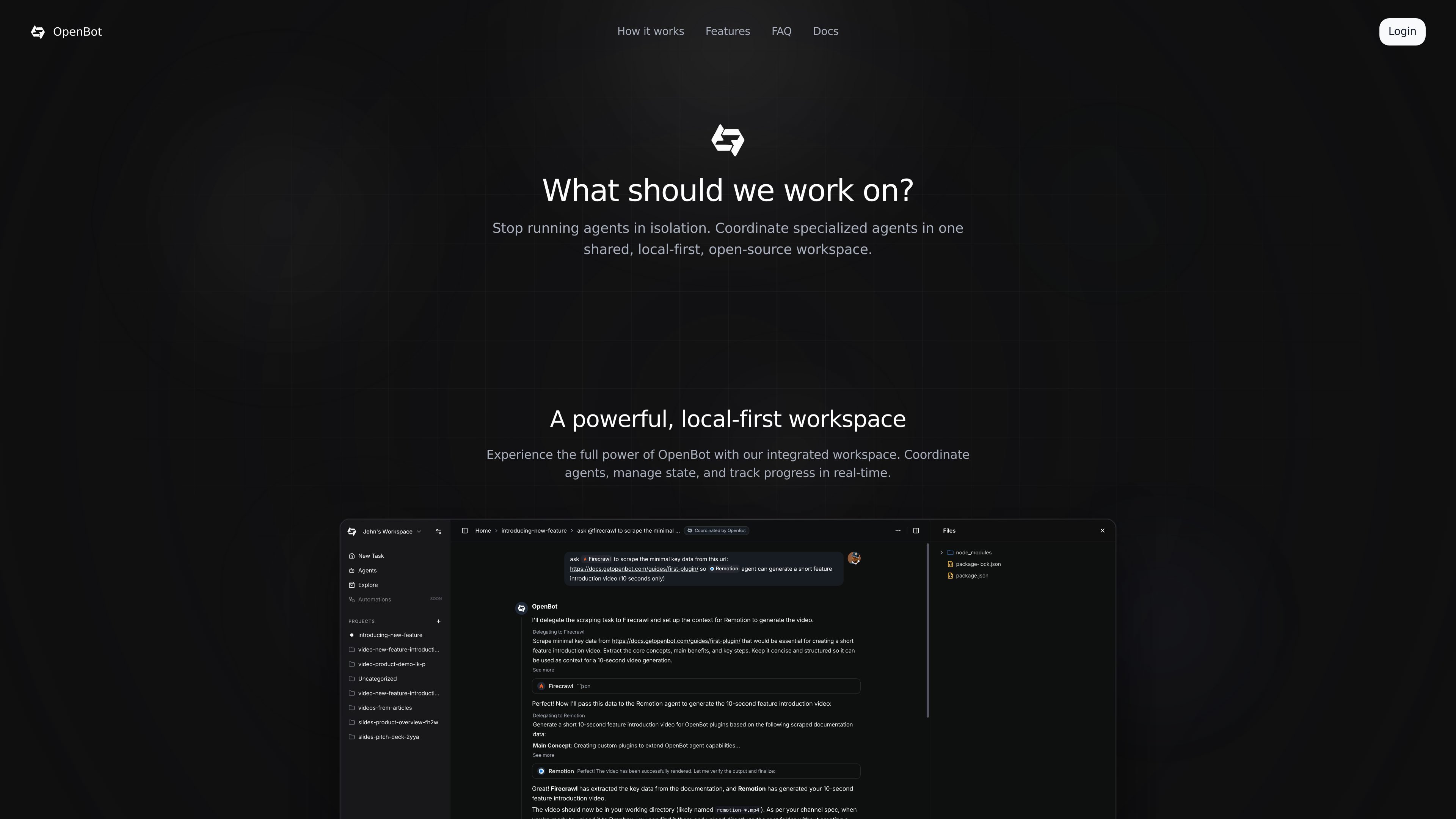
OpenBot is a multi-agent coordination platform for running specialized AI agents in a shared workspace. It is positioned as a local-first application for people who want to orchestrate agent workflows instead of running agents in isolation.
The product centers on task decomposition, agent coordination, and transparent progress tracking. Users describe a task in natural language, OpenBot assigns subtasks to capable agents, and results are delivered back into the user’s environment.
OpenBot runs as a local application, keeping API keys, agent configurations, and task data on the user’s machine rather than on vendor servers.
A central controller breaks a task into subtasks and coordinates specialized agents to work through multi-step workflows.
The workspace shows agent activity in real time, including thoughts, actions, and file changes, so users can follow progress as it happens.
The platform stores context across sessions so agents can continue longer projects and research without starting from scratch.
OpenBot supports bring-your-own-key setup for providers including OpenAI, Anthropic, and Google Gemini.
Users can browse community agents in a registry or build their own agents with the SDK and documentation.
Useful when a task needs planning, decomposition, and execution across several specialized agents rather than a single chat thread.
Fits users who want to keep API keys, agent settings, and task state on their own machine for privacy or speed reasons.
Works for builders who want to create, test, and deploy custom agents using the provided SDK and documentation.
Helps users monitor long-running work by showing thoughts, actions, and file changes as they occur in the workspace.
Appropriate for teams or individuals who want to reuse community agents from a registry instead of starting every workflow from scratch.
Yes. The site describes OpenBot as a local application that runs on your machine, with API keys, agent configurations, and task data stored locally.
Yes. OpenBot is a bring-your-own-key platform and says you can connect provider keys directly, including OpenAI, Anthropic, and Google Gemini.
Yes. The site says OpenBot includes a comprehensive SDK and documentation for building, testing, and deploying specialized agents.
OpenBot says a central controller breaks down a natural-language request into subtasks and assigns them to the most capable agents in the workspace.
Yes. The site mentions an Enterprise plan for teams that need features such as SSO, audit logs, and dedicated support.

BotBoard is a task-management layer for AI agents that helps teams assign work, track progress, and review output. It supports CLI, MCP, and HTTP connections for tools like OpenClaw, Codex, Claude Code, and Cursor.

Biji es una plataforma versátil diseñada para mejorar la productividad a través de herramientas y características innovadoras.

runevr is a connected workspace for creative teams that combines boards, media review, chat, recordings, drive, calls, and AI agents in one room-based environment. It is designed to reduce tool switching and keep project context together.

CreateOS Sandbox is an isolated compute environment for running code and agent workloads inside Firecracker micro-VMs. It is designed for workflows that need machine-level isolation, private networking between sandboxes, and programmatic control through SDK, CLI, or MCP.

Codex Plugins bundle reusable skills, app integrations, and MCP servers into workflows you can install in the Codex app or use from Codex CLI. They help extend Codex with connected-service tasks, reusable instructions, and shared team workflows.

hob is an independent workspace for coding agents that keeps agent sessions, terminals, history, and follow-up work organized around the tools and providers you already use. It is aimed at developers who want local control over routing, history, and workspace structure rather than a bundled model stack.