
Agent-oriented financial execution
Sequence positions itself as the financial execution layer for AI agents, meaning it is meant to sit behind agent workflows that need to act on financial tasks.

Sequence is a financial execution layer for AI agents that supports bounded, audited money movement on real US banks. It can be plugged into tools such as n8n, Claude, Base44, and Lovable.
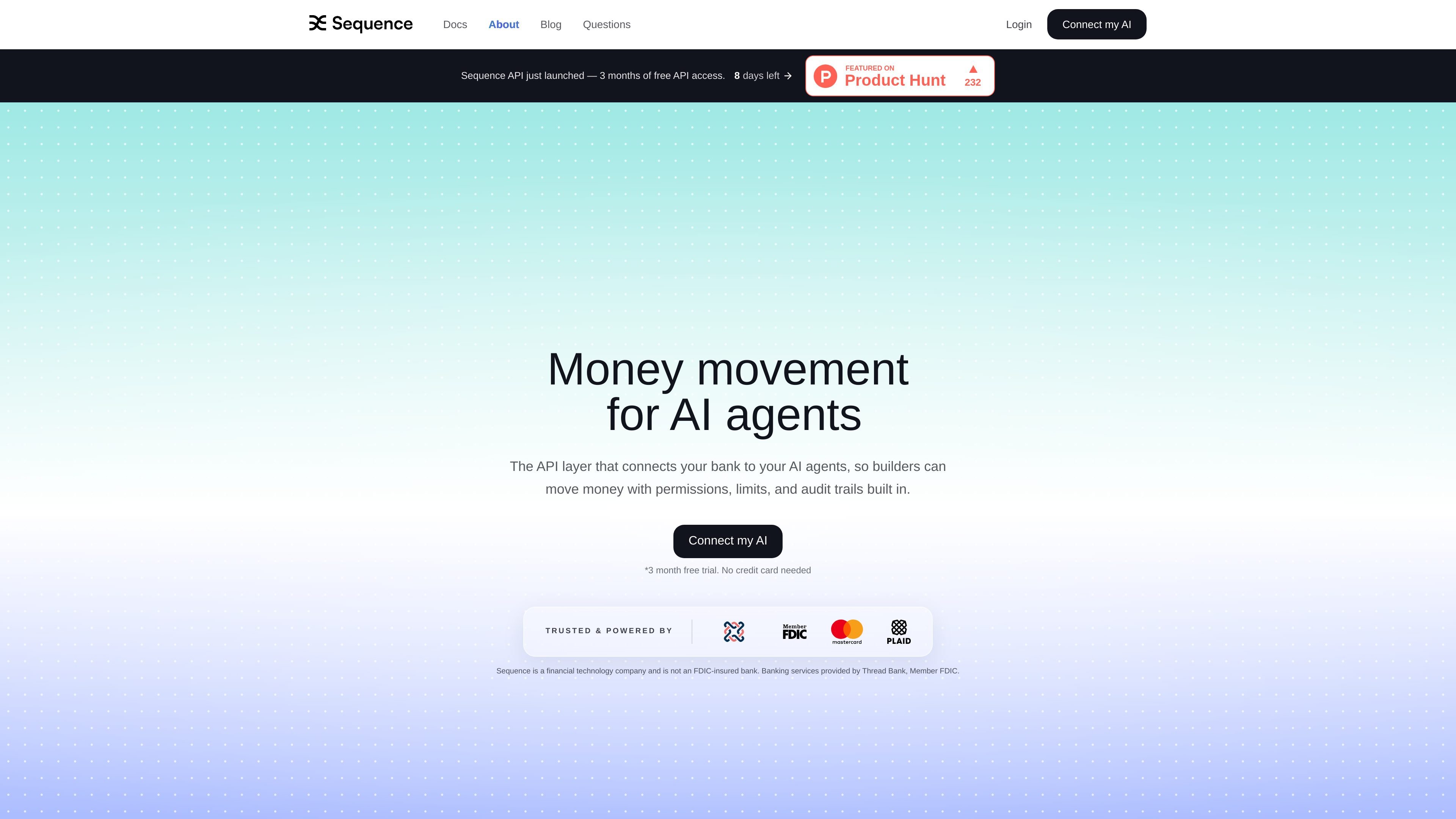
Sequence is a financial execution layer for AI agents. Its public homepage describes the product as “money movement for AI agents” and says it provides bounded, audited money movement on real US banks.
The product is presented as something you can plug into n8n, Claude, Base44, Lovable, and other agentic stacks. Based on the source, Sequence is intended for workflows where an AI agent needs to carry out controlled financial actions with traceability, rather than simply reason about them.
Sequence positions itself as the financial execution layer for AI agents, meaning it is meant to sit behind agent workflows that need to act on financial tasks.
The product emphasizes bounded money movement, which indicates that actions are intended to operate within defined limits rather than unrestricted access.
Sequence says money movement is audited, suggesting that transactions or actions are designed with traceability in mind.
The homepage says it works on real US banks, so the product is tied to actual banking rails rather than a sandbox-only environment.
The product can be plugged into n8n, Claude, Base44, Lovable, and other agentic stacks, which makes it usable in multiple automation environments.
An AI agent in an automation workflow can be connected to Sequence when it needs to initiate financial actions under defined rules instead of only drafting a recommendation.
Teams building assistants in Claude or similar environments can use Sequence to add controlled money movement to an otherwise conversational agent.
Builders using no-code or low-code tools such as n8n, Base44, or Lovable can add a financial execution step to a larger process without switching tools entirely.
Organizations that need transaction activity to be traceable can use the audited workflow model to support review and accountability around agent actions.
The site describes Sequence as the financial execution layer for AI agents, with bounded, audited money movement on real US banks. That suggests it is designed for agent workflows that need controlled financial actions rather than open-ended access.
The homepage says it can be plugged into n8n, Claude, Base44, Lovable, and other agentic stacks. Beyond those examples, the public source does not list a full integration catalog.
The public page does not provide setup steps or a technical onboarding flow. It only indicates that Sequence can be dropped into agentic tools and stacks.
No pricing details are available from the provided source. The pricing URL currently returns a 404, so the public pages do not confirm plans, trials, or usage-based pricing.
The source does not spell out the exact financial actions supported, only that it handles money movement on real US banks in a bounded and audited way. Users would need product documentation or a demo to confirm supported workflows and limits.

CreateOS Sandbox is an isolated compute environment for running code and agent workloads inside Firecracker micro-VMs. It is designed for workflows that need machine-level isolation, private networking between sandboxes, and programmatic control through SDK, CLI, or MCP.

ByteAsk is a terminal-first AI coding agent for C and C++ that edits repositories and verifies changes with the real compiler, debugger, sanitizers, and tests before showing a diff. It offers a free tier plus paid plans, with editor connectors and zero-retention handling described in the source.

Codex Plugins bundle reusable skills, app integrations, and MCP servers into workflows you can install in the Codex app or use from Codex CLI. They help extend Codex with connected-service tasks, reusable instructions, and shared team workflows.

hob is an independent workspace for coding agents that keeps agent sessions, terminals, history, and follow-up work organized around the tools and providers you already use. It is aimed at developers who want local control over routing, history, and workspace structure rather than a bundled model stack.

Wallie is an open-source AI streamer that watches your screen, hears chat, and generates live commentary in a configurable persona. It runs locally on your machine with your own keys and is aimed at faceless content, autonomous streams, and real-time reactions.

Manta AI is an autonomous web app testing tool for teams that want to map application behavior, catch regressions, and generate tests without writing scripts or maintaining selectors. It works from a URL and supports plain-English test flows, run results with screenshots, and scheduled or deployment-triggered checks.