
Atomic fact sheets
Write one claim per line and organize facts with Markdown headings so the spec stays short, readable, and easy for agents to scan.

Facts is an open-source developer tool for fact-driven development with AI agents. It turns project intent into atomic, checkable facts so humans and coding agents can keep specs aligned with code.
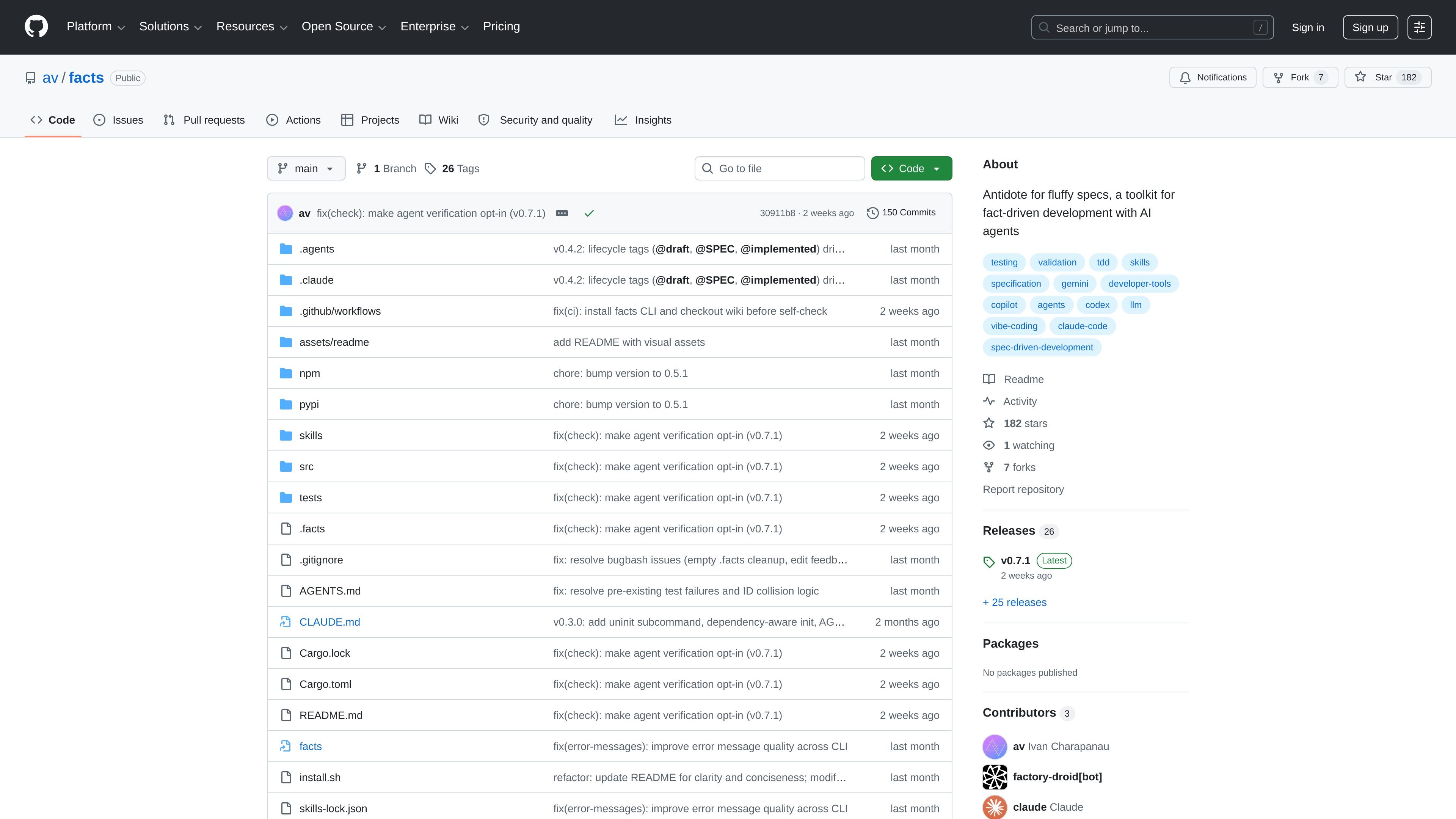
Facts is a developer tool for fact-driven development with AI agents. It replaces long, ambiguous specs with a compact `.facts` file made of atomic claims that describe what should be true in a project. Each fact can be tagged by stage and, when possible, backed by a command that proves it.
The tool is built to keep project intent readable and testable. The CLI can initialize a facts sheet, check command-backed claims, and help agents move work from draft ideas to precise specs and then into implemented, verified facts. The repository describes the workflow as useful for projects that need a clear source of truth for both humans and coding agents.
Write one claim per line and organize facts with Markdown headings so the spec stays short, readable, and easy for agents to scan.
Attach a shell command to facts that can be checked automatically, or leave facts for manual review when a machine check is not practical.
Track each fact through `@draft`, `@spec`, and `@implemented` states so teams can see whether an item is still rough, ready to build, or already backed by code.
Use the CLI to scaffold new sheets, inspect them with list and search commands, and update facts as the project changes.
Install companion skills that help agents discover facts in a codebase, refine rough items into specs, and implement verified work.
Filter facts by tags, sections, file, or text search, which makes it easier to focus on one area of a project at a time.
Create a new `.facts` sheet in an existing repository, detect the stack, and start turning project truths into trackable claims with `facts init`.
Capture requirements as short, atomic statements and add commands where the machine can verify the behavior automatically.
Have an AI coding agent read the fact sheet, work through `@spec` items, and run `facts check` to confirm the changes before marking them implemented.
Use tags, sections, and search filters to inspect one part of a project, such as auth, API behavior, or data handling, without reading the entire sheet at once.
Run `facts check` in CI or after local changes so command-backed facts stay aligned with the codebase over time.
Yes. The README describes `facts init` for scaffolding a `.facts` file and installing the companion skills, and the wiki documents `facts` commands for checking, listing, adding, editing, and removing facts.
Facts is designed around a `.facts` file made of atomic claims, each tagged by lifecycle stage such as `@draft`, `@spec`, or `@implemented`. The CLI can verify command-backed facts with `facts check` and leave manual facts for review.
The source describes companion skills for `facts-discover`, `facts-refine`, and `facts-implement`, which support an agent workflow from rough ideas to implemented and verified facts. The wiki also notes support for AI coding agents such as Claude Code, Cursor, Windsurf, and Aider.
The repository describes the CLI as a single Rust binary with dependencies, and the README states it runs on Linux, macOS, and Windows.
The public repository does not describe separate product tiers for Facts itself. The linked pricing page is GitHub’s platform pricing, while Facts appears to be an open-source repository distributed through code and CLI install commands.

GitBoard est une app native macOS pour GitHub Projects : consultez votre kanban, filtrez par statut, recherchez des issues, créez ou assignez depuis la barre.

Biji est une plateforme polyvalente conçue pour améliorer la productivité grâce à des outils et des fonctionnalités innovants.

Codex Plugins bundle reusable skills, app integrations, and MCP servers into workflows you can install in the Codex app or use from Codex CLI. They help extend Codex with connected-service tasks, reusable instructions, and shared team workflows.

Struere is an AI-native platform for turning spreadsheet data into structured operational software with dashboards, alerts, and automations. It is aimed at teams that want to replace manual spreadsheet workflows without building custom tools from scratch.

Starlie is a native macOS desktop client for Jira Cloud and self-hosted Jira. It helps Jira users search with JQL, manage sprint boards, review issue context, and make selected updates from a Mac app.

Wysera is an AI business platform that combines PostWyse for content and OpsWyse for CRM and revenue workflows, powered by the shared Wyse AI. It is built for solo operators, teams, and agencies that want approval-first automation across publishing, lead follow-up, and related operations.