
Enrich traces with intent and sentiment
Combine prompts, tool calls, model output, and surrounding context so traces include the behavioral signals needed to explain what happened.

Kubit is a product analytics and observability platform for AI agents that connects traces to user behavior. It helps teams understand why users re-prompt, drop off, or convert, and feed those insights back into AI workflows.
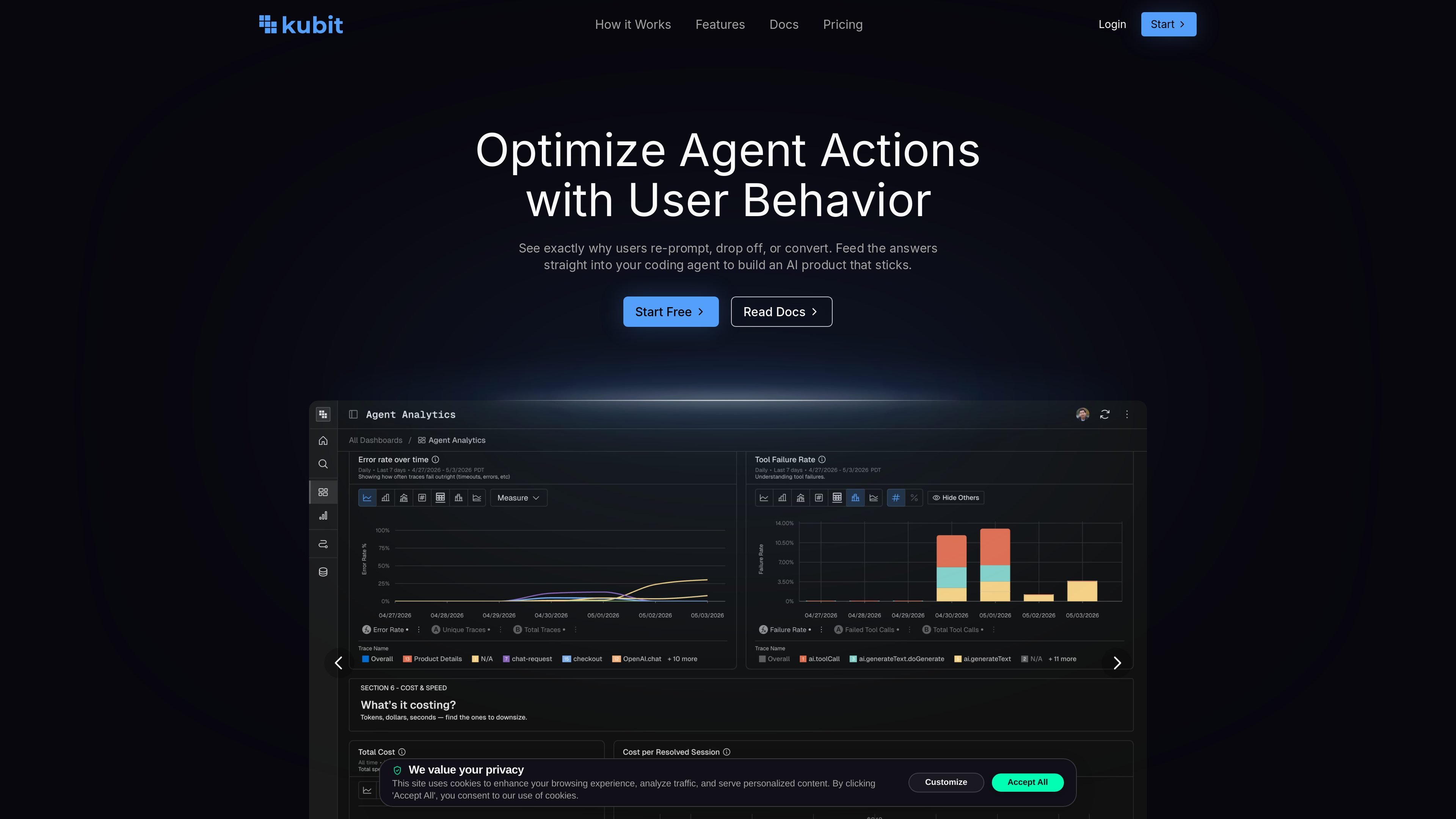
Kubit is a product analytics and observability platform for AI applications and agents. It is designed to connect agent traces with user behavior so teams can see why users re-prompt, drop off, or convert.
The homepage positions the product as a way to bridge a gap between traditional observability, which shows system behavior, and product analytics, which shows user actions. Kubit combines both sides so teams can investigate outcomes, then feed those findings back into coding agents and AI workflows.
Combine prompts, tool calls, model output, and surrounding context so traces include the behavioral signals needed to explain what happened.
Connect infrastructure signals such as latency and token usage to product outcomes like DAU and retention.
Analyze where hallucinations, bad tool calls, or other failures disrupt the path from first interaction to conversion.
Follow re-prompts, rage clicks, intent, and sentiment to identify UX dead ends that are hard to spot in observability tools alone.
Create segments that combine agent interactions and user behavior across multiple conditions.
Move data through open standards, with OTel, CDP, SQL, and warehouse-native workflows instead of a proprietary pipeline.
Use Kubit to investigate why users re-prompt an agent, then trace the issue back to prompts, tool calls, or model output that may have confused the workflow.
Track where users abandon an AI flow and correlate the exit point with latency, hallucinations, or broken tool calls to find the step that needs attention.
Measure whether a model or infrastructure change affects product outcomes by correlating latency, token use, DAU, and retention.
Build cohorts that combine agent behavior and user actions so product or data teams can compare segments by release, platform, campaign, or behavior pattern.
Kubit is a product analytics and observability platform for AI features and agents. It connects agent traces with user behavior so teams can investigate re-prompts, drop-offs, conversions, and other outcomes in one place.
The pricing page lists Starter, Pro, and Enterprise plans. Starter is free with usage-based pricing, Pro is $199/month plus usage-based pricing, and Enterprise uses custom terms with dedicated support.
The homepage says Kubit supports open standards such as OTel, CDP, SQL, and a warehouse-native workflow. The pricing page also mentions OTel and CDP integration, plus a Bring Your Own Warehouse option on higher tiers.
Kubit says you can ingest agent traces via OTel, pull clickstream events from your CDP, or query your warehouse directly. It also says you can use an OTel bridge for Sentry and Embrace.
The homepage says Kubit feeds behavioral insights into coding agents and mentions Claude Code, Cursor Skills, and MCP-based workflows. The pricing page also lists an Ask Kubit experience and MCP Server among the included features.

PromptScout tracks how ChatGPT, Gemini, Google AI Overviews, and Perplexity mention your brand or competitors, then pairs those results with source analysis and website audits. It helps teams decide what to fix in content, positioning, or site readiness next.

Sleek Analytics is a privacy-friendly web analytics tool with real-time visitor tracking, Core Web Vitals, and revenue attribution. It helps site owners understand traffic and conversions without cookie banners or a heavy setup.

ClawTick is an AI agent automation platform for scheduling jobs from the CLI, dashboard, or REST API. It is aimed at developers and teams running LangChain, CrewAI, webhook, or custom agent workflows that need monitoring, alerts, and logs.

OpenFlags is an open-source, self-hosted feature flag platform for modern JavaScript teams. It supports local evaluation, targeted rollouts, and controlled launches while keeping flag data in your own infrastructure.

EAS Observe is a production performance monitoring tool for Expo and React Native apps. It shows startup metrics, session timelines, release markers, and errors inside the Expo dashboard.

Skills Janitor is a GitHub-hosted set of slash commands for auditing, tracking, and managing Claude Code and OpenAI Codex skills. It helps users find duplicates, broken links, and unused skills, then clean them up with self-contained commands.